Guillermo del Toro Kick-Started His Own Universal-Inspired Monster Cycle with This Sequel

Guillermo del Toro has finally realized a long-cherished vision with his adaptation of Frankenstein — a project that feels like part of a larger conversation he’s having with classic monster cinema. Alongside his own take on Frankenstein and the obvious nods to creature features in The Shape of Water, del Toro seems intent on reinterpreting the canonical Universal icons; one can imagine him assembling his own version of the Big Six. If that ever happens, Blade II serves neatly as his unofficial Dracula — and even on its own terms it pairs surprisingly well with his Frankenstein.
Dracula does not appear in Blade II (he’s reserved for Blade: Trinity, the least accomplished entry in the trilogy, though it has its moments). Blade II, by contrast, is the series’ high point, largely because del Toro brings a sympathetic, almost elegiac view to its monsters. The original film, directed by Stephen Norrington, establishes Blade (Wesley Snipes) as the half-vampire “daywalker,” a hybrid whose exceptional abilities are tempered by an unending thirst kept at bay with a serum. That mingling of heroic and monstrous traits dovetails with del Toro’s conception of the Creature in Frankenstein — a tragic, quasi-superheroic figure.
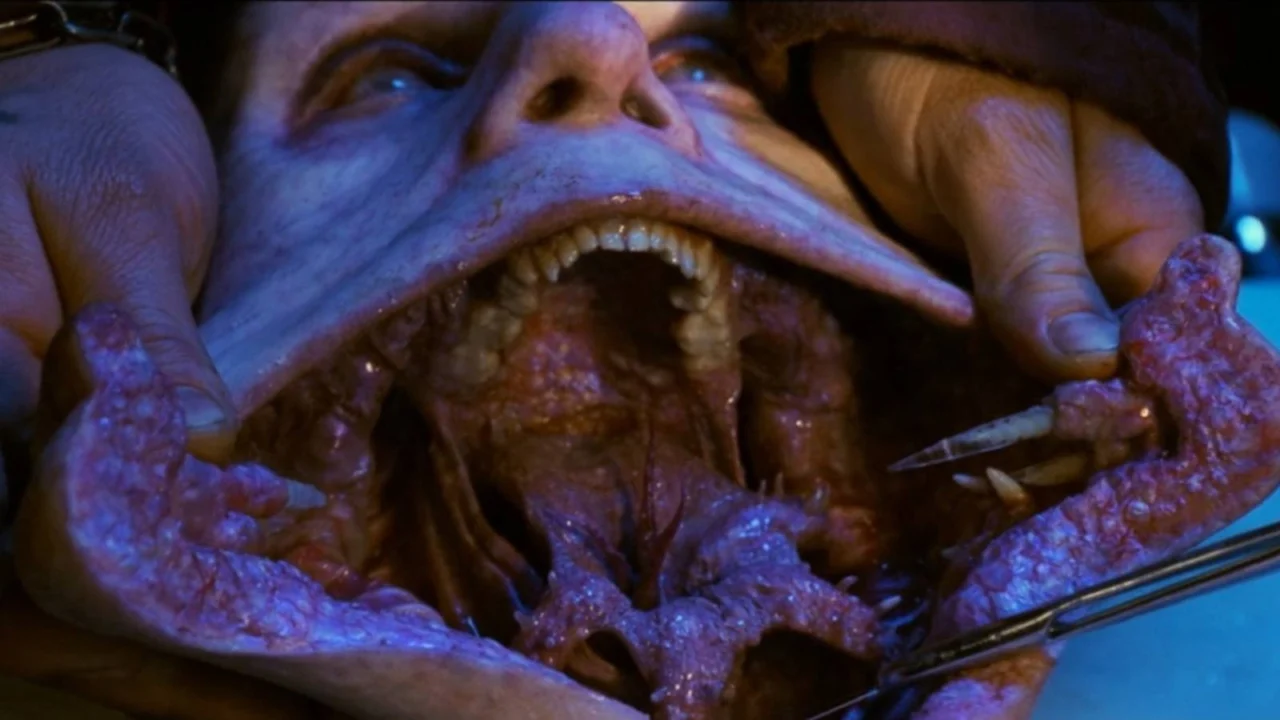
For the sequel, del Toro widens the depiction of vampire society, bringing a rogue ensemble of vampires into Blade’s orbit. They’re not merely background mooks; the film’s plot hinges on an uneasy alliance between Blade and a faction of vampires formed to confront an existential threat: the Reapers, grotesque predators that consume both humans and vampires and risk overrunning the world. The Reapers’ pallid, bald appearance evokes the old Nosferatu, until their chins split open to reveal massive, mandible-like fangs — a grotesque, signature del Toro flourish framed by the movie’s sickly green-and-yellow palette and vividly splattered crimson. If you’re going to stage an invasion of monsters, del Toro insists on something unforgettable rather than a parade of men in fangs. Yet this vampire mythology remains more classical than the version he explored in Cronos.

The plot’s straightforwardness limits deep character arcs for many of the vampires, but del Toro compensates by populating the film with a vividly drawn ensemble: the Blood Pack, a team of mercenary vampires whose personalities and occasional moral ambiguity give the film much of its color. Even the member who openly loathes Blade — portrayed by Ron Perlman, later known for Hellboy — has enough swagger and specificity to feel alive. More poignantly, Blade’s relationship with the vampire Nyssa (Leonor Varela) introduces a tender, conflicted thread: she responds to revelations about the Reapers with guilt and sorrow. Those revelations have a mad-scientist bent, as if a Frankensteinian heir tinkered with Dracula’s DNA, but realized with del Toro’s contemporary, intricate creature design rather than a 1940s studio’s constraints.
While this story doesn’t aim for the philosophical weight of a Mary Shelley adaptation — and it doesn’t need to — it does embrace the pleasures of genre cinema. Beyond its nods to monster-movie traditions, Blade II is unabashedly entertaining: set pieces centered on hunting vampires, late-night club confrontations, and hyper-stylized violence are rendered with a kinetic bravado del Toro rarely revisits. His subsequent films, even the action-oriented ones like Pacific Rim, tilt toward sensitivity and emotional nuance; by contrast, Blade II luxuriates in an R-rated, go-for-broke energy that reads like both a nostalgic studio sequel and a director’s guilty pleasure. Del Toro turns what could be a routine franchise installment into a fiercely committed, surprisingly personal action-horror piece.

As an outlier in del Toro’s filmography, Blade II is a reminder that he can also revel in loud, kinetic spectacle while still conveying sympathy for the monstrous. Many directors use franchise installments to demonstrate studio-savvy or to chase box-office returns; del Toro treats the sequel as a chance to indulge in high-octane horror and design-driven invention, and the result feels like both a passion piece and a crowd-pleaser.
Blade II is streaming on Disney+.
Source: Polygon
Related articles
 Ryan Reynolds’ “Mayday” receives positive reviews from critics
 Michael Keaton to Direct Western Starring Morgan Freeman
 “Daddy’s Daughters” wedding sequel to be released in 2027
 Halle Berry and Colin Firth to Star in New Rom-Com
 Netflix Begins Filming New Dan Brown Adaptation
 Spider-Noir series canceled after first season
 Actors cast as Dobby and Tom Riddle for Harry Potter season two
 International “Doker” Film Festival Kicks Off in Moscow