
Post-Release
Reflecting on Our Launch
Our official release unfolded largely as anticipated, and it has successfully established a profitable foundation for this month. It has been incredibly rewarding to watch your streams and videos, and we are sincerely grateful for the constructive feedback pouring in; rest assured, we have already begun integrating many of your suggestions.
We did encounter a few hiccups with our backend infrastructure. We inadvertently triggered a self-inflicted DDoS event at one point, and had to rapidly scale specific services to handle the influx of users. Typical of these situations, the bottlenecks emerged in areas we had completely overlooked.
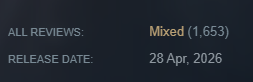
Our current “Mixed” user review status was entirely within our expectations. This is precisely why we intentionally avoided a storefront takeover or aggressive marketing pushes from Valve; we wanted our community to grow organically rather than through manufactured hype. The primary points of friction currently center on AI-generated content, technical performance, and comparisons asserting that “this isn’t Garry’s Mod.” Naturally, since our most ardent supporters received the game for free, they are unable to post reviews, which skews the perception.
I would like to address these specific concerns directly below.
Doubling the Play Fund
Following our release yesterday, the influx of players has bolstered our revenue, allowing us to double the Play Fund to $1,000,000 per year.
Our goal is to continue scaling this investment over time. We plan to re-evaluate our capabilities in a month’s time to determine how much further we can expand this support.
Addressing the “AI Slop” Concern
The vast majority of projects here are built by talented, hardworking humans. Labeling these contributions as “AI slop” unfairly diminishes the immense effort invested by these developers.
Some users are certainly relying on AI for game thumbnails, which unfortunately leads to unfair dismissal of their work. While I don’t believe that strategy is doing these creators any favors, it remains an accessible tool, so it persists.
However, AI is rapidly becoming an essential pedagogical tool for learning to program. It helps users generate examples and explains complex code logic. I believe an outright prohibition on AI would be detrimental; I am not concerned about the future of human creativity—I am confident it will continue to prevail.
To be clear: we are not an “AI company,” but we are pragmatic. We aren’t going to clutter the interface with redundant AI assistants, nor will we force AI tools upon you. We have no intention of creating a “make game” wizard that generates entire projects for you. Nevertheless, if a world-class game happens to be crafted with the assistance of AI, we will not prohibit its publication.
Our discovery algorithm is a work in progress, but we are refining it daily. Our objective is simple: ensure high-quality games rise to the top while keeping new, compelling content flowing for everyone.
Performance Optimization
Performance is undoubtedly the most frequent criticism we are receiving, so I want to be transparent about our current standing, our immediate actions, and our long-term trajectory.
If you are migrating from Garry’s Mod, the experience will feel different. Garry’s Mod operates on a two-decade-old engine optimized to run at high frame rates on virtually any hardware; we haven’t reached that state yet, and the comparison is fair. We are keenly aware that mid-range hardware, in particular, is struggling more than it should.
Rest assured, this represents the current “worst-case” performance level. We have been—and will continue to be—steadily improving. We have identified the primary culprits, and we have a concrete roadmap dedicated to rectifying these issues.
Transparency Through Metrics
We actively monitor performance data across a diverse spectrum of hardware, and we publish these findings publicly on sbox.game. This ensures that when we underperform, you can hold us accountable, and when we make gains, we have the data to prove it.
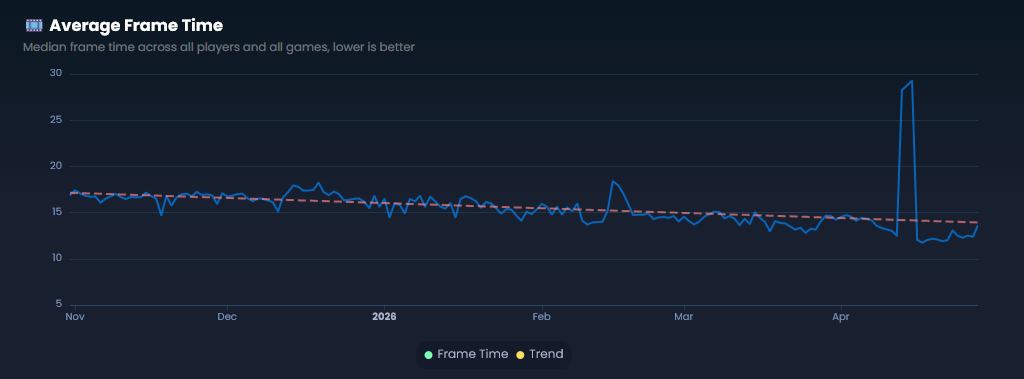
As you can see, our average frame time has improved from 17ms to 12ms over the last six months. This is the result of constant profiling, identifying the largest bottlenecks, and iterating until they are resolved. Rinse and repeat.
Hardware Benchmarks
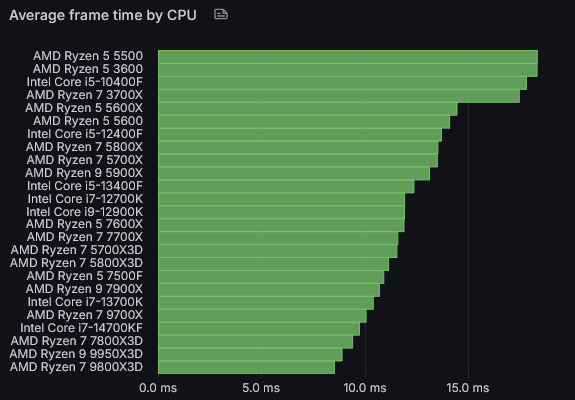
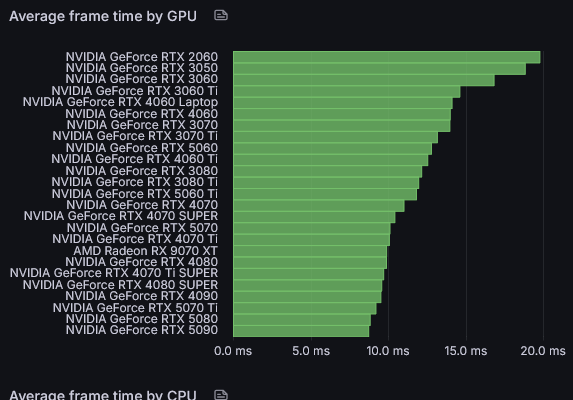
Here are the average frame rates we are currently observing across various hardware configurations:
- Ryzen 5 3600 + RTX 3060: ~54 FPS
- Ryzen 7 7800 + RTX 4070: ~108 FPS
- Ryzen 7 9800 + RTX 5080: ~125 FPS
There is significant room for improvement across all tiers, but the situation is far from dire. Every system configuration presents unique challenges that we are committed to addressing.
User-Generated Content Challenges
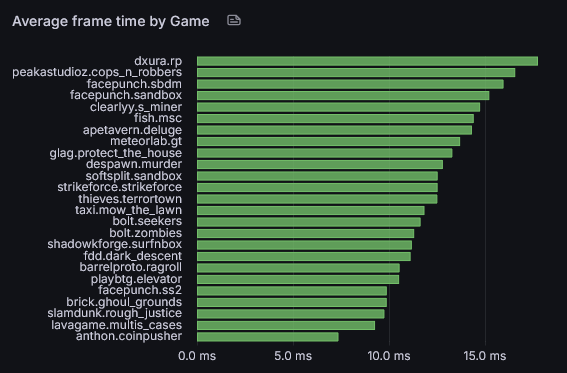
Optimizing for a UGC platform introduces distinct obstacles. We aim to keep the game-creation process as intuitive as possible, allowing creators to focus on their vision rather than getting bogged down by low-level performance tuning. Our solution must cater to an immense variety of use cases, from lightweight experiments to massive, complex games.
Commitment to Quality, Not Shortcuts
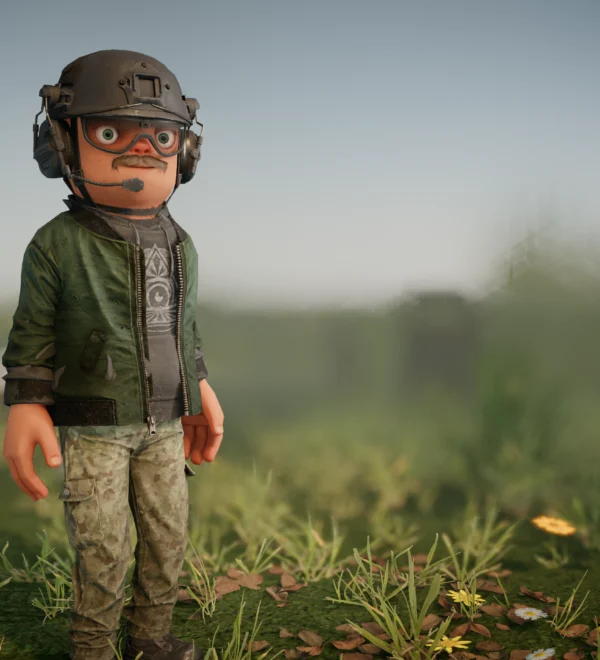
Most contemporary game engines achieve high performance by distributing rendering tasks across multiple frames using techniques like temporal upscaling, temporal anti-aliasing (TAA), and amortized global illumination. While this is efficient, it often results in a blurry, “ghosting” artifact that breaks the visual experience during movement.
We are taking a different approach: We render a complete, high-fidelity frame every single frame. Our goal is to ensure visual clarity in motion, not just in static screenshots. By utilizing forward rendering and MSAA, we are maintaining a standard of quality that doesn’t rely on the “fuzziness” of modern shortcuts.
These are technically demanding problems to solve, but we would rather face these challenges head-on than compromise our visual standards.
Looking Ahead
Expanding to a wider audience has helped us sharpen our focus on the most critical priorities. While we have significant development hurdles ahead, this is exactly why we do what we do. We love the challenge—in fact, we love it when things break because it gives us the opportunity to fix them and emerge stronger. We are eager to show you what we are capable of; we are ready for the fight. 💪🏼
 Neck and Neck
 Update 26.09.15
 Update 26.09.08
 Update 26.09.01
 Update: August 26, 2019
 Update 26.08.05
 Update July 26, 2022