
Elizabeth Olsen’s New Afterlife Rom‑Com Springs from a Strange Scientific Backstory

A24’s fantasy-drama Eternity centers on an intimate love story. When Joan — portrayed by Elizabeth Olsen — dies in her nineties, she wakes in a bustling, bureaucratic afterlife known as The Junction. There she learns she has seven days to decide which of her former husbands she will spend eternity with: Larry (Miles Teller), her companion of 65 years who recently passed, or Luke (Callum Turner), her first husband who died young in the Korean War and has been waiting for her in The Junction for nearly seven decades.
At its heart, the film repeatedly returns to the question of choice: which partner will Joan choose and what does that decision reveal about love and memory? But the movie’s deliberately offbeat world-building raises many other curiosities. In Eternity’s cosmology, souls browse a kind of afterlife marketplace, selecting themed eternities — for example, mountain retreats focused on hiking and cabins; a ruthlessly competitive, finance-driven Capitalism Eternity; or a tongue-in-cheek Weimar-era–inspired realm that deliberately sidesteps historical atrocities.
Choosing a themed eternity is binding: selection is permanent. Souls that decline to pick a destination remain in The Junction, where they take on menial jobs and occupy cramped basement apartments. The film treats this premise with wry humor, yet it also prompts the obvious question: who designed these peculiar, punitive rules and for what purpose?
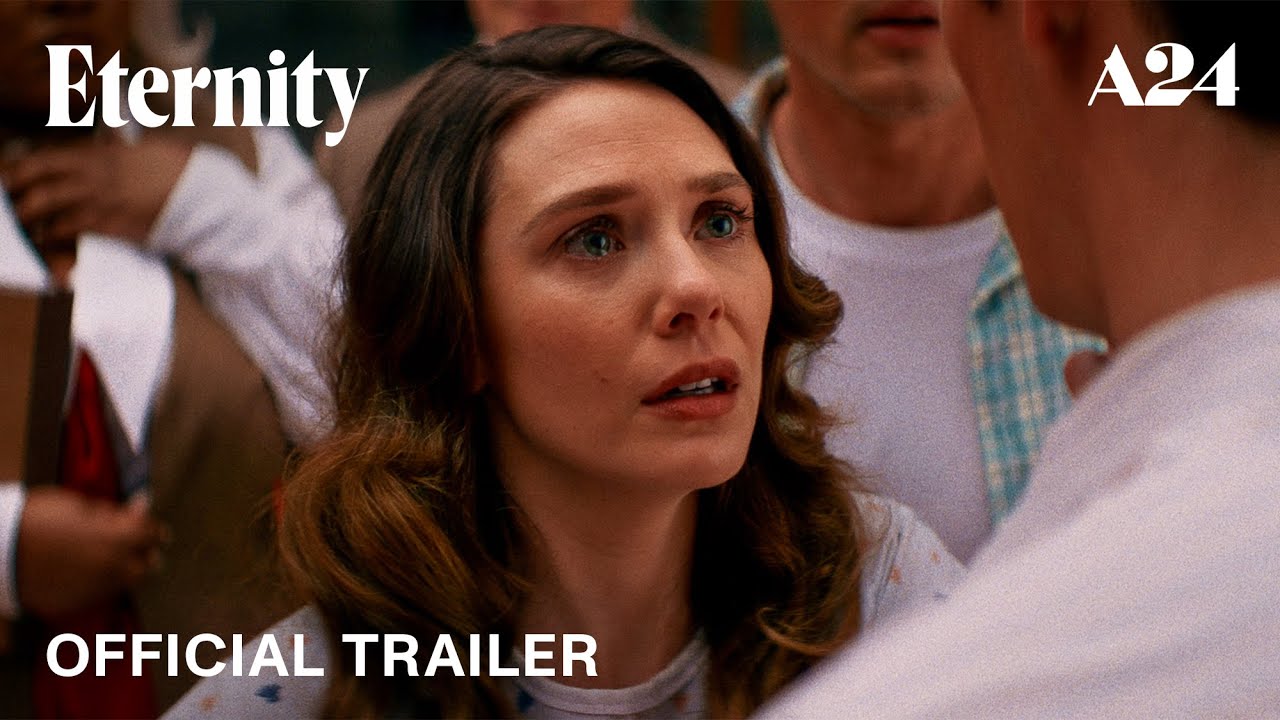
Minor spoiler: Eternity doesn’t exhaustively explain every element of its afterlife the way some other postmortem fables do. Still, director David Freyne has said the film rests on a fuller internal mythology that informed the production’s choices. He and co-writer Patrick Cunnane conceived The Junction as if it were a 1960s tourism fair, framed by Brutalist architecture — an era when those aesthetic ideas were imagined as forward-looking utopia — so the afterlife feels both modernist and slightly dated from its own perspective.
Freyne and Cunnane developed a pseudo-scientific underpinning for the world, then pared most of it from the screenplay to preserve narrative momentum. One seed of that backstory is the ARC protein, which they imagined as a memory-retaining agent: a biological element that preserves memory beyond death and, in the film’s conceit, becomes the substrate for this constructed afterlife. They drew inspiration from articles linking memory mechanics to viral ancestors, proposing — hypothetically — that something about this memory-bearing agent persists and accumulates, necessitating organized spaces to house those memories.

The film’s production design reflects that logic: arrivals and departures use a train network intended to echo the brain’s arterial pathways, symbolizing how memories are routed and parceled out. Caseworkers such as Anna (played by Da’Vine Joy Randolph) and Ryan (John Early) shepherd newcomers through the process, ensuring memories move along and that The Junction doesn’t become clogged. As a line in the script puts it, “All we are is a collection of memories.”
Freyne says much of this scaffolding was plotted during development and then lightly hinted at rather than fully spelled out on screen — decisions made to keep the story brisk and avoid bogging it down in exposition. He also teases a shadowy figure named Kevin, a bureaucratic punchline whose place atop the hierarchy hints at deeper, untold layers of the system — material the director suggests could be fertile ground for a future TV spin-off set in The Junction.

Eternity is in theaters now.
Source: Polygon
Related articles
 International “Doker” Film Festival Kicks Off in Moscow
 Milla Jovovich to Appear in the New Season of “Hot Rivalry”
 The first excerpt from Zach Cregger’s “Companion” has been released
 “Obsession” Star to Play Waitress in Apple Sci-Fi Series
 Paul Thomas Anderson is working on a new project
 Gal Gadot’s “Heart of Stone” receives scathing reviews
 Netflix and Alfonso Cuarón Developing Dungeons & Dragons Horror Series
 Critics approve of the second season of Guy Ritchie’s The Gentlemen