
Zero Parades: For Dead Spies Blurs the Line Between Betrayal and Survival
Hershel Wilk—callsign “Cascade”—isn’t just struggling; she is utterly out of her league. To say she is “out of her depth” is a gross understatement; she’s so far gone that any rescue effort would likely be a wasted expenditure of resources. Even in the opening moments of a mission designed to offer her redemption after a career-shattering blunder, she is so hopelessly bewildered that her inevitable termination begins to feel like a mercy. Cascade is a catastrophic operative, and Zero Parades: For Dead Spies is a messy, unconventional spy thriller. Yet, much like the most intellectually demanding page-turners, it is impossible to walk away from.
Let’s rewind. Zero Parades marks the second major project from ZA/UM, the studio famously behind Disco Elysium. The developer has spent years navigating its own internal turbulence, marked by the high-profile departure of key creative leads in 2021. Despite the media firestorm and behind-the-scenes drama, a contingent of the original team pushed forward to craft something entirely new—a narrative-driven RPG that explores the desperate, often pathetic struggle of a disgraced spy attempting to navigate a path to atonement after betraying her own.
For those still obsessively parsing the studio’s history for subtext, it’s tempting to view Zero Parades as a meta-commentary on the ZA/UM saga. However, looking at the game on its own terms, it succeeds as a gripping, multifaceted mystery that dances between the lines of a geopolitical thriller, a black comedy, and a profound humanist drama. When it stops leaning so heavily on the stylistic crutches of its predecessor, Zero Parades shines as a nuanced, deeply empathetic look at a chronic failure seeking a second chance.
Most spy fiction begins with a polished mission briefing—a high-stakes assassination or a mole hunt requiring a cool-headed professional. Zero Parades tosses that trope into the incinerator. Our story begins with Cascade, an asset for the clandestine organization known as Opera, waking up in a disheveled room above a camera shop. Her assigned partner is unconscious and disoriented, and her handler provides nothing but opaque, urgent orders to evacuate the town of Portofiro immediately. She has no idea why she was sent there, and frankly, she’s ill-equipped to find out.
This chaotic introduction sets the tone for the next 20 hours of delightful disarray. Zero Parades isn’t the tale of an elite super-spy; its most biting wit comes from allowing the player to *believe* it is. The game’s intricate dialogue system invites you to play the smooth, intellectual operative. I took the bait, sinking my initial skill points into “Personalism” and “Poetics,” thinking I was sculpting a charismatic lead. In reality, I was just constructing a façade—one that grew increasingly fragile and hilarious as the narrative spiraled out of control.
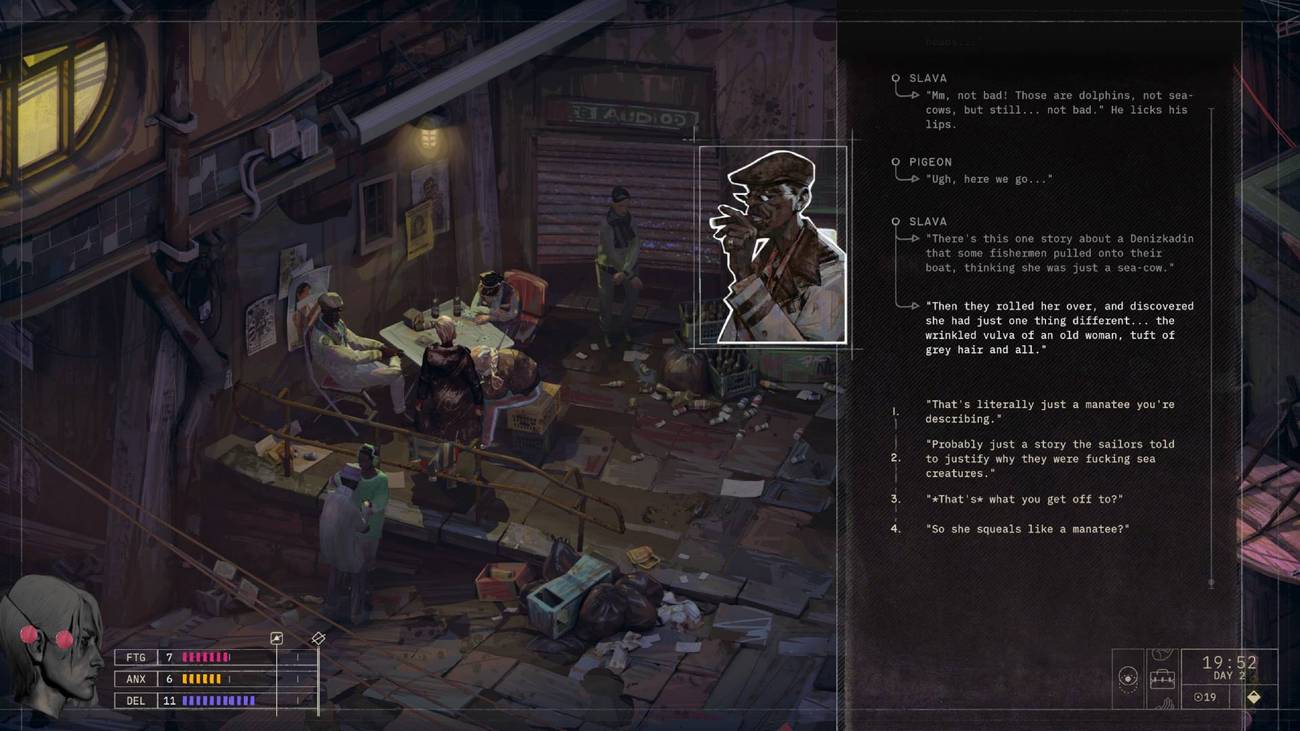 Image: ZA/UM via Polygon
If I characterize Zero Parades as a “terrible” spy story, I offer it as the highest form of praise. It is a masterful subversion of the genre, drawing inspiration from John le Carré’s methodical, grounded tension rather than the spectacle of James Bond. The vital distinction is that while a George Smiley character is always three moves ahead of the opposition, Cascade is consistently three steps behind herself.
So, what is actually happening in Portofiro? Through a dense, exposition-rich beginning, we learn the city is trapped in a cold war with La Luz—a rival nation defined by its insufferable pop music and aggressive, propagandistic cartoons. Various factions vie for cultural hegemony, and Cascade is coerced into assembling a team to destabilize the region. While the pacing is deliberate, the world-building is stellar. It occupies a surreal space between historical reality and the fantastic; you’ll find yourself discussing conspiracy theories about human-dolphin hybrids in an abandoned rocket silo as if they were mundane local politics.

Much like its predecessor, Zero Parades is deeply concerned with political ideology. Communism, neoliberalism, and techno-fascism are all explored, though these themes occasionally feel like they are included to meet an expected aesthetic rather than serving the narrative. Sometimes, the dialogue—particularly the snarky quips about the bourgeoisie—feels slightly forced, as if written specifically to be screen-capped for social media engagement rather than to deepen the characterization of Cascade.
However, once you strip away the grand political theater, the game reveals a deeply touching, human story. At its core, this is a narrative about someone returning to a place they once hurt, attempting to reconcile with the debris of their past. The genuine pleasure in Zero Parades comes from uncovering just how much of the surrounding chaos is directly attributable to Cascade’s own incompetence. The RPG systems, governed by harsh, chance-based dice rolls, only heighten the tragedy. You can attempt to be the ultimate strategist, but the game is designed to ensure that Cascade will, eventually, fail in spectacular fashion. Watching her scramble to cover up a botched interaction is a unique kind of empathetic agony.
Sometimes it just feels like nothing you do is ever right, doesn’t it?
These game mechanics act as an antagonist of sorts, reflecting Cascade’s internal anxiety and delirium. If her stress meters climb too high, she loses capability; you are forced to manage her psyche—whether through rest, a stiff drink, or interacting with a bizarre payphone mascot—just to keep her functioning. Furthermore, every skill upgrade comes with a potential cost, creating a balancing act that forces you to constantly weigh the consequences of your growth.
 Image: ZA/UM
The choices are inherently manipulative. To progress, you often have to deceive those you once cared about. You might spend time earning back the trust of an old colleague, only to realize that your ultimate goal requires you to use them in another dangerous, potentially fatal mission. In the world of Zero Parades, true forgiveness is a mirage, constantly retreating as you are compelled by your work to prioritize survival over integrity.
Perhaps the most devastating moment of my journey was encountering an old friend who had successfully moved on from our shared trauma. Through a small, earnest gesture—an apology written on a tacky card—I managed to bridge the gap. For a brief moment, the possibility of redemption felt tangible. Yet, as the conversation ended, the game presented a new, cynical option: I now possessed the emotional leverage to manipulate her into providing the information I desperately needed. I felt a visceral urge to walk away, to leave the path of betrayal behind—but the game’s mounting pressure made the temptation almost impossible to resist. In the end, I chose the cold, calculated path, and the mission advanced at the cost of the last shred of respect she held for me.
Is the cost of professional standing worth the sacrifice of one’s remaining connections? Zero Parades suggests that the lines between survival and betrayal are incredibly thin. When your back is permanently against the wall, even the most disciplined operative eventually snaps. Misinterpreting a cipher is one thing, but mistaking a lifetime of betrayal for a “survival strategy” is the ultimate tragedy.
Zero Parades: For Dead Spies is available now on Windows PC. This review was conducted using a prerelease code provided by ZA/UM. For further information regarding Polygon’s editorial ethics, please visit our policy page.
Source: Polygon
Related articles
 Valve Adds Hero Baba and Bench to Deadlock as Game Sets New Steam Record
 Report Suggests Resident Evil Requiem DLC Plot Leaked Alongside Remakes of Resident Evil and RE Veronica
 Exclusive Riftbound Radiance Reveal – Ziggs, the Explosive
 Creator of Garry’s Mod Successor Admits Rough Launch and Responds to s&box Criticism
 The Detective Is Already Dead Season 2 Gets New Poster Ahead of Premiere
 Former Activision CEO Bobby Kotick Joins Skydance Board of Directors
 Nathan Fillion Says Superman Sequel Will Further Explore Lex Luthor
 The Lord of the Rings D&D Books Smash Crowdfunding Record