
The Best Marvel’s Spider-Man Bonus Sheet Cards and the Comics That Inspired Them
Image: Wizards of the Coast/Steve Ditko
I admit I approached Magic: The Gathering’s newest release, the Marvel’s Spider-Man set, with reservations. I’m a longtime fan of MTG’s original tone, and Universes Beyond has never fully convinced me—Lord of the Rings felt plausible, but the incorporation of Spider-Man and the wider Marvel catalogue initially struck me as jarring. That said, my doubts evaporated when I examined the Marvel’s Universe bonus sheet included in Play Boosters and Collector Boosters.
I’ve read Marvel comics for most of my life, and Peter Parker’s ups, downs and cyclical turmoil are familiar territory. I’ve watched him win, lose, rebuild and start over more times than I can count—please, Marvel, let him keep a victory once in a while. Seeing classic comic panels faithfully reproduced on Magic cards filled me with both excitement at owning them and some dread at the likely price tag.
Several bonus-sheet images leap out because they recreate landmark moments in Spider-Man history. Below are the ones that impressed me most.
1 Ponder
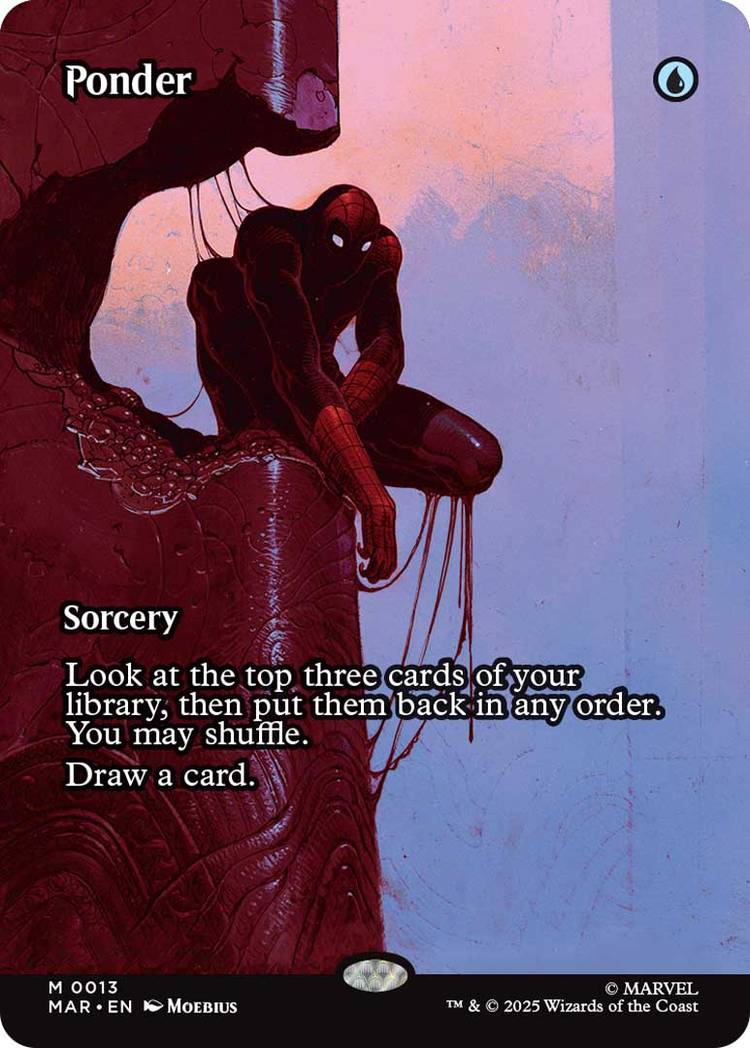
Jean Giraud—better known as Moebius—is a giant of comic art whose surreal visual language reshaped science-fiction illustration. Though he rarely worked for American publishers, he collaborated with Marvel on special projects (Stan Lee admired him greatly), and his contribution to Amazing Spider-Man #800 is unforgettable. Moebius’s Spider-Man is at once haunting and beautiful, set within a dreamlike tableau that only he could render. As a Pauper player, I’m quietly hoping these reprints stay affordable—I’d love a playset.
2 Counterspell

This might be controversial, but to my eyes this is the most evocative Counterspell illustration ever printed. It captures the exact sting of having a pivotal play nullified—like being figuratively slapped. The panel is taken from Doctor Octopus’s initial appearance in Amazing Spider-Man #3 (1963), by Stan Lee and Steve Ditko—one of the foundational moments in Spider-Man lore. If you think Spidey looks rough here, wait until you read Superior Spider-Man for a darker twist on Doc Ock’s cruelty.
3 Path to Exile
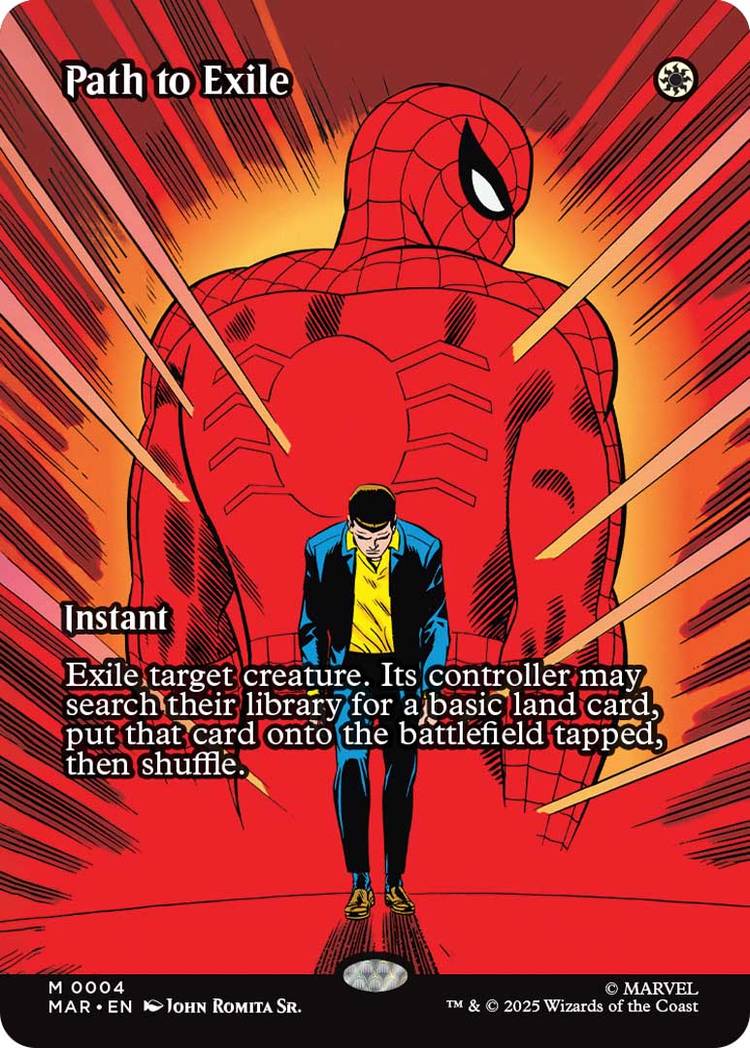
John Romita Sr. helped evolve Spider-Man from youthful whimsy into mature, dramatic storytelling. His cover for Amazing Spider-Man #50 (1967), which launches the “Spider-Man No More!” sequence, is a masterclass in silent storytelling—the pose, the mood, the resignation on Peter Parker’s part. That arresting image translates beautifully to the Path to Exile card, conveying an entire arc of emotion without a single caption.
4 Beast Within / Arachnogenesis


Todd McFarlane’s arrival on Amazing Spider-Man in 1987 altered superhero art forever; his hyper-detailed, sinewy anatomy and intricate webbing gave Spider-Man a visceral, almost predatory quality. Those traits are vividly reproduced across the Beast Within and Arachnogenesis cards, where Spider-Man reads as a taut, athletic force—simultaneously heroic and animalistic—while foes like the Lizard feel convincingly bestial.
5 Infernal Grasp

When Erik Larsen followed McFarlane on the title, his tenure left an indelible imprint—especially his take on Venom. Larsen emphasized monstrous, angular shapes and a visceral menace (that elongated tongue is unforgettable). The Infernal Grasp art, lifted from Amazing Spider-Man #347 and the Venom Returns arc, still gave me nightmares as a kid; it perfectly captures the terror and obsession surrounding Venom’s character.
6 Reanimate
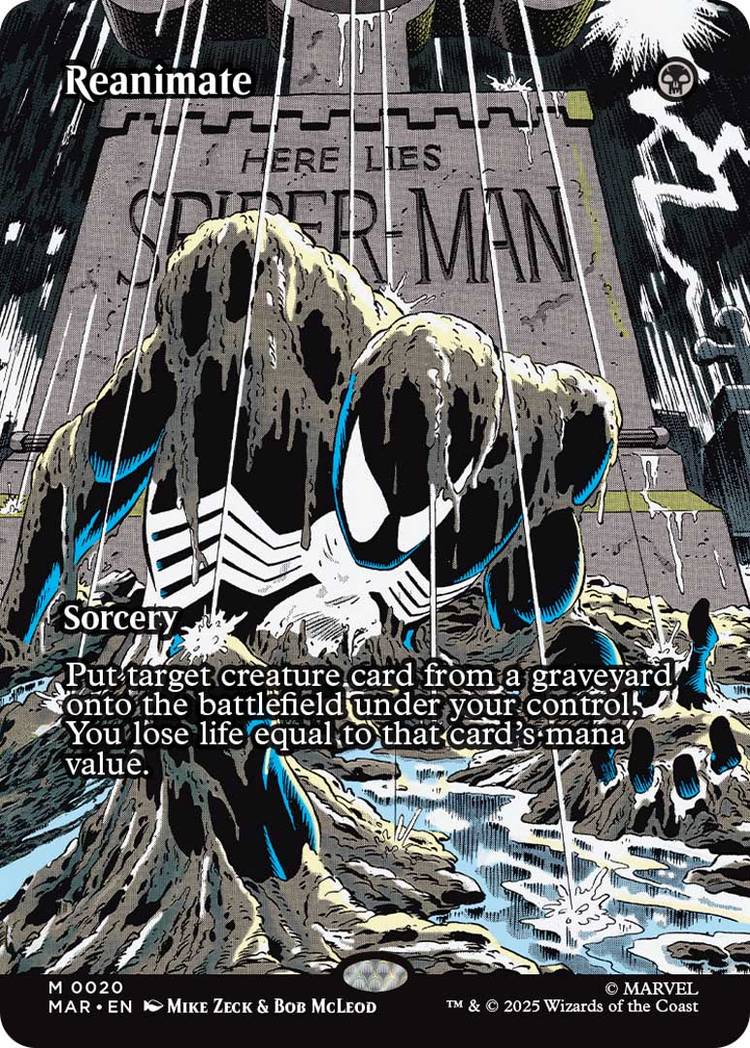
Kraven’s Last Hunt remains one of Spider-Man’s most harrowing and artful arcs, and Mike Zeck’s photorealistic pages are central to its emotional power. The sequence of Spider-Man rising from a grave—wounded, exhausted and resolute—is the perfect match for Reanimate’s somber tone. If you haven’t experienced this story, it’s a remarkable example of how mainstream comics can deliver literary weight and visceral suspense.
7 Terminate

Mark Bagley’s long run on Spider-Man produced some of the most kinetic and memorable imagery of the ’90s; he co-created Carnage, one of the character’s most brutal foes. The Terminate artwork channels that era’s intensity—Carnage’s violent unpredictability and the high-stakes chaos of storylines like Maximum Carnage are front and center. If anyone can pinpoint the exact issue for this panel, I’d welcome the tip in the comments.
8 Rite of Replication

The Clone Saga is easily one of the most polarizing Spider-Man eras—messy, overstuffed and endlessly debated—yet it defined many readers’ formative years. Nostalgia alone makes the Rite of Replication piece appealing to collectors who lived through that event; while the story’s twists and reversals are controversial, the sheer scale of the saga explains why Wizards saw value in mining it for Universes Beyond art.
9 Iron Spider, Civil Warrior (Alibou, Ancient Witness)

Civil War was the catalyst that normalized large-scale, serialized crossover events at Marvel, treating the universe like a serialized TV drama. The moment Spider-Man publicly unmasks and dons the Stark-designed Iron Spider suit is arguably the event’s most memorable beat—an instant that redefined the character’s public life, if only temporarily. That dramatic reveal translates neatly into MTG’s aesthetic, offering a snapshot of a seismic narrative turning point.
Source: Polygon
Related articles
 “The Bunker” starring Bardem and Cruz screened at Venice
 The Librarians: The Next Chapter Season 2 Has Concluded
 “The Mummy 4” filming has begun
 Urfin Jus Movie Announced
 Ellen Burstyn Receives Honorary Golden Lion
 Danny Boyle used artificial intelligence in his new film “Inks”
 Gary Oldman Reveals the Name of the New Bond
 Summer 2026 Becomes the Highest-Grossing Season in U.S. Box Office History