
GeForce RTX 5050 with 9GB GDDR7 to maintain 130W TDP — Insider
The upcoming entry-level refresh could be NVIDIA’s strategic play to navigate shifting memory supply dynamics.
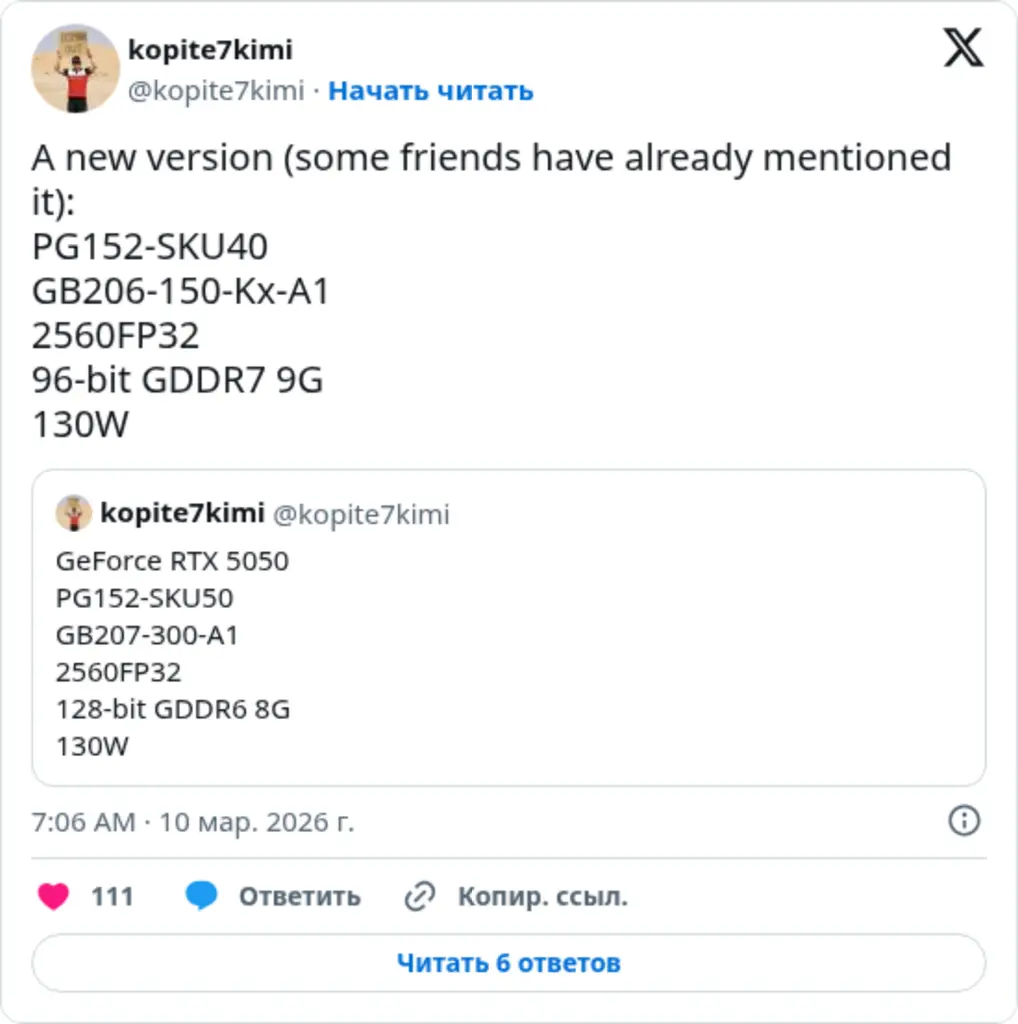
NVIDIA is reportedly developing a revised iteration of the GeForce RTX 5050 featuring a revamped memory configuration. According to prominent leaker kopite7kimi, this model will boast 9 GB of GDDR7 memory while maintaining a consistent power envelope of approximately 130W.
The standard specification for the RTX 5050 includes 8 GB of GDDR6 memory clocked at 20 Gbps on a 128-bit bus, delivering a bandwidth of roughly 320 GB/s. In this new variant, NVIDIA is expected to transition to three 3 GB GDDR7 modules. While this increases the total capacity to 9 GB, it results in the memory bus being narrowed to 96 bits.
Despite the narrower bus, the significantly higher speeds of the next-generation memory should more than compensate for the change. With GDDR7 projected to operate at 28 Gbps, the total bandwidth would climb to 336 GB/s—a 5% improvement over the current version. Consequently, users would gain a 12.5% increase in VRAM capacity alongside a slight boost in overall throughput.
The underlying silicon is expected to remain the same, with the card still utilizing the GB206 GPU and its 2,560 CUDA cores.
Industry analysts suggest that the pivot to GDDR7 is likely driven by current market conditions. As the supply of GDDR6 for mass-market components becomes less predictable, GDDR7 production is steadily ramping up. Furthermore, adopting 3 GB modules allows NVIDIA to reduce the component count from four chips down to three.
Rumors indicate that this 9 GB variant of the GeForce RTX 5050 might be unveiled around Computex 2026, which is set to take place in Taipei from June 2 to June 5. As of now, NVIDIA has not officially confirmed the existence of this specific configuration.
Related Reading:
- NVIDIA reclaims GPU market dominance, reaching 94% share — report
Source: iXBT.games
Related articles
 Valve Veteran Explains Steam’s Popularity, Says Gabe Newell Views the Service as an MMO
 GTA VI Trailer Reportedly Contains Nod to Original GTA, Which Fans See as Hint at Lucia and Jason’s Past
 Former Overwatch Game Director Cut All Ties With the Game After Leaving Blizzard to Preserve Peace of Mind
 Order of the Sinking Star Is Selling Better Than The Witness, Jonathan Blow Explains Earnings Caveat
 The Wolf Among Us Remastered to Launch Later on One of the Platforms
 Charlie Brown Quote From 60 Years Ago Carried Over Into Peanuts Movie
 Dan Houser Says His GTA: Vice City Writing Was “Awful,” Credits Ray Liotta With Making It Sound Good
 Polygon Ranks the 10 Best Books Released Since 2020