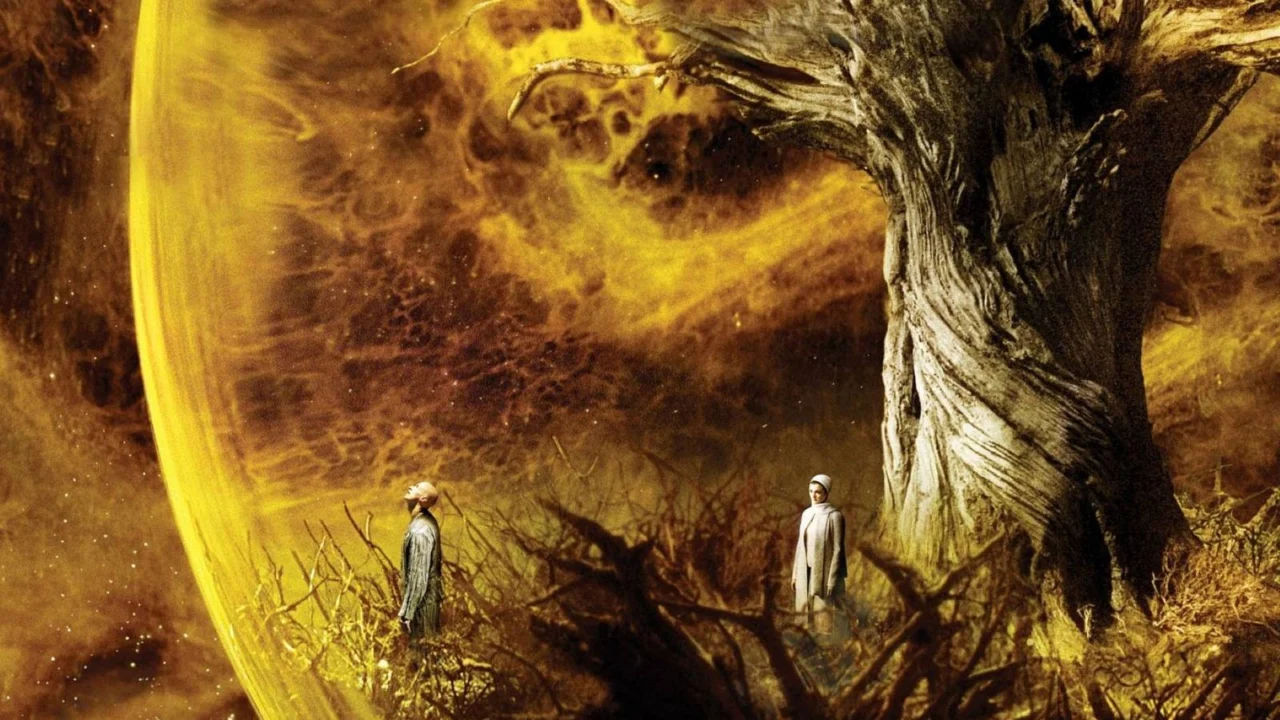
Craving More Aronofsky After “Caught Stealing”? Watch “The Fountain”
Darren Aronofsky’s 2025 film Caught Stealing functions like a director’s mixtape — a condensed return to familiar obsessions dressed as a straightforward crime picture. It often feels like something he might have produced at the outset of his career: the story itself is set in autumn 1998, months after the release of Aronofsky’s debut, Pi, and shares certain visual and thematic echoes with that film, including ominous depictions of Hasidic characters and scenes around Manhattan’s Lower East Side.
Viewers can spot moments that recall Requiem for a Dream (addiction-driven arcs and a Brighton Beach sequence), The Wrestler (an aging performer past his prime), Black Swan (a protagonist pushing through a severe abdominal injury), Mother! (a young lead beset by merciless circumstances), and The Whale (again, addiction and its fallout). In effect, Caught Stealing distills much of Aronofsky’s oeuvre — with the notable exception of The Fountain, his 2006 sci‑fi drama that, despite commercial failure, stands as one of his most daring and imaginative works.
The Fountain nearly didn’t reach the screen in its eventual form. The project started as a much larger studio vehicle, with Brad Pitt and Cate Blanchett attached and a reported $75 million budget before Pitt departed amid reported creative disputes. The film that wound up shooting three years later starred Hugh Jackman opposite Rachel Weisz (Aronofsky’s partner at the time) and arrived with a much smaller budget and an ill-timed Thanksgiving-week release. Audiences expecting a conventional fall blockbuster largely passed it by, leaving an experimental, time-hopping meditation on love and mortality to find its audience slowly.
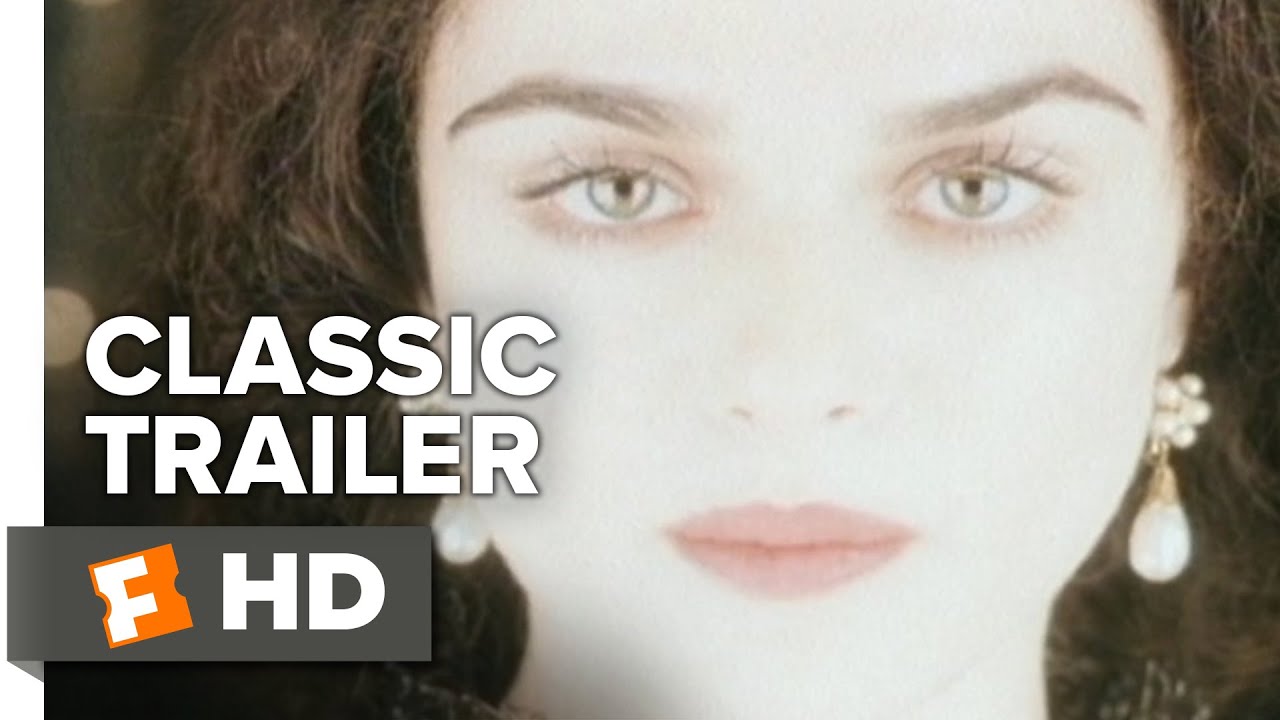
The film interlaces three parallel strands. In the contemporary thread, Dr. Tommy Creo (Jackman) obsessively pursues a botanical cure to save his wife Izzi (Weisz), who is dying of a brain tumor. Intercut with that present-day grief are two other narratives: a 16th‑century conquistador — also played by Jackman — hunting for a fabled “tree of life,” and a far‑future voyager transporting a solitary tree through a luminous, dying cosmos. Aronofsky never nails down a single literal reading of how these stories connect, but their thematic links — loss, obsession, and the desire to transcend death — make the relationships between them resonate.
One plausible interpretation is that the plant Tommy researches is the same object the conquistador quests for, and that the future tree reflects another stage of that same life force, perhaps even planted at Izzi’s grave in the film’s present. Alternatively, the past and future sequences could be imaginative chapters from Izzi’s unfinished book, meant to be completed by Tommy. Such ambiguity is central to the film’s power: it treats its characters like fragments of a single emotional investigation rather than pieces in a puzzle to be solved.
Structurally, the movie is lean — surprisingly so for a tale that stretches across millennia. There are only a handful of principal figures, and each of the three strands conveys its essential action in compact bursts. That austerity feels risky but also deliberate: rather than sprawling through encyclopedic detail, Aronofsky concentrates on visual and emotional repetition to create meaning across time.
That stylistic choice grows out of the director’s earlier work — the obsessive montages of Pi and the recurring visual motifs in Requiem for a Dream — but in The Fountain those repetitions are applied on a monumental scale. Aronofsky stitches together scenes across eras through match cuts and mirrored imagery: overhead shots of Jackman’s characters looking skyward, or multiple protagonists blinded by a relentless yellow light, for example. Where his later films often bring the camera physically closer to their subjects, here the repetition creates a ritualistic, almost liturgical cadence.
 Image: Warner Bros.
 Even when the film’s ambitions outpace its resources, Aronofsky’s visual inventions remain arresting. A number of expensive sequences planned for the original Pitt incarnation were pared down, yet the results are often more memorable than many high-budget effects set pieces. The far-future segment, with Jackman piloting a bubble-like craft, intercuts macro views of biological textures with cosmic vistas to produce an otherworldly, tactile space that feels unlike conventional cinematic depictions of the void.
The film also flirts with body-horror imagery that Aronofsky would later channel in more grounded ways. In one startling sequence a character ingests a life-giving sap and plant growth erupts from his body in a time-lapse flourish. That blend of practical trickery and Jackman’s committed performance yields some of the film’s most vivid moments. It’s a picture that would benefit from a high-quality reissue; it’s been largely absent from new-distribution cycles since its 2009 DVD and Blu-ray releases.
At roughly 90 minutes, The Fountain is unusually concise for a film that seeks to address grief, mortality, and metaphysical longing on a cosmic scale. Aronofsky has never been given to longwindedness: only a couple of his features surpass the two-hour mark. In spirit and theme, The Fountain sits somewhere between the allegorical intensity of Mother! and the sprawling biblical scope of Noah, while anticipating later, decade-spanning works like Terrence Malick’s The Tree of Life and the Wachowskis’ Cloud Atlas — though it is arguably more approachable than either.
Jackman’s performance anchors the film’s urgency: his characters obsessively battle the inevitability of loss, channeling both physical devotion and theatrical intensity. Izzi, played by Weisz, offers a quieter counterpoint — a presence that makes peace with the end in ways the film hints at but never fully resolves, leaving a productive tension between acceptance and resistance.
 Image: Warner Bros.
Because Aronofsky refuses to spell everything out, The Fountain feels less didactic than some of his later work. Films like The Whale or Black Swan often telegraph their emotional aims with a bluntness that can feel overwhelming; by contrast, The Fountain hovers in a space where meaning is suggested rather than asserted. Its uncertainty — whether the three narratives are literally bound or simply thematic echoes — is precisely what gives the film its haunting quality.
The Fountain is available on Kanopy (through many public libraries) and can be rented or purchased from digital retailers such as Amazon and Fandango, among others.
Source: Polygon
Related articles
 “The Bunker” starring Bardem and Cruz screened at Venice
 The Librarians: The Next Chapter Season 2 Has Concluded
 “The Mummy 4” filming has begun
 Urfin Jus Movie Announced
 Ellen Burstyn Receives Honorary Golden Lion
 Danny Boyle used artificial intelligence in his new film “Inks”
 Gary Oldman Reveals the Name of the New Bond
 Summer 2026 Becomes the Highest-Grossing Season in U.S. Box Office History