
Bring Back 1981’s Coolest Animated Series — and Its Iconic Sword

When Cartoon Network announced a Thundercats revival in 2010, my first reaction wasn’t nostalgia so much as impatience: “Nice — but what about Blackstar?” The same thought returned in 2014 with Boat Rocker’s Danger Mouse reboot and again in 2016 when Disney revived DuckTales. Each revival felt like another missed cue: the industry keeps mining ’80s catalogs, yet Blackstar — one of that decade’s most inventive fantasy cartoons — has been mostly left alone.
Over the past decade we’ve seen returns for countless retro properties — from Netflix’s She-Ra and recent reimaginings of He-Man to modern takes on Voltron, numerous Teenage Mutant Ninja Turtles and Transformers projects, and endless franchise sequels and remakes. It’s understandable: creators who grew up in the ’80s now wield influence and want their childhood stories back on screen. Still, it’s surprising that so few of those creators seemed influenced by Blackstar, a short-lived but remarkably original show centered around a remarkable magical blade.
There’s a clear line from the success of 1977’s Star Wars to the surge of space-fantasy cartoons that followed. Shows like ABC’s Thundarr the Barbarian riffed on that mix of sword-and-sorcery and sci-fi — and Blackstar, produced for CBS, occupies a similar territory: a burly hero in a primitive costume, a mystical companion, and a singular, powerful sword. Where Thundarr leaned more toward broad popularity, Blackstar dug into stranger, darker territory and felt, to me, more imaginatively adventurous despite lasting only a single 13-episode season.
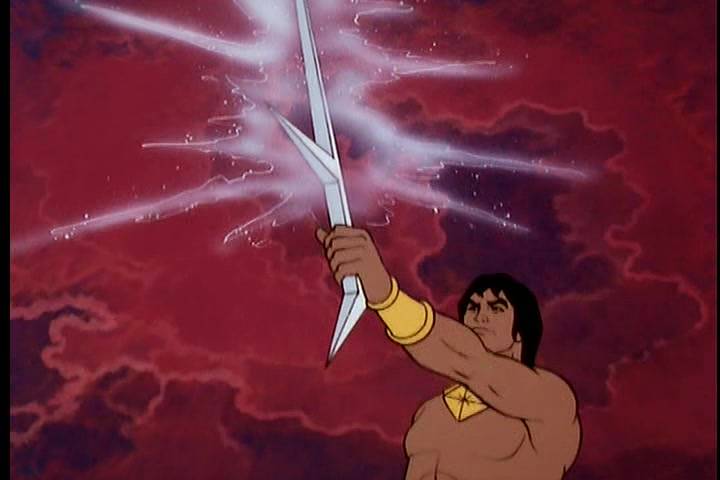
The premise is simple but evocative: astronaut John Blackstar is hurled through a black hole and strands on Sagar, an alien world in which technology and sorcery coexist uneasily. The planet’s tyrant, the Overlord, wields one half of a colossal weapon called the Powerstar; the other half — the Star Sword — finds its way into Blackstar’s hands. That fractured sword becomes both a literal weapon and a narrative hinge: two halves of a single, planet-shaping force with the hero and villain each holding a portion of the world’s fate.
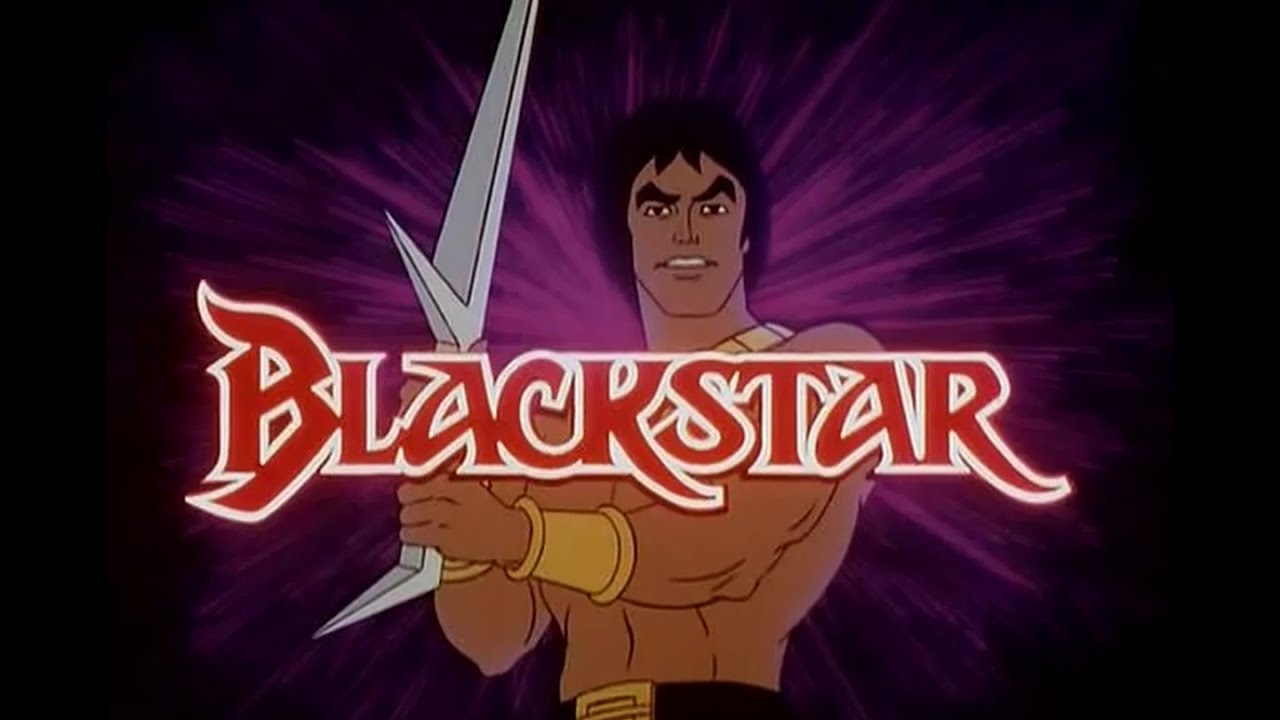
Creators have acknowledged a range of influences: Edgar Rice Burroughs’ John Carter tales, the pulpy spirit of Flash Gordon, and live-action series like Buck Rogers. Comic-relief characters such as the Trobbits nod to Tolkien’s hobbits and Disney’s dwarfs — tiny, personality-driven companions — while the Overlord channels archetypal space-opera villains. Yet, despite some familiar character beats, the show’s world-building stands apart: Sagar feels layered and strange, populated by hybrid creatures and suggestive vestiges of lost civilizations.
The Powerstar device is especially clever: in the Overlord’s grasp it functions as raw destructive force, but in Blackstar’s hands the Star Sword manifests subtler, often unpredictable powers. Writers leaned hard on that flexibility, inventing new abilities episode to episode, which made the weapon feel protean even if its rules were inconsistent. That yin-and-yang relationship between the two blades — brute force versus nuance — gives the series a thematic thread that few contemporaries bothered to explore.

From a modern production standpoint, the original series shows its age. Filmation’s in-house animation style and tight budgets resulted in repeated cycles of the same cels, frequent slow pans over painted backgrounds, and a sound palette that can feel garish by today’s standards. Dialogue often leans to broad, shouted lines and clumsy attempts at one-liners, and the series — built for syndication — lacks episode-to-episode continuity, so character arcs and long-form storytelling are largely absent.
Still, those budgetary constraints are offset by genuinely intriguing designs and settings. Sagar’s ecosystems and bizarre fauna — shark-bats, frog-rabbits, and hybrid creatures of all sorts — evoke a wildly creative imagination. The painted backgrounds, reused though they were, suggest a deep, lived-in world with ancient technology half-buried beneath verdant growth, a tone closer to Jim Henson’s darker fantasy work than to most Saturday-morning fare.

Connections to other Filmation works are obvious: voice actors and writers migrated between projects, and motifs repeat across series. After Blackstar ended, Filmation moved on to produce the better-funded He-Man and the Masters of the Universe, which shares many surface similarities — a musclebound protagonist, magic swords, and a hybrid techno-fantasy milieu — and ultimately eclipsed Blackstar in popularity and cultural impact.
That popularity cycle continues: while He-Man receives repeated reboots and new iterations, Blackstar remains largely neglected. For fans like me, the appeal of a revival wouldn’t be to recreate every rough edge of the original, but to realize the show’s unrealized potential: a properly realized origin for John Blackstar, coherent magic rules, and a serialized narrative that leans into the rich mythology hinted at in the 1981 episodes.

A contemporary reboot could harness modern animation, tighter scripts, and serialized storytelling to probe the mystery behind the Powerstar’s sundering, the true nature of Sagar, and the moral complexity hinted at in the original. Rather than nostalgia for nostalgia’s sake, a new Blackstar could be an opportunity to expand an intriguing premise into a full-fledged epic.

Most of all, a new version could finally explore the incident that shattered the Powerstar and transformed it into two complementary instruments of power. That single mystery alone holds so many narrative possibilities — and that’s why, to me, Blackstar still deserves another chance.
Further reading and sources: interviews and archival material are available online, including a set of creator interviews released with the 2006 DVD. External references in this piece link to original interviews and background articles for context. Links open in a new tab.
Source: Polygon
Related articles
 “Gangsterland” starring Tom Hardy renewed for a third season
 First still from the film “The Luckiest Girl Alive” featuring Kate and Rooney Mara released
 Friday the 13th Screenwriter Victor Miller Dies
 “Borat” screening cancelled due to racist jokes
 «Obsession» Star Inde Navarrette to Be Submitted for Oscar Consideration
 George Clooney awarded honorary Golden Lion for career achievement
 Danny Boyle’s “Inks” Opens the 83rd Venice Film Festival
 Volga to Release Teen Melodrama “My Hooligan”