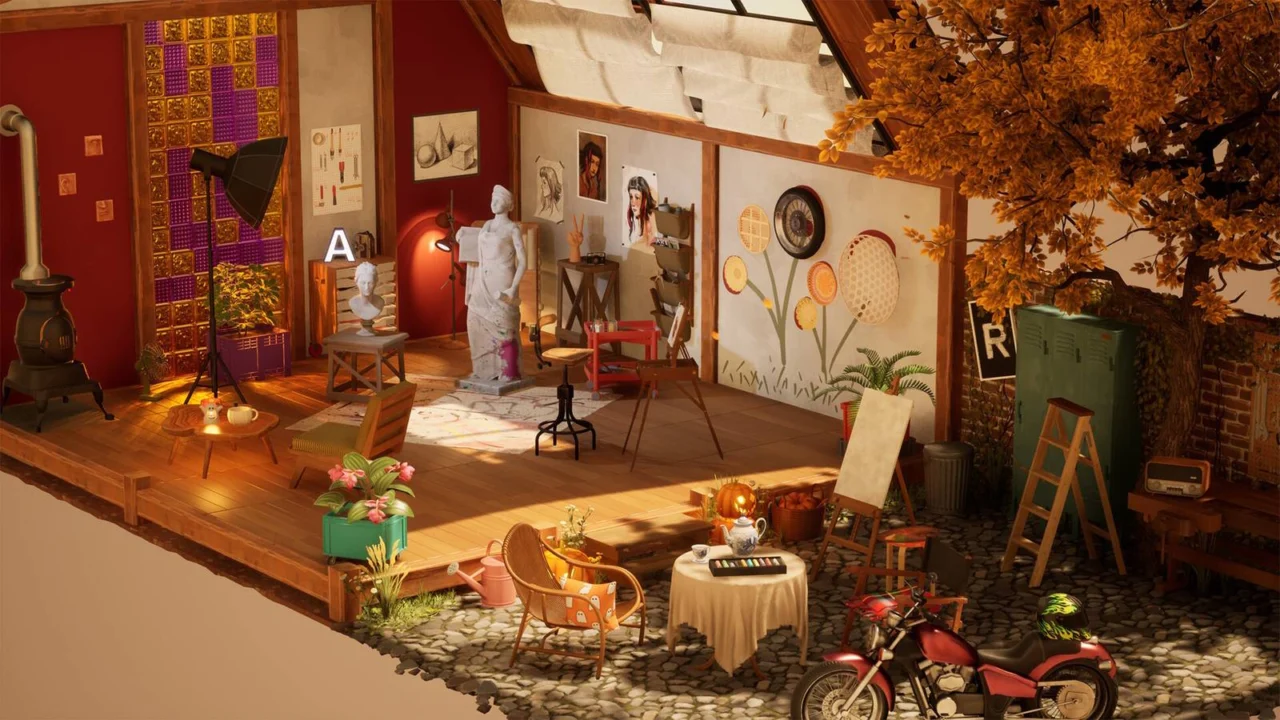
I’m Obsessed with Hozy: The Perfect Cozy Decorating Game on Steam
A peculiar rhythm took hold of me shortly after I began Hozy, the tranquil interior design title from Come On Studio. After purging a space of its grime and unburdening boxes that seem to possess a Mary Poppins-esque defiance of physics, I often found myself needing a reprieve. Confronting dozens of decor pieces in a confined area is a distinct brand of sensory overload, demanding a moment of quiet contemplation. Yet, even away from the screen, Hozy lingered. It occupied my thoughts during dinner prep, while scrubbing the dog, and in those quiet moments before sleep. It possesses a magnetic pull that even The Sims rarely achieves mid-build; it simply burrows into your subconscious.
The experience begins with a transformation. Every new environment is initially a disaster zone—filthy woodblocks, fractured parquet, and windows obscured by years of neglect. Sanitation is a prerequisite for style, and Hozy masterfully balances the tedious labor of House Flipper 2 with the cathartic, singular focus of PowerWash Simulator. Garbage is gathered in a whirlwind of debris and tossed toward bins with a resonant, satisfying thud. The mop work is equally tactile, gliding across surfaces with a fluid drag of the mouse and leaving behind a glistening trail of cleanliness. A standout moment occurs in the second location, where you pry up ancient floorboards with a crowbar—the animation carries a deliberate weight and tension before you shower the room in fresh, “thunky” parquet planks.

It is somewhat disappointing, however, that the game offers limited agency during this foundational phase. Beyond painting or wallpapering, there is little room to personalize the shell of the room, which feels like an odd constraint in a game centered on self-expression. That said, the curated palette of colors and patterns available in each level is well-chosen, allowing you to pivot from calming minimalist neutrals to bold, character-driven accent walls with ease.
The limitations become clearer when you consider the flooring—Hozy dictates the planks, and by extension, so does the room’s unseen occupant. Unlike Unpacking or Whisper of the House, which obsess over the minutiae of daily life—the cutlery, the cookware, the specific stack of paperbacks—Hozy provides a curated set of furniture that reflects a pre-defined personality. Each set has a thematic through-line but remains flexible enough for individual interpretation.
Take the first inhabitant: her collection includes a tribal mask, a neon glow, and antlers serving as a lantern stand. She is clearly a traveler and an artist. Are these artifacts treasures from her journeys meant for center stage, or are they merely visual stimuli for her workstation? The narrative logic is left entirely to your discretion. While some may find the lack of “living essentials”—like a place to sleep or a source of water for the tea set—jarring, I found it liberating. By focusing on the “macro” elements of design, Hozy makes redecorating feel impactful. You can completely redefine a room’s energy by shifting three chairs and a sofa, whereas there are only so many ways to realistically stack dinner plates.

Where the game falters is in its occasional attempt to mimic the overt sentimentality of Unpacking. Hozy sometimes forces a narrative onto specific objects through heavy-handed text blurbs that feel saccharine and redundant. In the second area, a prompt asks if a cloth-covered table is intended for a date—a strange suggestion for what is clearly a messy artist’s studio. These forced story beats cheapen the natural environmental storytelling that the furniture already provides.
Fortunately, these narrative stumbles are eclipsed by the sheer tactile joy of the gameplay. The developers have invested immense care into the sensory profile of every object. A beanbag chair looks and sounds so authentic you can almost feel the synthetic fabric and the shifting beads inside. Ceramics meet wooden surfaces with a crisp, crystalline clink, made all the better by their digital indestructibility. Even the music players are interactive; toggling a turntable adds the warm, nostalgic crackle of vinyl to the background score.
While the ultimate goal is decoration, the true pleasure lies in the interaction. Hozy is a profoundly relaxed experience, teeming with charm and offering surprising depth within its small-scale constraints. It has completely cleared my mental cache—leaving room for nothing but the perfect placement of a velvet armchair.
Hozy is available now on Windows PC via Steam. This review was conducted on PC using a pre-release code provided by tinyBuild.
Source: Polygon
Related articles
 Lords of the Fallen II to feature improved combat and reworked story
 Disney Survival Thriller Whalefall Fails to Replicate The Martian
 Dragon Quest Creator Uses AI to Make Game in 30 Minutes and Is Unfazed by Criticism
 Unofficial Port Brings Forza Horizon 2 to PC in 4K
 Valor Mortis: ‘The Scarecrow’ Quest Walkthrough
 Microsoft Updates Xbox Cloud Gaming Requirements, Leaving Outdated TVs Behind
 Nintendo Details Switch 2 Battery Replacement Process
 US Gaming Industry Demands Action Against Piracy Amid Threat to Cheap Retro Consoles