
D&D’s Most Famous Vampire Is the Secret Behind the Game’s Success

If you polled tabletop fans about Dungeons & Dragons’ most recognizable figure, the contest would likely come down to Drizzt Do’Urden — the drow ranger who dominated fantasy fiction — and Strahd von Zarovich, the brooding vampire sovereign of Barovia. Unlike Drizzt, whose renown was amplified by dozens of novels, Strahd’s stature grew mostly from his presence within the game itself: a villain forged by play and legend rather than by an extended book series.
Strahd’s origins trace back to the dawning days of D&D. Created by Tracy and Laura Hickman in the late 1970s, he emerged as designers were already stretching the game’s possibilities beyond simple dungeon crawls. The hobby itself had only recently begun — the original Gygax-and-Arneson boxed set arrived in 1974 and the Basic Set followed in 1977 — and adventures were still dominated by rooms, traps, and treasure. A vampire felt out of place in that context: an archetype, not a fully realized antagonist.
The turning point came in 1978 when Tracy Hickman returned from a session frustrated by a banal vampire encounter — a monster that, in his view, belonged to drama and gothic atmosphere, not a generic dungeon bestiary. That question — why is this creature here, lingering in a dank corridor among kobolds and crates? — led the Hickmans to craft an adventure steeped in gothic horror and focused on a charismatic, tragic vampire: Strahd von Zarovich.
They refined the scenario over several Halloweens, playtesting the module with friends for five years before joining TSR, the company then publishing D&D. The result, Ravenloft (released in 1983 for Advanced Dungeons & Dragons 1st Edition), was compact but revolutionary: a thematically cohesive adventure that remains one of the hobby’s most influential releases.
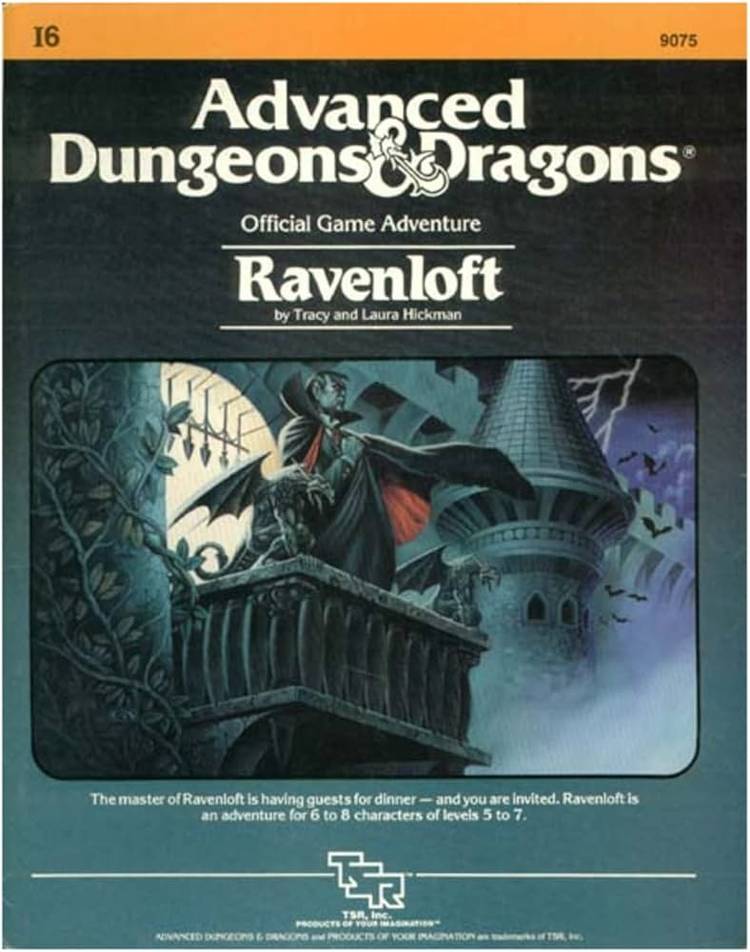 Image: Wizards of the Coast / Clyde Caldwell
Ravenloft centers on Strahd, a sorrowful yet formidable vampire who rules the fogbound valley of Barovia and has become fixated on a woman named Ireena Kolyana, who resembles a lost love. The module introduced an elegant mechanic: the Dungeon Master draws cards (a tarot-like Tarokka deck) to randomize Strahd’s motives, his whereabouts, and the locations of critical artifacts. Those motives vary — from murder and substitution to manipulation and sabotage — and they change the narrative stakes each time the adventure is run.
Because Strahd’s behavior is guided by those random elements, the book advises running him as a cunning, adaptive foe: he retreats when outmatched, he manipulates when it serves him, and he reappears at opportune moments. The Tarokka draw gives each session a fresh, unpredictable feel and helps preserve the adventure’s mysteries from players who might otherwise spoil it for others.
Another leap forward was the isometric mapping by Dave Sutherland. The Hickmans wanted interiors and castles that made architectural sense, so Castle Ravenloft was conceived as a coherent three-dimensional structure with interlocking floors and spaces — a far cry from the sheet-of-rooms layouts common at the time.
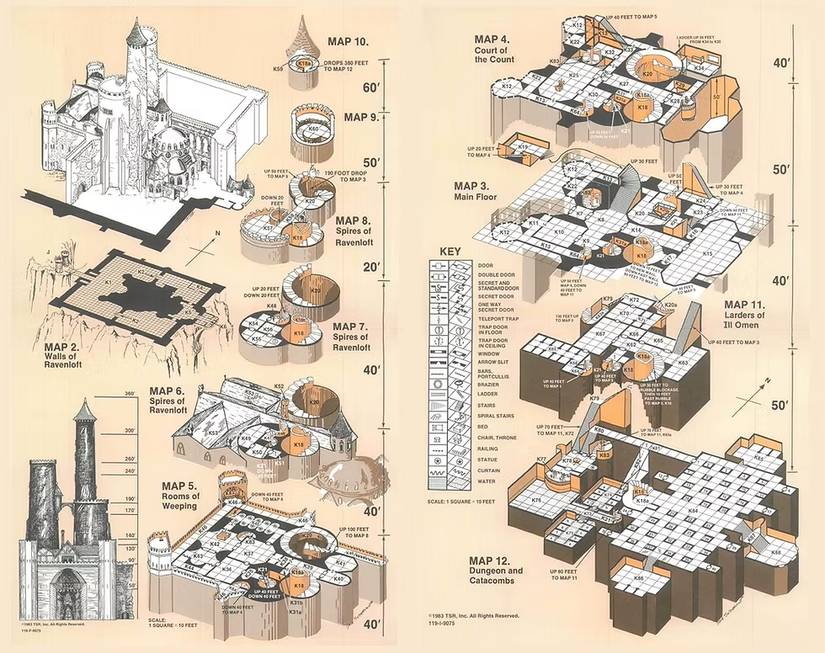 Image: Wizards of the Coast / Dave Sutherland
The most striking innovation of Ravenloft was placing the antagonist at the story’s center. Previous modules had been largely location-driven: go here, clear that room, claim the treasure. Ravenloft made the villain proactive — a presence that influences events, pursues goals, and shapes the campaign’s shape. That approach elevated roleplaying and narrative cohesion in a way earlier publications rarely did.
Fast-forward to the fifth edition of D&D, which has enjoyed immense commercial and cultural success thanks to a streamlined ruleset and mainstream exposure from outlets like Critical Role, Stranger Things, and the movie Dungeons & Dragons: Honor Among Thieves. Among fifth edition’s early releases, Curse of Strahd stands out as one of the edition’s cornerstones.
Published in 2016 and led by Chris Perkins with contributions from Jeremy Crawford, Adam Lee, Richard Whitters, and creative input from Tracy and Laura Hickman, Curse of Strahd expanded the original Ravenloft into a dense, playable campaign. Where Ravenloft was a compact 32-page module, Curse of Strahd stretches across 256 pages, preserving the original’s spirit while deepening its setting, characters, and threats.

Why does Curse of Strahd resonate so strongly? Perkins and the design team deliberately honored the original while enlarging its scope: more locations, richer NPCs, and expanded player agency. Perkins has said he didn’t set out to reinvent Ravenloft so much as to refine and amplify what already worked — turning a brilliant idea into a full-length, flexible campaign that rewards both dungeon exploration and dramatic roleplay.
The Tarokka deck returns as a storytelling device, preserving the module’s variability. At its best, Curse of Strahd balances direction and freedom: there’s a core narrative and a final confrontation, but players can roam Barovia, pursue side quests in any order, and uncover the vampire’s tragic past through scattered clues. That mix of sandbox exploration and a looming, character-driven antagonist is a defining reason the module still ranks among players’ favorites.
Barovia feels lived-in: its NPCs carry their own arcs, its side plots reward curiosity, and the atmosphere constantly reminds players they are in a land touched by despair. When Strahd does appear, the encounter matters — he is not an obstacle to be casually bypassed but the culmination of investigation and consequence. The module’s structure encourages DMs to tune tone, pacing, and difficulty to fit their table.
There is dungeon content aplenty — Castle Ravenloft and the Amber Temple offer classic, intricate exploration — yet roleplaying is never sidelined. The adventure is adaptable: DMs can modify scenes, emphasize different themes, or alter the ending to suit their group. Above all, the adventure places meaningful choices in players’ hands.
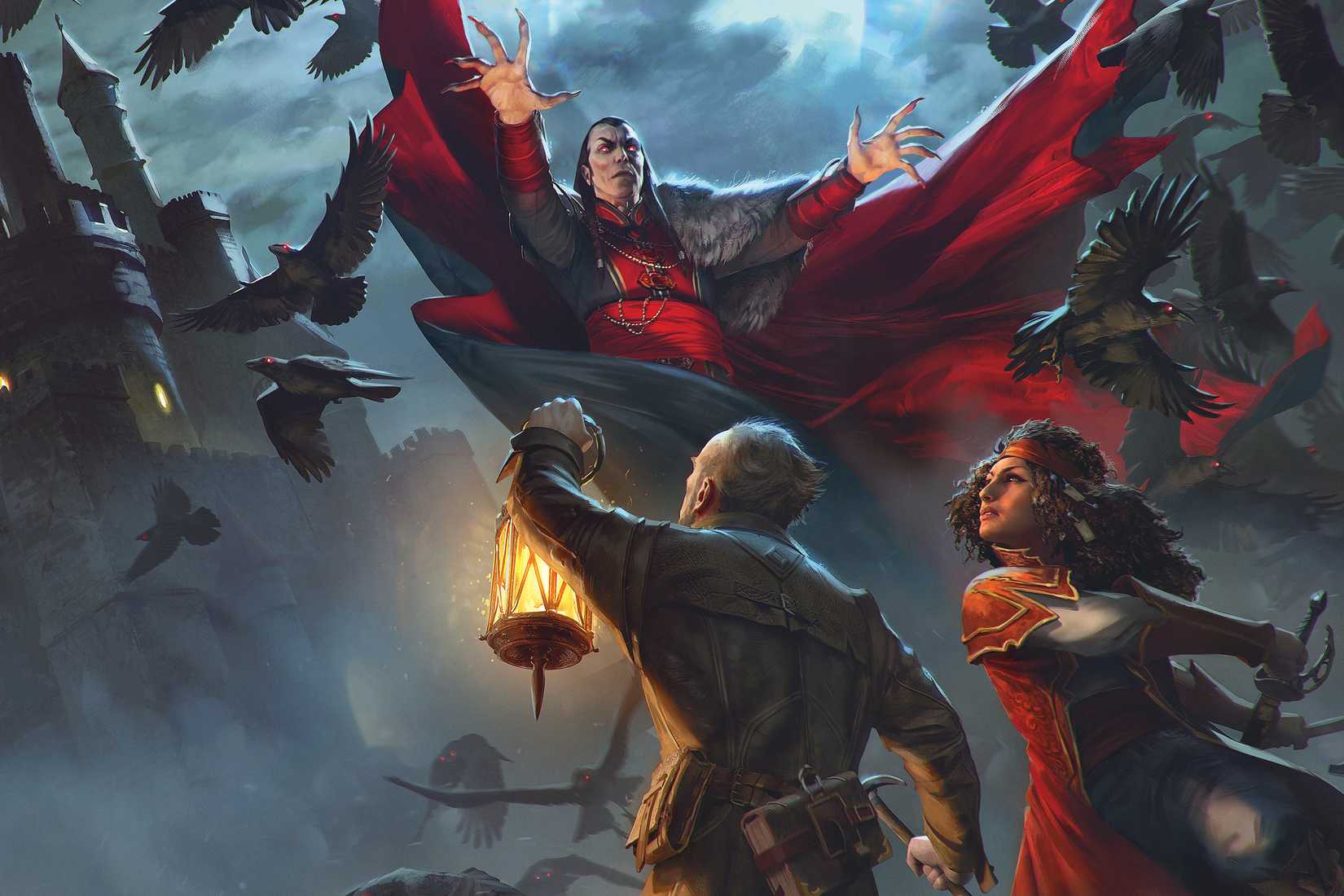 Image: Anna Podedworna / Wizards of the Coast
For Strahd, the campaign is both sport and torment: he has repeatedly watched parties of adventurers come and go, a recurring diversion in a prison of his own making. The mysterious Dark Powers that bind Ravenloft ensure his fate is cyclical, which explains why the artifacts that could defeat him are scattered throughout the land rather than locked away in his throne room.
When running the module, prioritize Strahd’s psychology and tactics. The party typically arrives at level 3, at which point Strahd could extinguish them if he wished. Deciding why he tolerates or toys with the group — whether he underestimates them, seeks amusement, or is compelled by some tragic compulsion — will define the campaign’s tone and the vampire’s role as antagonist.
Ultimately, the Hickmans’ insight endured: D&D need not be limited to corridors and treasure chests. It can be a layered, character-driven story “intricately woven into the play itself,” told through the interactions of players and memorable NPCs. Strahd remains the module’s brightest achievement — an antagonist who is at once terrifying, sympathetic, and endlessly compelling.
“I am the Ancient. I am the Land. My beginnings are lost in the darkness of the past…”
Source: Polygon
Related articles
 International “Doker” Film Festival Kicks Off in Moscow
 Milla Jovovich to Appear in the New Season of “Hot Rivalry”
 The first excerpt from Zach Cregger’s “Companion” has been released
 “Obsession” Star to Play Waitress in Apple Sci-Fi Series
 Paul Thomas Anderson is working on a new project
 Gal Gadot’s “Heart of Stone” receives scathing reviews
 Netflix and Alfonso Cuarón Developing Dungeons & Dragons Horror Series
 Critics approve of the second season of Guy Ritchie’s The Gentlemen