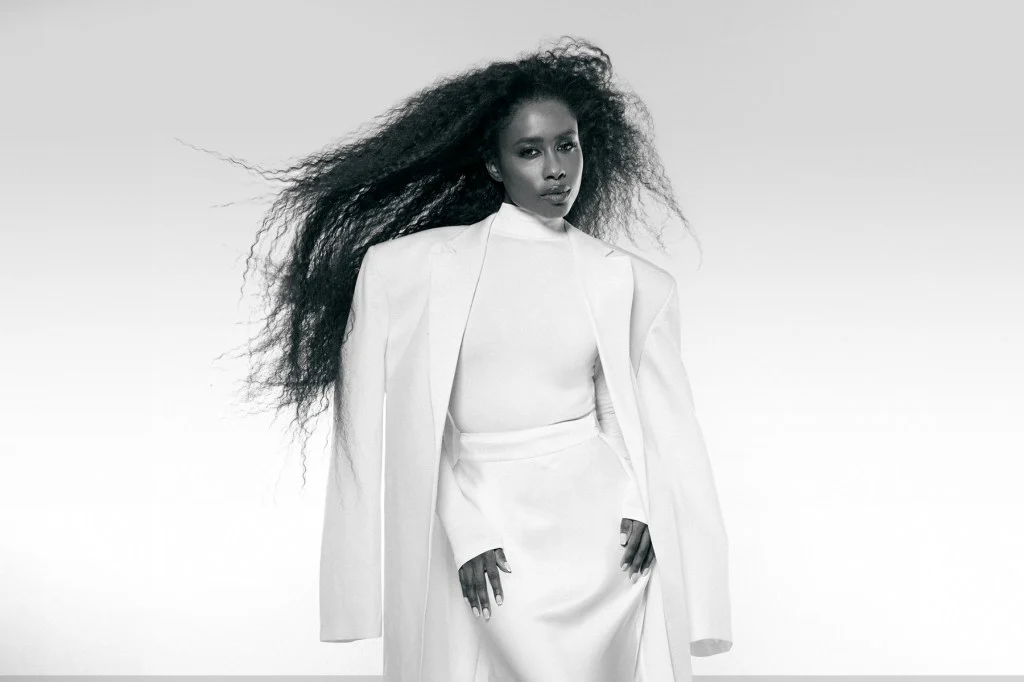
Dalia Mubarak: A Voice Beyond Boundaries

When Dalia Mubarak arrived at the Billboard Arabia set for her March cover feature, she didn’t just show up as a celebrity—she brought her entire world with her. Accompanied by her two daughters, Lily and Jazz, the atmosphere quickly shifted from a rigid production to a vibrant portrait of her everyday reality, where the roles of mother, artist, and visionary seamlessly intertwine.
There is an refreshing lack of artifice about Dalia. At first glance, she appears effortlessly grounded, someone who refuses to perform for the sake of the room. Yet, as the day progressed, a more intricate portrait emerged: a woman meticulously crafting her legacy on her own terms, possessing a voice that resonates with profound conviction.
Navigating through various takes while keeping a watchful, tender eye on her children, Dalia maintained a sense of warmth and grace. Even amidst the inevitable chaos of a high-profile shoot, she remained present, never too preoccupied to share a genuine smile or a kind word with those around her.
It was this multidimensionality that made her the quintessential choice for the March cover. In a month defined by the celebration of International Women’s Day and Mother’s Day, Dalia embodies the modern Arab woman’s journey. She stands at a professional crossroads, balancing the anticipation of a forthcoming album with her new high-profile role as a coach on The Voice Kids. Today, she appears more aligned with her true self than ever before.
Since her debut in 2014, Dalia has navigated the music industry with a quiet, steely resolve. She is a sonic explorer, fluidly transitioning between dialects and treating her visual identity not as a cosmetic layer, but as a vital extension of her artistry.
Her musical roots run deep, nurtured by her mother—whose voice Dalia insists remains the superior of the two. From her early days navigating the pressures of talent show auditions to her current status as a mentor for the next generation, Dalia has consistently pushed the boundaries of Saudi music. She has successfully reframed traditional Khaleeji poetry and feminine expression through a bold, contemporary lens.
Her discography is a testament to her refusal to be pigeonholed. Whether she is delivering the modern pop vibrance of “Mara ‘Aan Million” (One in a Million Woman), honoring the heritage of the Gulf in “Yareitni Rajal” (I Wish I Were a Man), or experimenting with Iraqi tones in “Arja’ La’en” (Come Back, Because…), she remains in a state of constant evolution. For Dalia, creative stagnation is the ultimate enemy.
Her career is punctuated by milestones that many spend a lifetime chasing. She is one of the youngest Saudi artists to hold a coaching chair on The Voice Kids and made international waves by signing a landmark deal with Warner Music. Yet, when confronted with these accolades, Dalia reacts with a disarming humility. “I never really paused to reflect on that,” she admitted during a quiet moment off-camera. “Perhaps I should have.”
This raw honesty defines her. Dalia has little interest in the polished, rehearsed scripts that often dominate celebrity discourse. Every time the conversation veered toward safe, PR-friendly territory, she instinctively pulled it back to the human experience—the messy, beautiful truth of it all.
To understand Dalia is to read the subtext of her music. From the soaring ambition of “Qimmat Tumoohi” to the defiance of “Ya Hasidi,” her song titles serve as a roadmap of her identity. They reveal a narrative of vulnerability, heartbreak, and a relentless drive to reclaim her power.

Beneath the radiant exterior lies a woman who has weathered significant storms. She speaks candidly about the weight of two past marriages, industry betrayals, and the moments when the pressure nearly forced her to walk away from the spotlight entirely.
Paradoxically, it was children who led her back to her passion. While Dalia speaks of motherhood with an intensity that borders on emotional exhaustion—admitting the sheer weight of love and worry is something she wouldn’t dare repeat—her role on The Voice Kids acted as a spiritual rescue.
“I had lost my spark,” she confessed, fighting back tears. “But the energy I received from those children reminded me of why I started this journey. Looking at them, I told myself: ‘Dalia, you are in this chair because once, you were exactly where they are.’” That realization effectively silenced any thoughts of retirement.
As she prepares for her most ambitious chapter yet, Dalia is expanding her horizons further into the Egyptian and Iraqi markets, seeking a deeper connection with the pan-Arab audience. She is no longer just an artist or a mother or an inspiration; she is a woman who has finally centered herself in her own story.
The March cover isn’t just a celebration of her fame; it’s a tribute to an artist who has stopped trying to meet external expectations and has finally embraced the power of simply being herself.
This article is an adapted version of a feature originally published by Billboard Arabia.

Related articles
 Joni Mitchell Celebrates U.S. Citizenship After A Journey That Began 62 Years Ago
 Tia Ray Becomes First Chinese Female Singer to Headline Grammy Museum Show
 Art of Play Owner Says Viral Dispute With Kelly Clarkson Has Led to Threats Against NYC Store
 Taylor Swift Appears in New Patient Zero Footage With Dakota Johnson and Travis Kelce
 Skrillex Issues Apology Following Head Trip Set
 Brandi Carlile’s 2027 Girls Just Wanna Weekend Lineup to Feature Headliners Kelly Clarkson, Sierra Ferrell
 Olivia Rodrigo and Chappell Roan to release remix of Expectations
 Tate McRae Pictures Late Pop Icon to Combat Stage Fright