
Yousuke Yukimatsu, The Genre-Defying DJ Taking the World by Storm: Billboard JAPAN Monthly Feature
¥ØU$UK€ ¥UK1MAT$U
Jun Yokoyama
Billboard JAPAN’s “MONTHLY FEATURE” highlights innovators who are shifting the cultural landscape. This edition turns the spotlight on ¥ØU$UK€ ¥UK1MAT$U, the Tokyo-based visionary whose singular approach to DJing has captivated dancefloors across the globe.
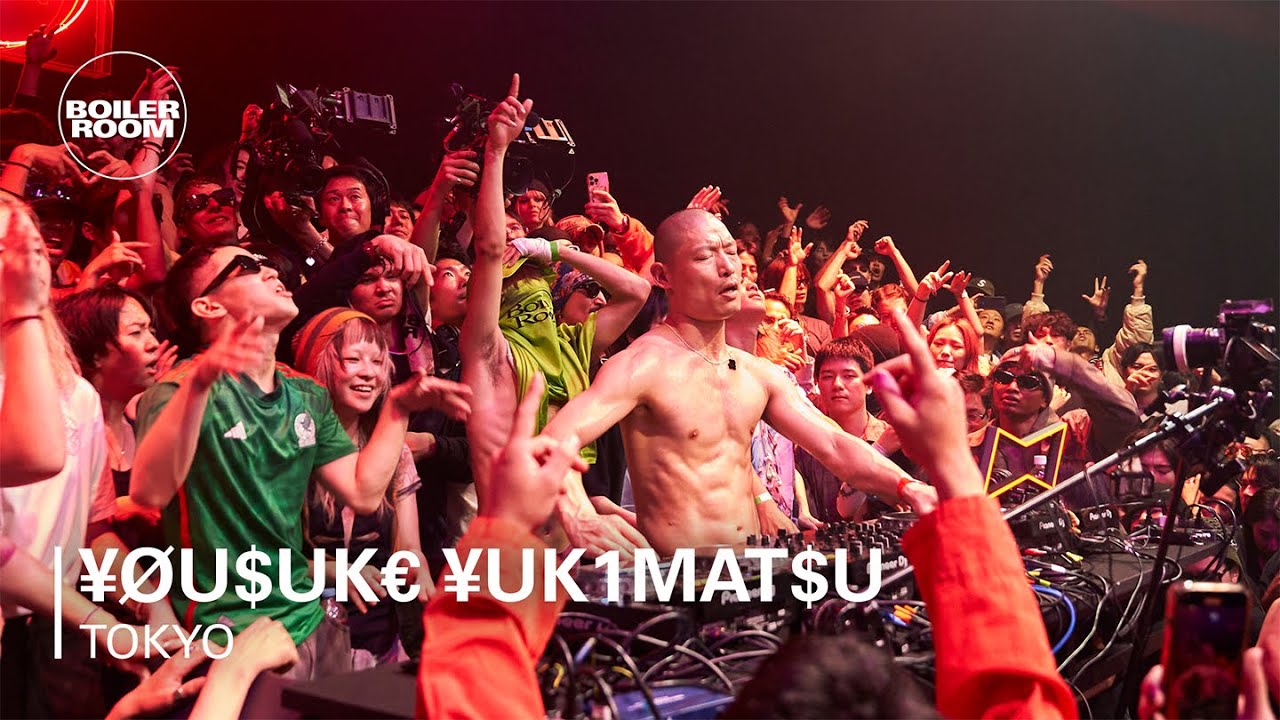
In recent years, a new wave of Japanese producers and selectors has begun to dominate the international festival circuit. ¥ØU$UK€ ¥UK1MAT$U stands at the vanguard of this movement, renowned for his fluid, genre-defying mixing style and an uncanny ability to bridge disparate sonic eras. His legendary set for the Boiler Room has amassed over 18 million views—a testament to his status as a pivotal figure in modern club culture.
Following his high-profile appearance at Coachella 2026 and a successful tour of South America, we caught up with him while he was stationed in Colombia to discuss his artistic philosophy and the evolution of his craft.
You’ve been traversing South America recently—how has this debut tour felt for you?
It’s been a remarkable experience. I toured the U.S. for the first time last year, and now to be part of Lollapalooza in Argentina and Chile—festivals I used to read about in magazines as a teenager—is truly surreal.
The energy from South American crowds is legendary. Have they lived up to the hype?
Absolutely. The intensity is incredible. In Chile, the crowd response was so electric that a mosh pit ignited the moment I dropped a Skrillex track. There is a raw, vocal passion here that you don’t find everywhere.
Your Boiler Room set was a defining moment. Looking back at its 18 million views, how do you feel about the impact of that performance?
I’m incredibly humbled. That set was a calculated endeavor; I wanted to ensure the flow was seamless regardless of the genre shifts. While I love improvising, a high-stakes hour like that requires meticulous design to resonate with such a wide audience.
You’ve often cited cinema as a major influence. Does that influence your DJ sets?
I find a parallel between great films and a great set. The more you revisit a masterpiece, like the works of Sho Miyae or Paul Thomas Anderson, the more you uncover hidden layers. I aim to build that same kind of depth into my performances—where the music feels like a cohesive, unfolding narrative rather than just a sequence of tracks.
There’s a clear sense of durability and emotional weight in your sound. How has your approach to mixing evolved over the last decade?
I’ve become more precise with my EQing, which I think owes a lot to my long-standing admiration for artists like Ryuichi Sakamoto. Mixing isn’t just about beat-matching; it’s about sculpting the frequencies to ensure the melody breathes. It’s an ongoing process of refining how I handle complex, layered audio.
You’ve overcome significant health challenges in the past ten years. How has that shaped your perspective on your work?
It has made me deeply grateful. I want every set to offer something cathartic to the listener. The world can feel increasingly dark, and if my music can provide a moment of relief or a burst of energy, then I’ve succeeded. I don’t aim for fame; I aim for a genuine, positive connection.
What does the future hold as you continue to represent Japan on the global stage?
I have no intention of moving abroad; I love life in Japan, from the local record shops to the culture. My goal is simple: to keep evolving, stay curious, and continue using the DJ booth as a platform for messages of unity and peace. The potential for discovery in music is infinite, and I’m just getting started.
– Interview by Shino Okamura, originally published on Billboard Japan
Related articles
 Kelly Clarkson Responds to Brooklyn Store Dispute With New Statement
 John Stamos Says Mike Love Is Facing Serious Health Challenges
 Troye Sivan’s ‘She’s the Best’ Voted Fans’ Favorite New Music of the Week
 Kelly Clarkson Criticizes Brooklyn Store for Refusing Service and Causing a Lost Sale
 Calvin Harris performs on day two of Head Trip after weather cuts night one short
 Cornell University Cancels Homecoming Concert Amid Fallout From Sexual Assault Case
 Night One of Head Trip 2026 Ends Early Due to Weather
 Barry Manilow Cancels Vegas Shows Due to Bronchitis After Walking Off Stage