Uketsu on ‘Strange Maps’ Topping the Inaugural Billboard Japan Book Chart, Musical Influences, and Writing for ‘One Reader’: Interview

Strange Maps, the latest masterwork from the veiled horror-mystery sensation Uketsu, has secured the No. 1 position on the debut all-genre rankings of the newly established Billboard Japan Book Charts.
Renowned for a singular narrative technique that fuses traditional prose with a wealth of visual aids—including intricate diagrams, sketches, and maps—Uketsu has captured a global audience. His work is celebrated for its remarkable approachability, drawing in even those who seldom engage with literature. The “Strange” series has now exceeded 8.5 million copies in worldwide circulation, with Strange Pictures alone moving over 2.1 million units across 37 territories, cementing his status as a “global sketch million-seller.”
The fourth installment, Strange Maps, weaves its narrative through more than 200 detailed illustrations, set against haunting backdrops like isolated coastal hamlets and decaying tunnels. This volume represents the apex of the author’s craft, synthesizing the experimental elements explored in his previous bestsellers into a definitive mystery experience.
By redefining the reading experience for the digital age, Strange Maps has already seen over 700,000 copies distributed. Hailed as a nationwide “cartographic mystery phenomenon,” the book dominated Billboard Japan’s inaugural Hot 100 book chart—which aggregates physical sales, digital editions, and library data—and has maintained its lead on the Literary (Bungei) charts for a full month.
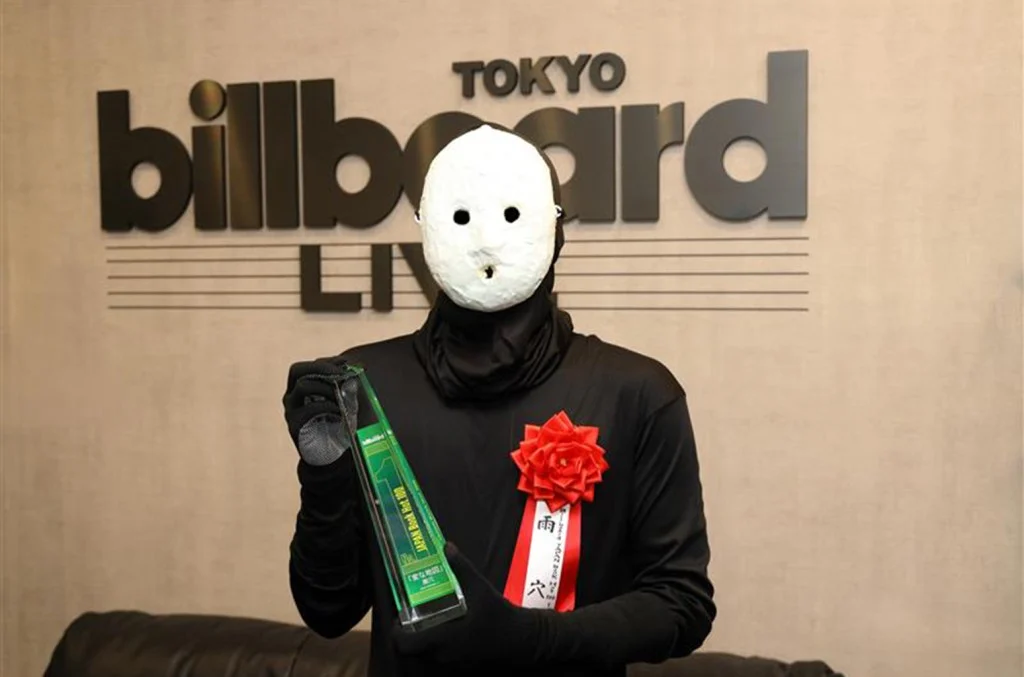
Despite his massive success, Uketsu remained characteristically disguised behind his signature mask during the Billboard Japan Book Charts awards ceremony on December 16. In an exclusive conversation following the event, the elusive creator delved into the origins of Strange Maps, his creative philosophy, and how his eclectic musical tastes fuel his literary output.
What music soundtracks your daily life?
My childhood was spent in the United Kingdom, where I was surrounded by the pop sounds of the Spice Girls, Westlife, and Steps. Those melodies were the constant background noise of our family car trips. While Oasis and R. Kelly were also massive at the time, their sound felt a bit too mature for me back then; I couldn’t quite find a way into their music as a kid.
When I returned to Japan, Southern All Stars became my first true musical obsession. I remember the profound sense of connection I felt listening to them. As I entered my teens, I became fascinated by musical lineage. Investigating the influences of Keisuke Kuwata led me down a rabbit hole into ’60s and ’70s rock and pop, eventually expanding my palette to include the sounds of the ’80s and ’90s as well.
Is there a specific track that fundamentally altered your perspective?
“Sayonara Jinrui” (Goodbye, Humanity) by the band Tama. I only caught a ten-second snippet of it on a television retrospective, but it was instantaneous—I knew I was hearing something wholly unique. It stood in stark contrast to the polished pop of Southern All Stars and left an indelible mark on me.
During that era, the airwaves were saturated with adult love songs that felt distant from my reality. Tama, however, utilized imagery that resonated with a child’s imagination—the moon, the stars, and the surreal. Their music felt accessible and immediate. To this day, that song remains incredibly significant to my creative identity.
How do you stay current with new musical trends?
I frequently monitor Billboard’s global charts. I treat it almost like a professional study. Even if a particular sound doesn’t immediately resonate with me, I feel a certain responsibility to understand why it’s trending. Though I only release music occasionally through my videos, I want to remain conscious of the contemporary sonic landscape, even if I don’t directly emulate it.
With your work reaching a vast international audience, what do you hope global readers take away from your stories?
I intentionally avoid writing stories that require a granular understanding of Japanese linguistics or niche cultural tropes. My goal is to create narratives that don’t demand prerequisite knowledge. I want international readers to dive in without the “Japanese literature” label weighing them down. If they happen to perceive a specific Asian or Japanese aesthetic along the way, that’s wonderful, but my primary hope is simply that they find the books engaging and easy to digest.
You’ve described Strange Maps as the culmination of your series. Where did you focus your creative energy this time?
I’ve lived with a lingering sense of regret regarding my debut, Strange Houses. At that time, I felt my technical skills weren’t sharp enough to fully execute the mystery elements of the ending. With Strange Maps, I wanted to revisit the motifs of abandoned settlements and forgotten spaces but with a much more sophisticated narrative structure.
I combined everything I learned from the literary depth of Strange Pictures and the intricate foreshadowing of Strange Houses 2. After a year of intense labor, I can finally point to this book as the definitive introduction to who I am as a writer.
Strange Maps has resonated with everyone from young children to adults. Why do you think your work has such broad appeal?
There was a two-year hiatus between my projects, and I am honestly humbled by the patience of my readers. Their loyalty is the only reason the book has reached this level of success. I don’t have a magic formula; I simply write what I find compelling. The readers are the ones who have nurtured the work and allowed it to grow into a phenomenon.
Are you consciously trying to engineer “bestsellers” while you write?
I actually believe that writing for a “mass audience” is a mistake. I write for a single, imaginary reader. Throughout the process, I am in a constant internal dialogue with this person, gauging their reactions and asking, “What if this happens next?” Staying true to that one reader’s experience is what keeps the work focused.
What lies ahead for Uketsu? Are there new genres you wish to explore?
I want to remain fluid and write whatever captures my interest at the moment. Lately, I’ve found myself drawn to the complexity of political dramas and high-stakes financial thrillers. These are territories I haven’t explored yet, but I find the mechanics of those genres fascinating. It would be a significant departure from my current style, and it might take years to master, but it is a challenge I hope to accept in the future.
—Interview by Takanori Kuroda; originally featured on Billboard Japan.
Related articles
 Hailee Steinfeld Covers The Cars’ “Magic” for the Movie “Hexed”
 Noel Gallagher Disparages Vegetarians on ‘Chicken Shop Date’ but Makes One Exception
 Billy Corgan Explains Why Olivia Rodrigo Is Popular With Rock Stars: “She’s Not Afraid”
 Billboard Readers Poll: Which New Release by LISA, Miley Cyrus, John Mayer and Others Is Your Favorite This Week
 Billy Corgan Explains Why He Has Stood by Marilyn Manson, Saying He Doesn’t Want the World to Tell Him Who His Friends Are
 Ariana Grande Shows Off New Bob as Boyfriend Ricky Alvarez Falls in Love With Her Again
 Jazzy Opens Up on Debut Album, Saying People Might Think She Is a Closed Book
 LISA, Miley Cyrus, Kacey Musgraves and John Mayer Feature in New Music Friday Guide