The World’s Greatest Erotica Author on His Pivot to Zombie Horror

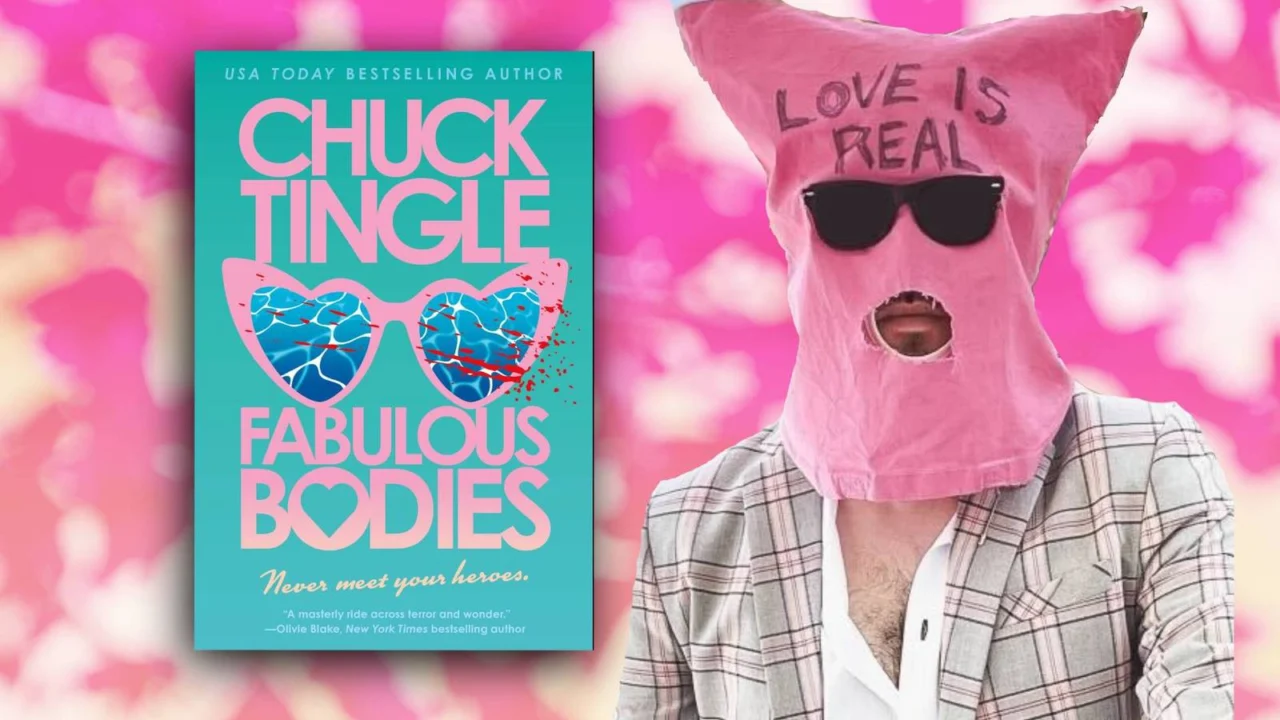
While he initially gained notoriety for surreal and satirical queer erotica titles like Pounded by President Bigfoot and I’m Gay for My Billionaire Jet Plane, Chuck Tingle—who famously conceals his identity behind dark sunglasses and a signature “Love Is Real” pink mask—has evolved into a formidable voice in the horror genre.
 Image; Macmillan
Tingle’s upcoming release, Fabulous Bodies (arriving July 7), is being marketed as a mashup of Drive and Beetlejuice. It is the quintessential summer page-turner, perfect for lazy afternoons by the shore or lounging poolside.
The story follows Poppy Stringer, a fashion influencer who moonlights as a grave robber transporting corpses across Los Angeles. Her life takes a lucrative but gruesome turn when she is hired to collect the body of Eddie Michaels—a queer rock icon cut from the same cloth as Elton John—only for him to wake up from the dead.
We sat down with Tingle to discuss his fascination with the macabre, whether affection and terror can coexist, and the soundtrack for his protagonist’s life. Continue reading for an exclusive look at Fabulous Bodies.
Polygon: What first drew you into the world of horror? Was there a specific catalyst for this passion?
Chuck Tingle: I have a few formative memories, but the 1990 remake of Night of the Living Dead, starring Tony Todd, really solidified it for me. There is something deeply unsettling about late-night television when you’re struggling to sleep—you feel profoundly disconnected from the world. Seeing those characters barricaded in a farmhouse, mirrored that sense of isolation. I felt a sudden, profound connection: the world is a dangerous place, but there is a strange, shared comfort in being terrified together.
How does your approach to crafting horror differ from writing your signature short-form satirical erotica?
Chuck Tingle: The primary difference is the immediacy. I can write my “Tinglers” in about 24 hours, which allows me to channel my reactions to current news cycles almost instantly. It’s a exhilarating way to release art, breaking down the wall between creator and audience. Conversely, a traditional horror novel is a months-long marathon, and the publishing cycle means it won’t hit shelves for a year. I have to focus on broader cultural themes rather than fleeting headlines—though sometimes, life catches up. In Bury Your Gays, I explored AI’s impact on Hollywood. At the time, I worried it felt too speculative or absurd, but by the time the book was released, it felt like I had written it just yesterday.
Much of your horror work examines queer individuals being targeted by straight societal norms. Is this present in Fabulous Bodies? What draws you to this dynamic?
Chuck Tingle: That’s a keen observation. Fabulous Bodies actually pivots toward a critique of queer culture itself. Stan culture—that blind, absolute devotion to celebrity—is pervasive, and it often feels particularly intense within the queer community. We adore our icons, but that adoration can sometimes curdle into something toxic. As for why I lean into these themes, it isn’t a grand design; it’s simply an organic expression of who I am. I love horror, and I love exploring sexuality. They just intersect naturally.
Having published five novels now, what have you learned about your process that you wish you’d known at the beginning?
Chuck Tingle: I don’t necessarily wish I knew anything differently, because I prize art that captures the exact moment of its creation. True perfection is often a myth; “sanding down” a work too much can strip away its soul. Think of punk bands—would their early records be better if they went back as adults, perfectly in tune and polished? I don’t think so. I strive for raw, ruthless honesty. If a work feels a bit off-kilter, that’s where the flavor lives.
Your mantra, “Love is real,” is central to your brand. Why do you believe love and horror are such effective bedfellows?
Chuck Tingle: People often ask why a writer with such an optimistic message is drawn to the darkness. But to me, that’s the point: there is no better environment to illuminate the light than in the deep, heavy dark.
Tonally, Fabulous Bodies feels distinct. How did you strike the balance between visceral body horror and the undead chaos?
Chuck Tingle: I rarely start writing with the goal of being funny. If people laugh, that’s wonderful, but humor isn’t the primary intent. Comedy and horror are two sides of the same coin; both revolve around the intrusion of the bizarre into everyday life. Your reaction to that intrusion dictates the tone. My neurodivergent perspective plays a role, too. I often find myself questioning standard tropes—asking “Why must it be done this way?”—which often leads me to chart my own path. That inherent divergence often creates humor, even when the subject is grotesque.
Are there subgenres you haven’t tackled yet that you are eager to explore?
Chuck Tingle: Business-wise, I have the freedom to explore whatever I want. The hurdle is always emotional resonance. I’ve had a vampire novel gestating for years, but it didn’t “click” until I discovered the underlying emotional core. It’s currently in progress, though it’s sitting in the queue to be released in a few years.
If you had to pick a theme song for Poppy, what would it be?
Poppy’s fictional theme is “A Star Like Me,” but if we’re choosing something real, I’d go with Elton John’s “Rocket Man.” The lyrics perfectly mirror the life of someone whose career has isolated them from their family, leaving them with that bittersweet realization that they’re excelling at their craft while missing the world down below. Plus, Fabulous Bodies has a groovy 70s rock aesthetic, so it fits perfectly.
Any horror recommendations for readers right now?
Headlights by CJ Leede is coming out this summer, and it is absolutely brilliant. I cannot recommend it highly enough.
And now, here’s an exclusive excerpt from Fabulous Bodies. The book hits shelves July 7.
Source: Polygon
Related articles
 Three New Games Join Xbox Game Pass on Launch Day
 Physical Edition of Phantom Blade Zero Appears Unlikely for PS5
 Hacked PS5 Consoles Banned by Sony, Owners Warned of Risks
 Wuthering Waves Developers Propose Solution to Large Game File Sizes
 Former PlayStation Chief Criticizes Future of Disc-Based Games
 PS6 and Xbox Project Helix Face Memory Shortage Through 2028
 Xbox Lacks Exclusive GTA 6 Streaming Rights and PC Skips Cloud Version
 Ranking All Seven Seasons of Buffy the Vampire Slayer