
The First Horror Masterpiece of 2026 Was Ten Years in the Making

At the turn of the decade, Irish filmmaker Damian McCarthy was virtually unknown. That changed rapidly with a string of chilling, highly acclaimed horror projects. He first made waves with Caveat, a low-budget exercise in tension centered on a drifter tasked with guarding a fragile woman in a desolate estate. He followed that success with the 2024 Shudder standout Oddity, a gripping tale of a blind psychic seeking vengeance for her sister’s murder. Now, McCarthy is delivering his most ambitious vision yet: Hokum. Featuring Adam Scott as a writer who retreats to a remote Irish hotel, the film traps its protagonist in a nightmare governed by a malevolent, ancient witch.
Staying true to his roots, McCarthy anchors Hokum in the Irish landscape with a predominantly local cast—with the notable exception of Adam Scott’s character, Ohm Bauman. True to his signature style, the narrative is claustrophobically confined to a singular, oppressive setting. While Oddity explored the dread of a creaky family home, Hokum elevates the stakes within the decaying grandeur of an isolated hotel. Ultimately, McCarthy once again proves his mastery of the genre: the film is genuinely, deeply terrifying.
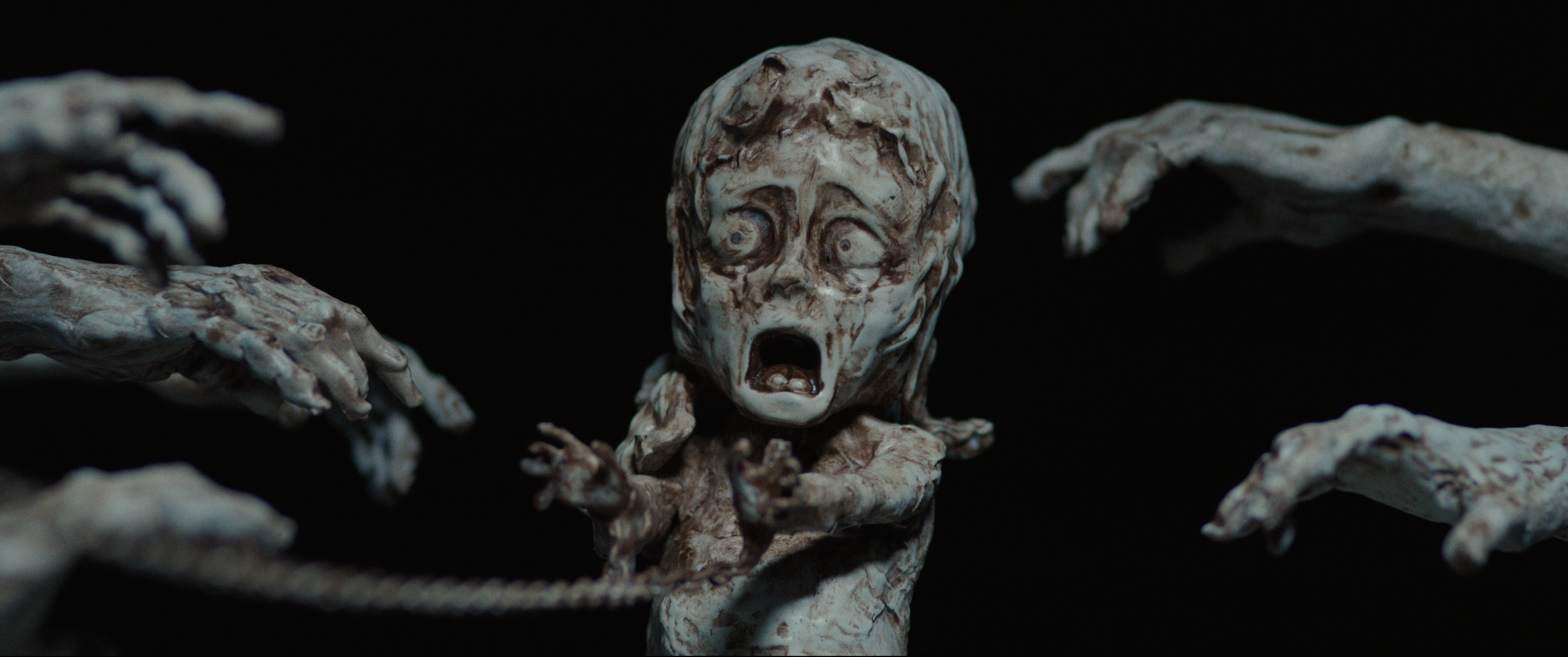 Image: Neon
When asked about the secret behind his knack for building unease, McCarthy credits a lifelong immersion in horror, fostered by regular film nights with his brother. Beyond mere fandom, however, he possesses a precise, intuitive approach to the jump scare, balancing meticulous planning with sheer creative instinct. “A lot of it is just gut feeling,” he notes.
Polygon sat down with McCarthy to discuss the genesis of Hokum, the haunting nature of its central antagonist, the psychological power of physical environments, and his expert strategy for keeping an audience on the razor’s edge. This interview has been edited for length and clarity.
Polygon: What was the initial spark for Hokum, and how long did the development take?
Damian McCarthy: The idea has been percolating for about a decade. At its heart, it was just the concept of a man trapped in a haunted honeymoon suite, desperate to escape. I tinkered with the script for years, but it only really crystallized once Oddity wrapped. I wanted to move away from the non-linear, ensemble feel of my previous work and lean into something more straightforward and visceral—a survival story where the goal is simply to survive until sunrise.
How did you bring Adam Scott into the project? Was a Hollywood name always part of the plan?
McCarthy: I wanted a blend of local Irish talent and an internationally recognizable lead. I was watching Severance and was struck by his performance—he has this incredible, dark, internal energy. As fate would have it, he had already seen Oddity and was interested in my next move. We started talking, and it clicked immediately.
 Image: Neon
Your lead character is deeply unlikable. Was that characterization intentional?
McCarthy: Absolutely. I warned Adam, “This character is not easy to like.” I think many actors would have pushed to soften his edges, but Adam was brave. He understood that the challenge was to keep the audience invested despite his cruelty, and hopefully, create a sense of empathy as the ordeal progresses. In horror, if you don’t care about the protagonist, the stakes vanish. Adam managed that balancing act perfectly.
The film explores folklore about a witch who drags children to Hell. Is this based on real myth, or is it an original creation?
McCarthy: It’s purely invented. I wanted to tap into that universal, primal fear of the “witch” archetype. Growing up in Ireland, there’s always an undercurrent of Catholic guilt regarding sin and damnation, which definitely bled into the script. For me, the scariest thing about a witch is that she seems to be having fun. Their motivations are often opaque and bizarre, which makes them infinitely more threatening.
What’s always scared me about witches is, they’re always having a really good time.
The witch feels more like a feral creature than a person. Did you ever consider making her more human?
McCarthy: No, her ambiguity is her strength. I love the “creature feature” simplicity: “She’s a monster—watch out.” I didn’t want to explain away her motives or give her a backstory that humanized her too much. The unknown is always the most frightening thing.
 Image: Neon
Your films are heavily defined by their settings. How much does the location dictate the writing?
McCarthy: It’s everything. If the setting doesn’t work, the movie collapses. I’ll often start with a loose script, and then once I find the right door, hallway, or window, I rewrite scenes to utilize those physical elements. Architecture is a character in my films.
What is the secret to a genuinely effective jump scare?
McCarthy: Authenticity. If you use a cheap, unearned scare early on, the audience stops trusting you. You have to establish that the threat is real. It’s about building anticipation and then either paying it off perfectly or using misdirection to subvert expectations. I study horror constantly, trying to see where the audience expects the scare, and then I do the opposite. Sometimes, it literally comes down to shaving off a few frames in the edit to get that perfect rhythm.
Take off a couple of frames, suddenly it works.
Your movies are inherently Irish. Why does that setting work so well for horror?
McCarthy: It’s the isolation. Even when the characters are visitors from afar, the Irish landscape has this ancient, lonely quality. There is nowhere to run for help in these rural areas. That sense of abandonment is something I love to lean into.
Hokum opens in theaters on May 1.
Source: Polygon
Related articles
 Modder Adds Co-op and AI Partner to Resident Evil 2 Remake
 The Last of Us and Uncharted 4 Creator Admits Fear of GTA VI Release
 Ben Affleck Recalls Being Harassed by Children in Online Video Games Over Skin Prices
 Modder Recreates Battlefield 2 After 21 Years with Modern System Support
 Starfield Modder Creates Seamless Planet Landings Solo
 Hacker Claims Full GTA VI Story Build Could Leak Before Release
 Fan-Made Diablo Remake Released With Ray Tracing and Online Co-Op Support
 Gran Turismo 7 Developers Express Surprise That the Game Remains Popular