
While I certainly appreciate Spaceballs as much as anyone, my personal go-to for Star Wars satire is a much deeper dive into pop culture history. The 1980s sparked a vibrant era of independent comics, rising up as a creative counterculture to the dominant DC and Marvel superhero model. These indie titles traversed every imaginable genre—from the hardboiled, gritty atmosphere of Grimjack to the sheer, unadulterated wackiness of The Flaming Carrot. Many of these fell into the “funny animal” category, a descriptor for anthropomorphic characters that didn’t always lean toward humor. While the Teenage Mutant Ninja Turtles remain the most famous example, this movement also produced enduring gems like Usagi Yojimbo, Stan Sakai’s long-running, independently owned epic about a samurai rabbit.
In that same spirit, but with a sharper focus on genuine comedy, came the five-issue series Space Ark, crafted by Ken Mitchroney and Mark Cantrell.
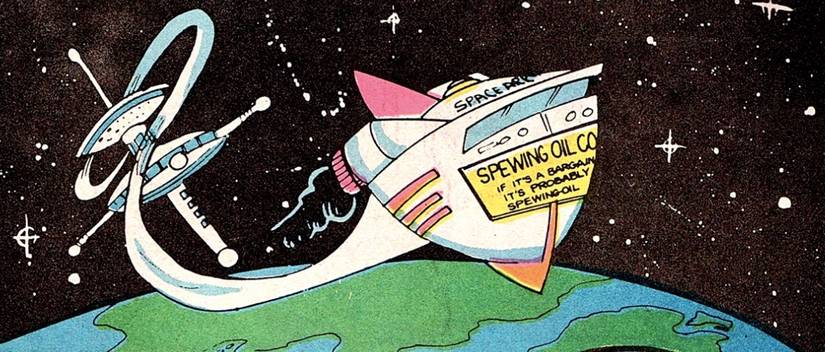
The comic follows the crew of the titular ship, a vessel belonging to the Fur-Bearing Alliance—or “FURBALL” for those in the know. This organization operates as a galactic police force, utilizing small, specialized crews—mostly mammals, though not exclusively—to maintain order.
The Space Ark itself is piloted by a hopelessly inept crew under the command of Captain Stone, a fox with an ego as inflated as his rank. He’s joined by Dr. Whoot, an owl serving as a self-important science officer, and Barker, a dog who technically handles navigation but seems perpetually distracted by his next meal. The engineering department is run by Brooklyn, a gambler who loves his cigars, assisted by Slinx, a snake. Kitty, the first mate, stands as the only competent member of the bunch. Completing the roster is Boltz, a silent, all-purpose droid who somehow bungles even the most routine janitorial tasks.

Every installment offers a zany, standalone cosmic adventure. The debut issue features the crew clashing with the Bucoids, a repulsive, mucus-covered extraterrestrial race. The second issue pivots to Captain Stone’s romantic mishaps, while the third—my personal favorite—revolves around Brooklyn’s disastrous luck at an intergalactic horse track. Later issues see Boltz replaced by a malevolent robot, culminating in a sprawling, high-stakes galactic war in the fifth. Regrettably, these five issues, published between 1985 and 1988, were the end of the line for Space Ark, save for a brief eight-page crossover tucked into the back of Usagi Yojimbo issue #22 in 1990.

That crossover is actually how I first stumbled onto the series. During high school, I worked at a comic shop, where I used my employee discount to hunt down back issues of Usagi Yojimbo. Finding that backup feature was a revelation, especially because I recognized the artist, Ken Mitchroney, from his stellar work on the Teenage Mutant Ninja Turtles.
Mitchroney was a foundational talent on the Archie Comics title Teenage Mutant Ninja Turtles Adventures. I was captivated by his style, which injected a fluid, kinetic energy reminiscent of Looney Tunes animation into the Turtles’ world. Tracking down Space Ark took years of digging, and they remain elusive collectibles today. They have never been reprinted, though stray issues occasionally surface on eBay. They weren’t produced by industry giants; the first two issues, in full color, were released by the Florida-based AC Comics, while the subsequent three were published by Connecticut’s Apple Comics.
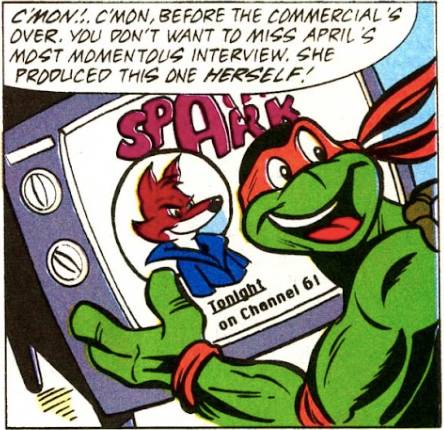
What keeps me coming back to Space Ark is its absolute commitment to classic cartoon logic, where the laws of physics are merely suggestions to be ignored for a laugh. There’s a memorable sequence where Brooklyn tries to prevent Boltz from boarding, only for the droid to pull on Brooklyn’s shirt, snap it back, and leave the engineer rolled up tightly like a window shade.

The book is also peppered with delightful, if thoroughly dated, pop culture references. The series kicks off with a nod to 1950s comedian Shecky Greene, and there’s a recurring, absurd gag where the crew attempts to disguise their ship as Groucho Marx.

Space Ark is clearly a love letter to both Star Wars and Star Trek, but to me, it always felt like a spiritual successor to Chuck Jones’ masterpiece, Duck Dodgers in the 24 1/2th Century—essentially offering an ongoing Duck Dodgers-style series decades before that actually happened on television. Since Duck Dodgers was a spoof of the 1929 Buck Rogers newspaper strip, which itself influenced Star Wars, that same DNA is woven into Space Ark, particularly through the swashbuckling bravado of Captain Stone.
Despite its promise, the crew only logged those five adventures. I’m still not sure why it ended, especially since the final page of issue #5 included a teaser for what was next. However, Mitchroney’s career shifted toward Ninja Turtles in the late ’80s, eventually leading him to Pixar in the 1990s.
Intriguingly, the Space Ark saga might not be over. Mitchroney has been sharing teases on his Instagram recently, showing off his work cleaning up the original pages and hinting at potential animated projects. While we’ll have to wait and see what materializes, I’d be thrilled to see Space Ark make a comeback. That brand of unapologetically irreverent, Looney Tunes-esque humor is a rare commodity these days, and we could certainly use more of it.
Source: Polygon