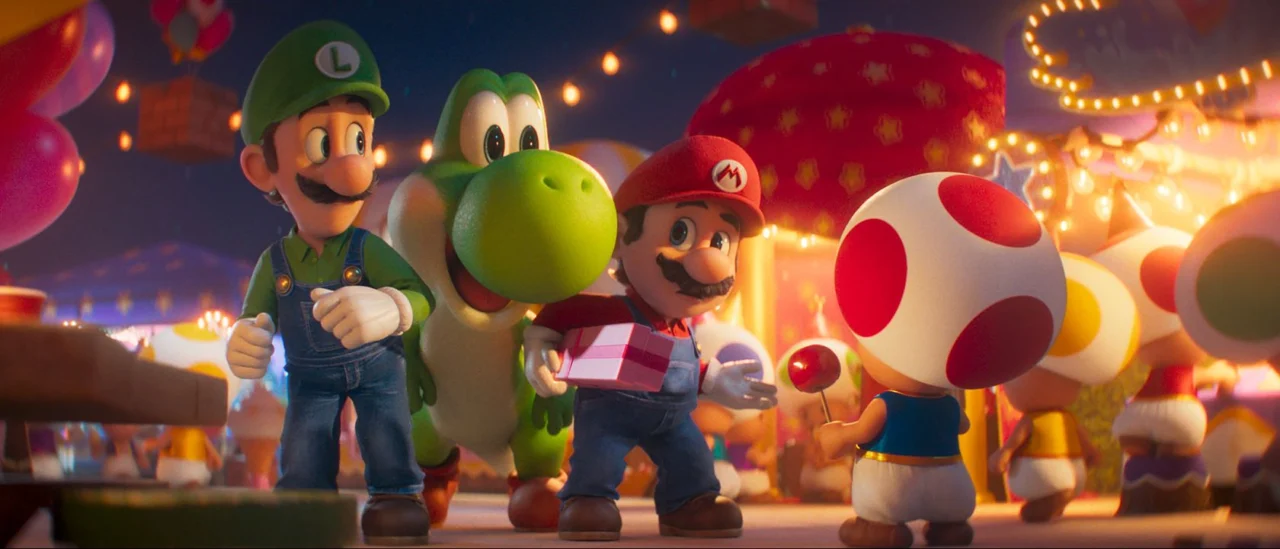
Super Mario Galaxy Movie Review: Why Nintendo Should Have Made a Star Fox Film Instead
While the Super Mario universe is celebrated for its boundless imagination and whimsical charm, complex storytelling has rarely been its primary focus. For decades, the narrative blueprint has remained remarkably consistent: Mario and Luigi, two blue-collar plumbers, navigate a surreal landscape of sentient fungi and antagonistic turtles to rescue Princess Peach from the clutches of Bowser. Historically, Nintendo has prioritized iconic imagery and inventive gameplay mechanics over profound character arcs or psychological depth.
The Super Mario Galaxy Movie

Theatrical Debut: April 3, 2023
Direction: Aaron Horvath and Michael Jelenic
Screenplay: Matthew Fogel
Cast: Chris Pratt, Charlie Day, Anya Taylor-Joy, Jack Black, Keegan-Michael Key, Brie Larson, Benny Safdie, Glen Powell, and Donald Glover
Classification: PG (Action, mild violence, and irreverent humor)
Duration: 98 minutes
In 2023’s The Super Mario Bros. Movie, the creative team—directors Aaron Horvath and Michael Jelenic alongside writer Matthew Fogel—attempted to construct a cinematic foundation where little existed. While that initial outing often felt more like a frantic collection of Easter eggs than a cohesive film, it deserves credit for establishing a functional origin story. It successfully transported the titular brothers from the gritty streets of Brooklyn to the kaleidoscopic wonders of the Mushroom Kingdom.
Unfortunately, the same cannot be said for their follow-up, The Super Mario Galaxy Movie. While the sequel manages to string together a plot and introduce fresh faces, its creative momentum stalls almost immediately. The film functions largely as a vessel for game references, moving characters from one locale to another with the sole purpose of triggering nostalgia. Aside from Jack Black’s boisterous Bowser, Anya Taylor-Joy’s capable Peach, and Benny Safdie’s debut as Bowser Jr., the characters lack genuine agency or evolving relationships. It is, in many ways, an exercise in narrative vacuum.
Picking up shortly after its predecessor, the story kicks off when Bowser Jr. arrives with a dual agenda: to abduct Princess Rosalina (Brie Larson) and liberate his father, who remains imprisoned in his shrunken state. This prompts Princess Peach and Toad (Keegan-Michael Key) to embark on a rescue mission to uncover the mystery of Rosalina’s origins. Simultaneously, Mario (Chris Pratt) and Luigi (Charlie Day) are joined by the newly introduced Yoshi (Donald Glover) as they pursue the younger Koopa, only to find themselves followed by the elder Bowser, who insists he has found redemption and merely wishes to reconcile with his son.
An Absense of Character Evolution
Critics might dismiss these complaints with the “it’s just for kids” defense, but that sentiment feels increasingly hollow in an era where studios like Pixar and Disney routinely produce sophisticated works like Hoppers or Zootopia 2. One doesn’t necessarily expect a Mario sequel to tackle heavy sociopolitical themes, but it is reasonable to expect the storytellers to offer something more than the bare minimum for their audience.
The handling of Yoshi serves as a prime example of this missed potential. Despite the high-profile casting of Donald Glover, the character is relegated to a series of chirps and familiar gameplay mechanics. Yoshi is discovered in a warp pipe, given a fleeting backstory montage, and then simply exists as a utility for the plot—laying eggs and consuming enemies on cue. Any opportunity to explore his heritage or connection to the world is bypassed in favor of maintaining a “toy-ready” status quo.
Perhaps more egregious is the stagnation of the central protagonists. Mario and Luigi are given remarkably little to do emotionally. Mario’s skepticism regarding Bowser’s reformation is surface-level at best, and Luigi’s occasional prodding for Mario to pursue a romantic interest goes nowhere. By the time the credits roll, neither brother has undergone a meaningful transformation; they are simply participants in an odyssey that lacks internal stakes.
Star Fox: A Glimmer of Interstellar Brilliance
If there is a standout element in this otherwise formulaic sequel, it is the introduction of Star Fox, voiced with charismatic bravado by Glen Powell. Fox McCloud effectively hijacks every scene he inhabits, aided by sleek ship designs and a distinct animation style that briefly breaks the film’s visual monotony. However, his inclusion is a double-edged sword; his sequences are so engaging that they leave the viewer wishing for a dedicated Star Fox feature rather than returning to the main plot.
The film does offer occasional flashes of inspiration, such as a gravity-defying battle royale involving Peach in a celestial casino and a clever homage to 8-bit era mechanics. Yet, these highlights are sporadic, separated by long stretches of narrative padding that fail to elevate the material.
Ultimately, The Super Mario Galaxy Movie feels like a product of its own commercial success. When a franchise generates over a billion dollars, there is often little incentive for radical improvement. While the film will undoubtedly satisfy those looking for a brightly colored checklist of Nintendo iconography, it remains a disappointing example of the lowest common denominator in blockbuster animation.
Related articles
 FILM.ru invites you to a preview screening of Christian Mungiu’s drama “Fjord”
 Garik Kharlamov to Play Gulliver
 Selma Blair arrested following airplane incident
 Hulu is officially working on a new X-Files series
 ‘The White Lotus’ Star Parker Posey to Lead New Blumhouse Horror Film
 Lead Actor Found for New “Intuition”
 James Franco Wears NKVD Uniform in “The Price of Confession” Trailer
 Critics praise A24’s “Crystal Lake” series