
One Piece Quietly Rewrites One of Its Most Mysterious Characters

Shanks remains one of One Piece’s most inscrutable figures despite appearing in the manga’s opening chapter. Even after more than 1,100 installments, readers are still peeling back layers of his past beyond the memorable moment with young Luffy and his episodic returns to the plot. The most recent installment leaves questions about his fidelity and true objectives lingering in the wake of new revelations.
[Ed. Note: Spoilers ahead for One Piece chapter 1167]Fans have long argued over whether Shanks is a principled mentor or a calculating enigma. He’s the pirate who inspired Luffy, who can laugh off jests yet will instantly show his strength to defend allies. At the same time, he has operated in the shadows—ending the Summit War at Marineford on a moment’s notice, later revealed to possess ties to the Celestial Dragons and a troubling family history. We now know he absconded with the Gomu Gomu no Mi from Marine custody for reasons still unrevealed, and only recently put forward a claim on the One Piece after Luffy’s devil-fruit awakening shifted the game.
Despite these insights, Shanks’ aims, loyalties, and ethical compass remain ambiguous. Creator Eiichiro Oda frequently reminds readers to distrust their first impressions. A figure resembling Shanks meeting the Five Elders in chapter 907 prompted speculation—until the appearance of a twin brother, Shamrock, clarified the situation. Oda’s storytelling consistently suggests that even the facts we take for granted may be misleading.
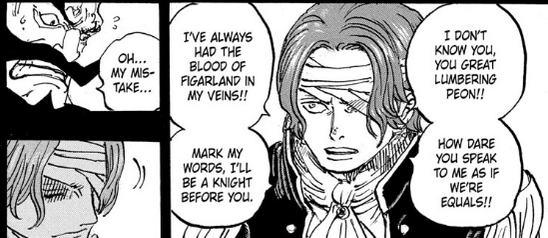 Image: Viz Media/Eiichiro Oda
Chapter 1167 finally exposes a chapter of Shanks’ life in Mary Geoise: his upbringing in the Holy Land alongside his father, Saint Garling Figarland, and his twin, Shamrock; his tenure as a Devoted Blade of God; and his apprenticeship under the God’s Knights. Though he later sailed with the Roger Pirates, this arc confirms he returned to the capital to investigate his Celestial Dragon lineage—a background that clashes with the generous, free-spirited pirate persona fans have known.
Many readers suspect Shanks’ candor is performative—part of a larger strategy to infiltrate the God’s Knights and observe the Gorosei. By the time he formed the crew that became the Red-Haired Pirates, he may already have been gathering intelligence. The chapter also clarifies that Blackbeard inflicted the scar over Shanks’ eye roughly 15 years before the current timeline.
Those Holy Land experiences appear to explain his later choices: returning to the surface, seizing the Gomu Gomu no Mi, and rising to Emperor status while biding his time to pursue the One Piece. A persuasive theory is that Shanks maintained a deliberate façade to learn hidden truths—possibly even the existence of Imu, which the chapter links to an advanced level of the God’s Knights’ “contract,” the Depths Covenant. Supporting this idea, someone who is almost certainly Shanks surfaces in the chapter saving Fisher Tiger and aiding a slave liberation—actions that complicate any simplistic moral reading.
 Image: Viz Media/Eiichiro Oda
One Piece rarely offers tidy divisions between heroism and villainy, and Shanks exemplifies that complexity. His mystique and overwhelming power are part of his allure, but what makes the character compelling is the uncertainty about his motives—why he acts, who he ultimately serves, and whether his choices will benefit or harm the world.
Consider Luffy’s reaction anytime Shanks’ integrity is questioned: it underscores Oda’s thematic focus on reputation, loyalty, and the danger of appearances. The revelation of Shanks’ lineage naturally calls his legacy into question, forcing both characters and readers to reassess long-held assumptions.
Shanks is fundamentally paradoxical: a jovial trickster who can become lethal in an instant; a top-tier Emperor commanding a modest crew and fleet; a seemingly altruistic figure who nonetheless moves through clandestine channels. Even their wardrobes signal inversion—Shamrock’s attire mirrors Shanks’ modern look, while Shanks wears clothing reminiscent of Shamrock’s Elbaph outfit—suggesting another layer of foreshadowing. As ever with Oda’s work, answers may arrive slowly, and only time will reveal the full scope of Shanks’ design.
Source: Polygon
Related articles
 Netflix and Alfonso Cuarón Developing Dungeons & Dragons Horror Series
 “Gangsterland” starring Tom Hardy renewed for a third season
 Martin McDonagh Presents “Wild Horse” Starring Malkovich and Rockwell in Venice
 Werner Herzog dedicates the film “Bad Lieutenant” to David Lynch
 First still from the film “The Luckiest Girl Alive” featuring Kate and Rooney Mara
 First still from the film “The Luckiest Girl Alive” featuring Kate and Rooney Mara released
 Friday the 13th Screenwriter Victor Miller Dies
 “Borat” screening cancelled due to racist jokes