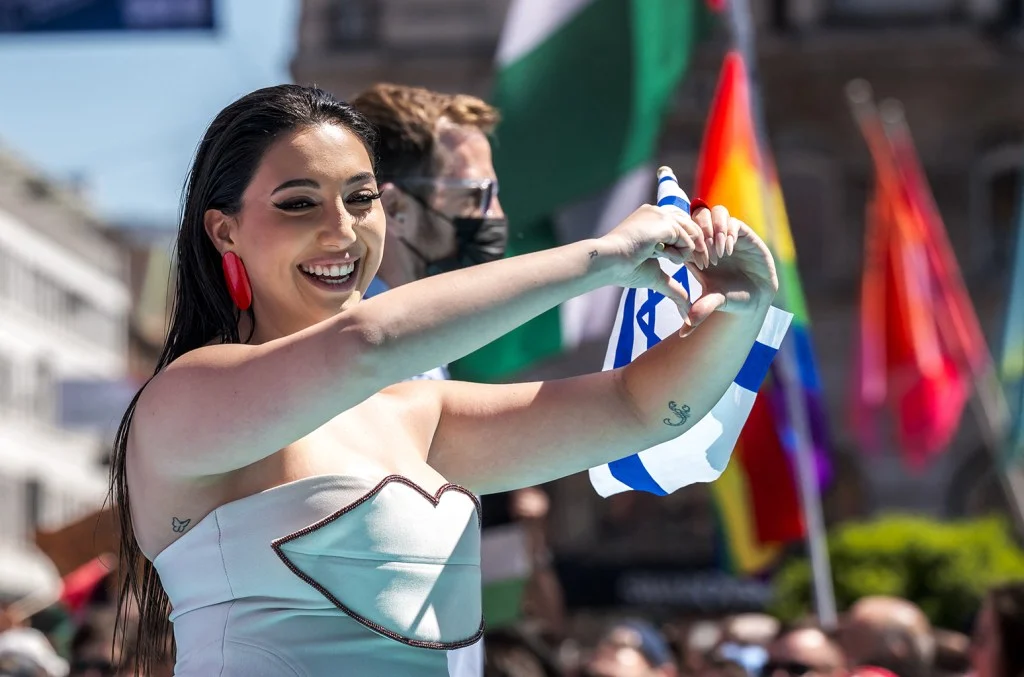
Eurovision Organizers Postpone Vote on Israel’s 2026 Participation Following Gaza Peace Deal
Eurovision Postpones Vote on Israel’s 2026 Participation Following Gaza Ceasefire Announcement
Updated: October 13, 2025

On the same day that President Trump announced an agreement intended to end the two-year war between Israel and Hamas, Eurovision organizers said they would delay a scheduled vote on proposals to exclude Israel from next year’s competition.
According to reporting by The Hollywood Reporter, members of the European Broadcasting Union (the consortium of public broadcasters that run Eurovision) had planned an emergency session in November to decide whether Israeli broadcaster KAN should be allowed to enter the 2026 contest. That vote has now been postponed and deferred to the EBU’s regular winter general assembly in December for “an open and in-person discussion.”
The decision to delay came after Tuesday’s announcement of a ceasefire and the reported return of 20 living Israeli hostages alongside the release of more than 1,000 Palestinian detainees. At the time the ceasefire was announced, it appeared to be holding.
Several member broadcasters — notably from Ireland and Spain — had called for a boycott or exclusion of Israel in protest of the Israeli military’s conduct in Gaza during the conflict. Other public broadcasters, including those in Germany and Austria, opposed a ban. Implementing an exclusion would require an “absolute majority” of EBU members, and some countries such as Ireland, the Netherlands, Slovenia and Spain have already threatened to skip the 2026 contest if Israel is allowed to participate; the BBC has not taken a formal position.
Eurovision, now in its 69th year, is among the world’s most-watched non-sport television events, renowned for flamboyant staging, striking costumes and intense regional voting patterns. The contest’s rules emphasize political neutrality: participating broadcasters are obliged to ensure their delegations do not politicize or bring the event into disrepute.
Israel has been a Eurovision participant since 1973 and has won four times: 1978 (Izhar Cohen & the Alphabeta), 1979 (Milk and Honey), 1998 (Dana International) and 2018 (Netta). The nation previously hosted the contest in 1979, 1999 and 2019.
This year’s Israeli entry, Yuval Raphael, finished as the 2025 runner-up with the uplifting ballad “New Day Will Rise.” The song’s hopeful message carried an added poignancy because Raphael is a survivor of the October 7, 2023 attack that precipitated the prolonged conflict.
Following the 2025 contest, winner JJ publicly expressed a desire to see Israel excluded from the next Eurovision, saying at the time they would prefer the 2026 edition to take place in Vienna without Israel taking part. Martin Green CBE, director of the Eurovision Song Contest, responded to Billboard by acknowledging JJ’s right to personal expression while noting the EBU’s need to consider the broader concerns surrounding the conflict.
Debate over Israel’s presence at Eurovision is not new: in 2024 more than 400 music industry figures signed an open letter urging that attempts to bar Israel be rejected. Conversely, a petition from roughly 1,000 Swedish and Finnish artists urged exclusion that year, arguing Israel’s wartime actions ran counter to Eurovision’s spirit.
The EBU’s board has now opted to move the matter to the December assembly for face-to-face deliberation. Meanwhile, Vienna remains scheduled to host Eurovision next year.
For additional context, see the original reporting by The Hollywood Reporter.

Related articles
 Channing Tatum Denies Using Instagram Burner Account to Troll Ex Zoë Kravitz and Harry Styles
 Taylor Swift Announces New Single Patient Zero
 MAGA Festival Featuring Kid Rock Canceled After Selling 6 VIP Tickets
 Bunnie Xo Defends Dating Man 22 Years Younger Following Split From Jelly Roll
 Taylor Swift Updates Website With New Countdown After Dropping Cryptic Clues
 Lionel Richie Undergoes Heart Procedure and Cancels Three Upcoming Shows
 Travis Kelce Calls Taylor Swift Wearing a Gun on Her Waist in Law & Order Emmys Skit Kinda Hot
 Hayden Panettiere’s Cause of Death Revealed