
Developer’s Diary: Historical Japan
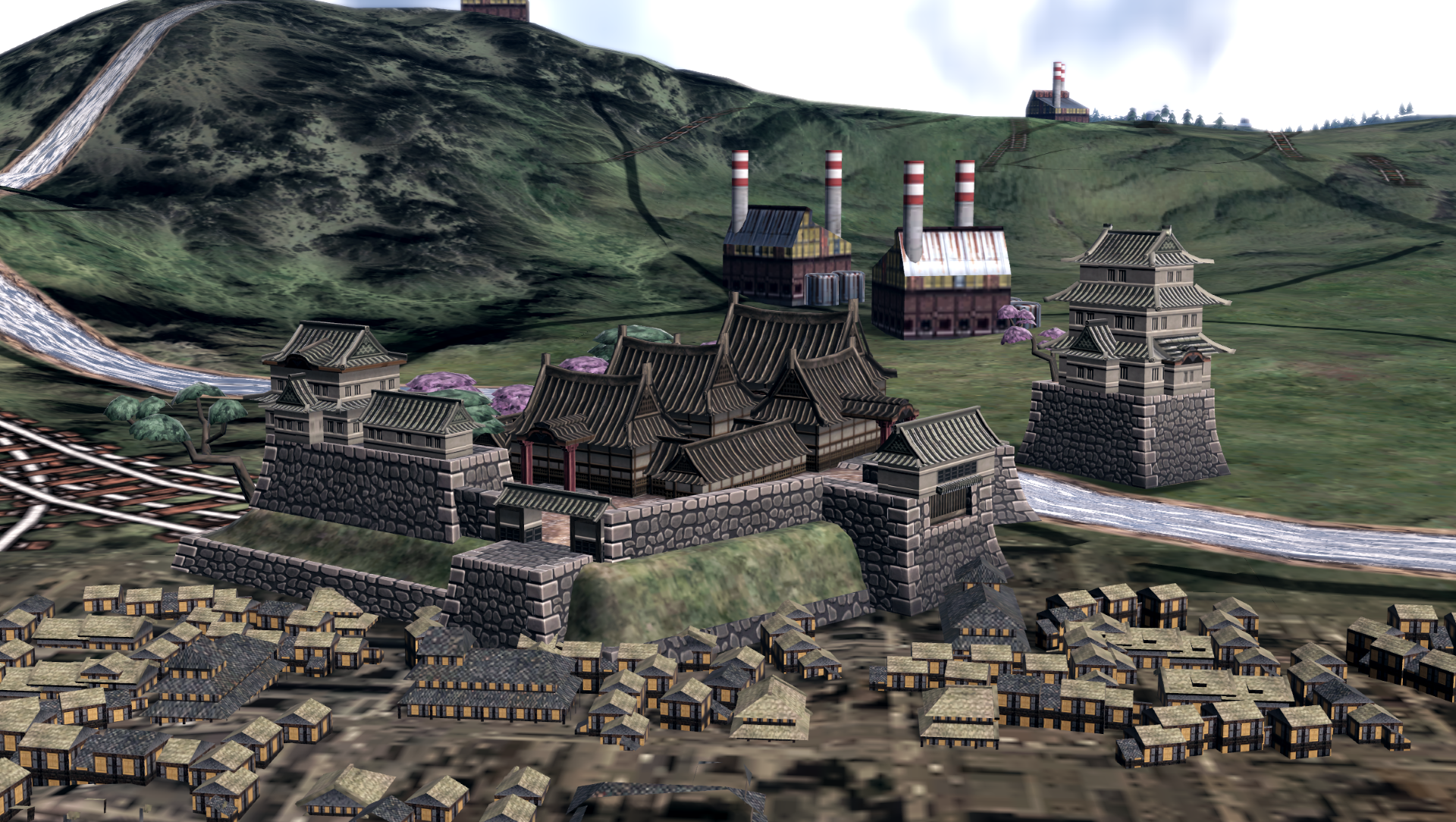
Kon’nichiwa — welcome to Japan’s dedicated Development Diary. I’m PDX_Danne, joined by D3vil, and today we’ll explore the historical Japan content coming in the No Compromise, No Surrender DLC. We touched on some of these mechanics in our Dev Corner, but here we’ll go deeper into the design choices and how they reflect the 1936 situation.
Historical Recap
To understand our design choices, it helps to review Japan’s state in early 1936. Despite siding with the Allies in World War I and gaining territorial concessions in the Pacific, Japan felt marginalized by the Western great powers. Coupled with the belief that wars required total mobilization and the nation’s severe shortage of natural resources, militarism took root and intensified through the 1930s. This escalation culminated in the Manchurian invasion of 1931 and, a few years later, the larger conflict with China in 1937—an escalation driven in part by military initiatives that civilian governments struggled to restrain. Army and navy commanders often pressured, undermined, and even assassinated civilian leaders when military aims conflicted with civilian policy, producing a chaotic political landscape. That same rivalry between services produced poor coordination and competition for scarce resources, which in turn shaped Japan’s strategic limitations in the decades to follow.
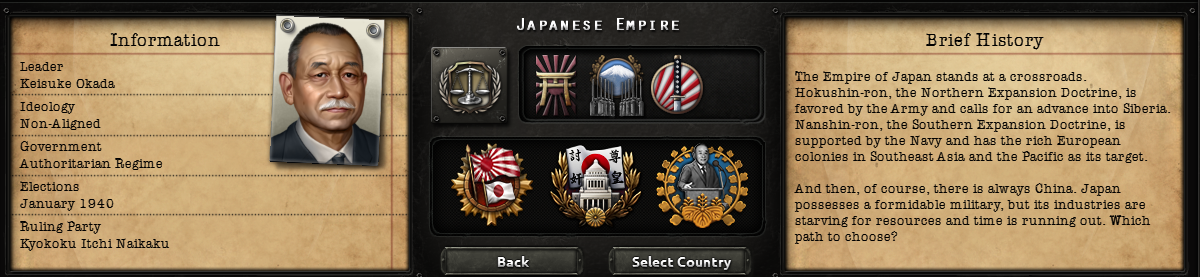
New additions: expanded Focus Tree, fresh National Spirits, a new country leader option, and a changed starting ideology.
Let’s examine what those additions mean.
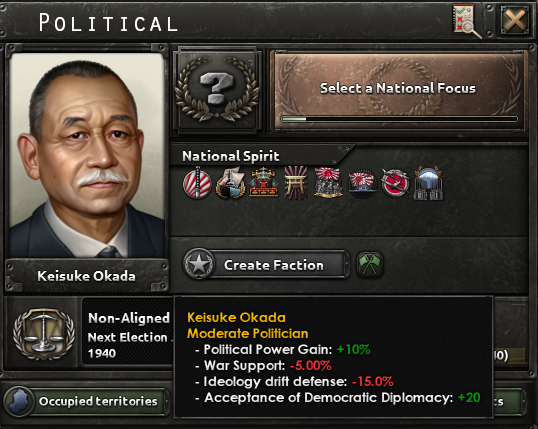
The political situation in Japan, 1936
Japan now begins the 1936 bookmark as Non-aligned, reflecting the nation’s fragile democracy and the rapid drift toward authoritarianism that follows in the opening months and years. We debated starting Japan as Democratic and transitioning to Non-aligned or Fascist as the tree progressed, but that provided little mechanical benefit. Instead, Japan will adopt fascism as its ruling ideology when a one-party state consolidates in the early 1940s.
National Spirits and Doctrinal Splits
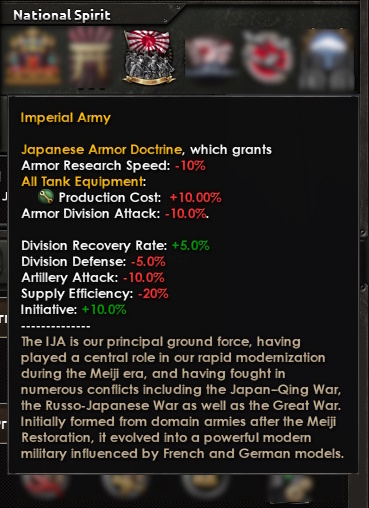
The Imperial Army National Spirit is presented in two parts: an armor-specific entry, the Japanese Armor Doctrine, and a set of broader army modifiers. This split—enabled by last year’s Götterdämmerung DLC—lets us separate armor-related bonuses and penalties from general land force traits. Historically, Japanese tanks lagged behind Western designs in armor, firepower, and technology; tactically, their forces prioritized surprise, rapid offensives, and an aversion to retreat. Logistics, both on land and at sea, remained a chronic weakness, which helps explain why Japanese forces eventually became bogged down during the China campaign.
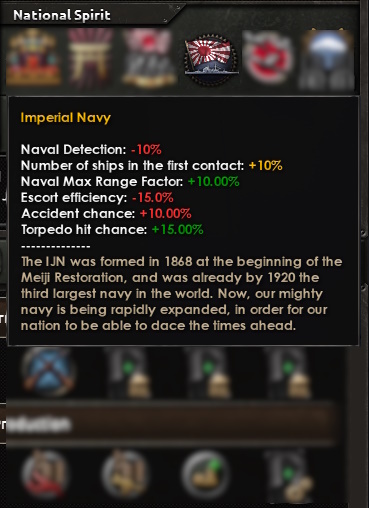
The naval doctrine centers on Kantai Kessen, the decisive battle concept, which emphasized winning one climactic fleet engagement. That doctrine shaped ship design—prioritizing big guns and punchy armament—often at the cost of stability and convoy protection. Japan excelled at torpedoes and carrier aviation early on, but anti-submarine capability and convoy defense were persistent shortcomings.
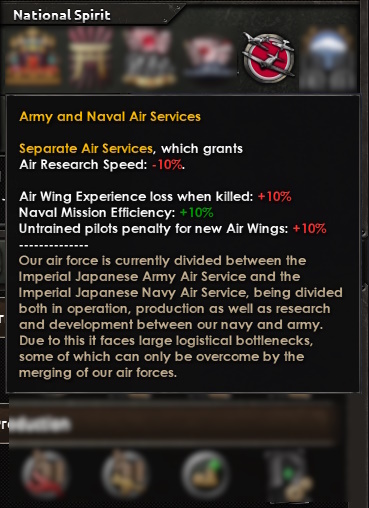
Japan historically operated separate army and navy air services, jealously guarding their technologies. In-game, we consolidate them into a single National Spirit—Army and Naval Air Services—but still present the division via a research penalty for Separate Air Services plus distinct air modifiers. Japan starts with strong carrier aviation but suffers in pilot replacement due to demanding training, which later degrades the quality of aircrews when losses mount.
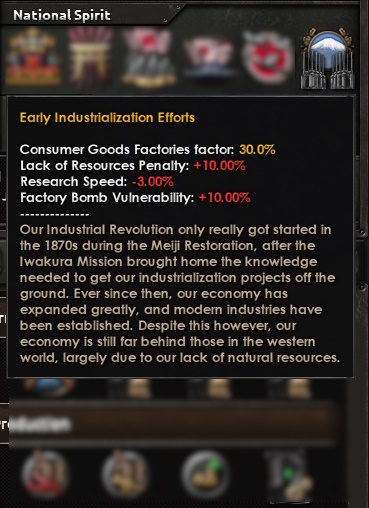
Japan industrialized rapidly in the late 19th and early 20th centuries, yet never matched the great powers’ industrial base. The home islands’ lack of critical resources drove imperial ambitions—securing raw materials became a central strategic imperative.
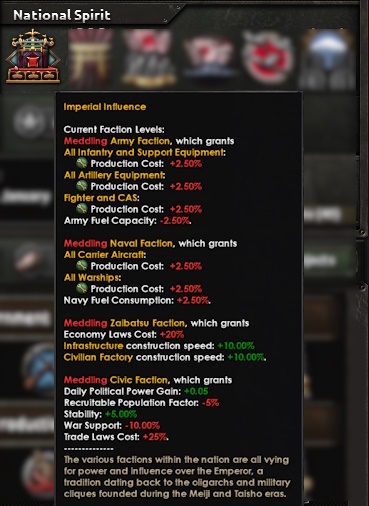
Political infighting and unchecked military influence defined this era. To represent those tensions we created the Imperial Influence mechanic: army and navy factions compete for scarce resources and influence. If one faction dominates, it gains production advantages while the rival faces higher production costs. Two other groups—the industrial Zaibatsu and the civilian government—also vie for the Emperor’s favor.
Why not use a standard Balance of Power mechanic between services? Balance of Power simulates rivalry well, but it’s limited to purely inter-service competition. We wanted to express the tangled political reality—military factions, industrial conglomerates, and civilian authorities—so we combined these interactions into a single, central system placed prominently within the Focus Tree.
Imperial Influence
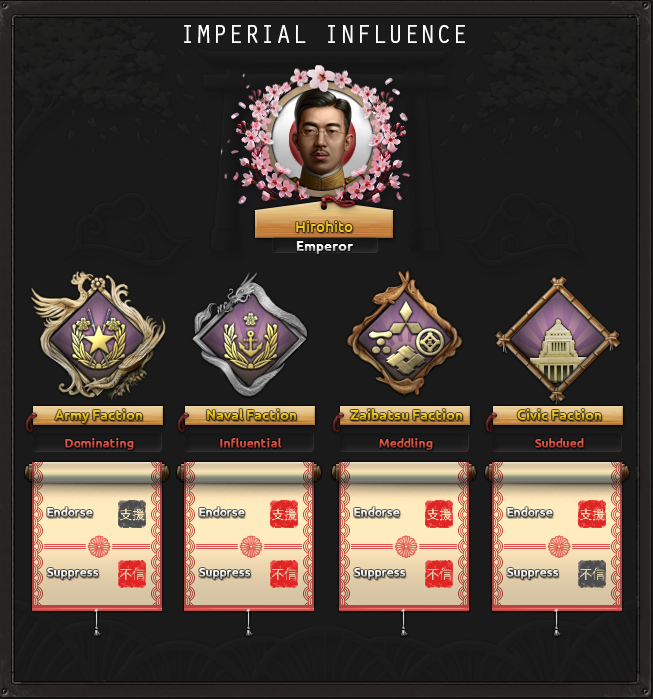
The four stages of influence.
Each faction can be elevated or suppressed, and their standing provides tangible benefits. Influence has four tiers: Subdued, Meddling, Influential, and Dominating. Only one faction can be Dominating at a time, and at most two can be Influential simultaneously. When you bolster a faction you gain targeted bonuses—Army and Navy factions reduce production costs for their respective equipment; Zaibatsu support accelerates civilian factory and infrastructure construction; the Civic faction boosts Political Power gain and lowers Trade Law change costs.
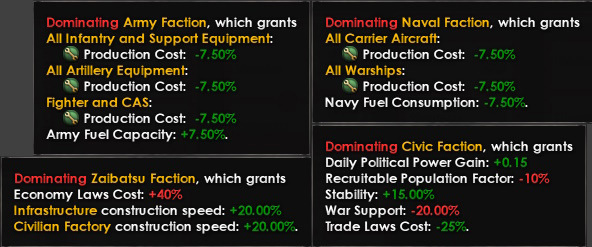
Army and Navy influence directly counterbalance one another: parity causes small production penalties for both, while a clear advantage gives the leading faction production discounts and imposes heavier penalties on its rival. This lets you pursue a playstyle that shifts over time—support the Army early to mass infantry and artillery for China, then pivot to the Navy to build a fleet capable of contesting the Allies.
Influence affects which Focuses you can select and can modify the rewards from certain branches. You raise or lower faction standing by completing Focuses or spending Political Power to Endorse or Suppress factions through the Imperial Influence panel.
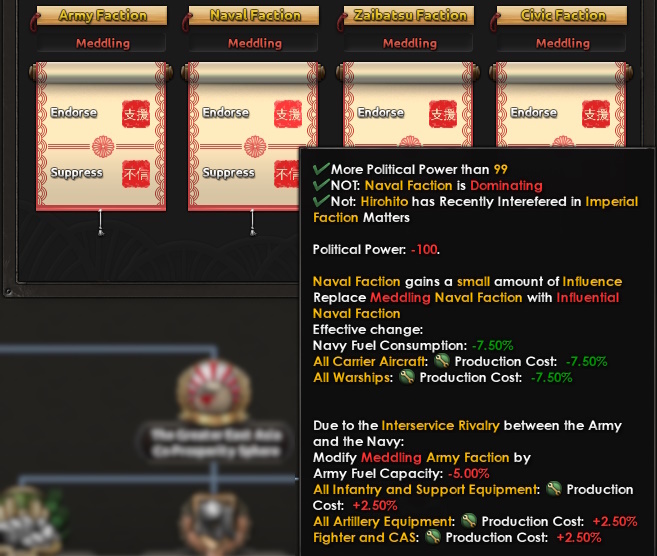
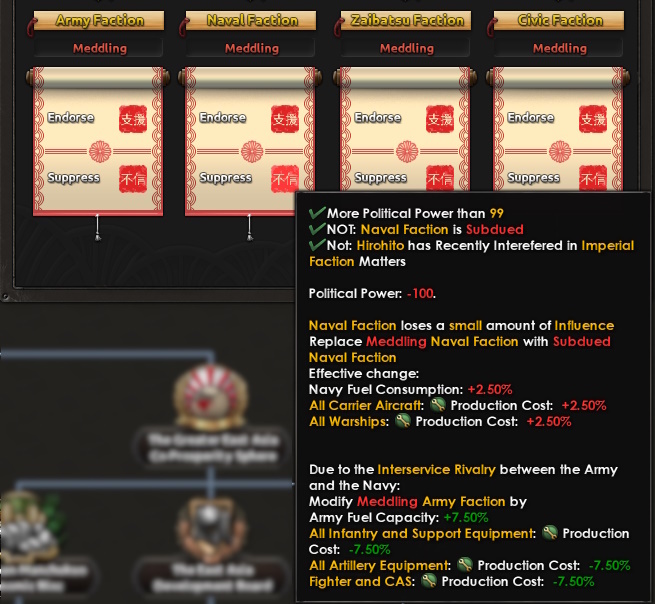
When factions become sufficiently influential they issue Demands. Fulfilling a Demand increases their influence; failing reduces it. Players familiar with historical Italy’s “Missiolinis” will recognize the same concept here.
With Imperial Influence explained, let’s move into the Focus Tree itself.
Industry
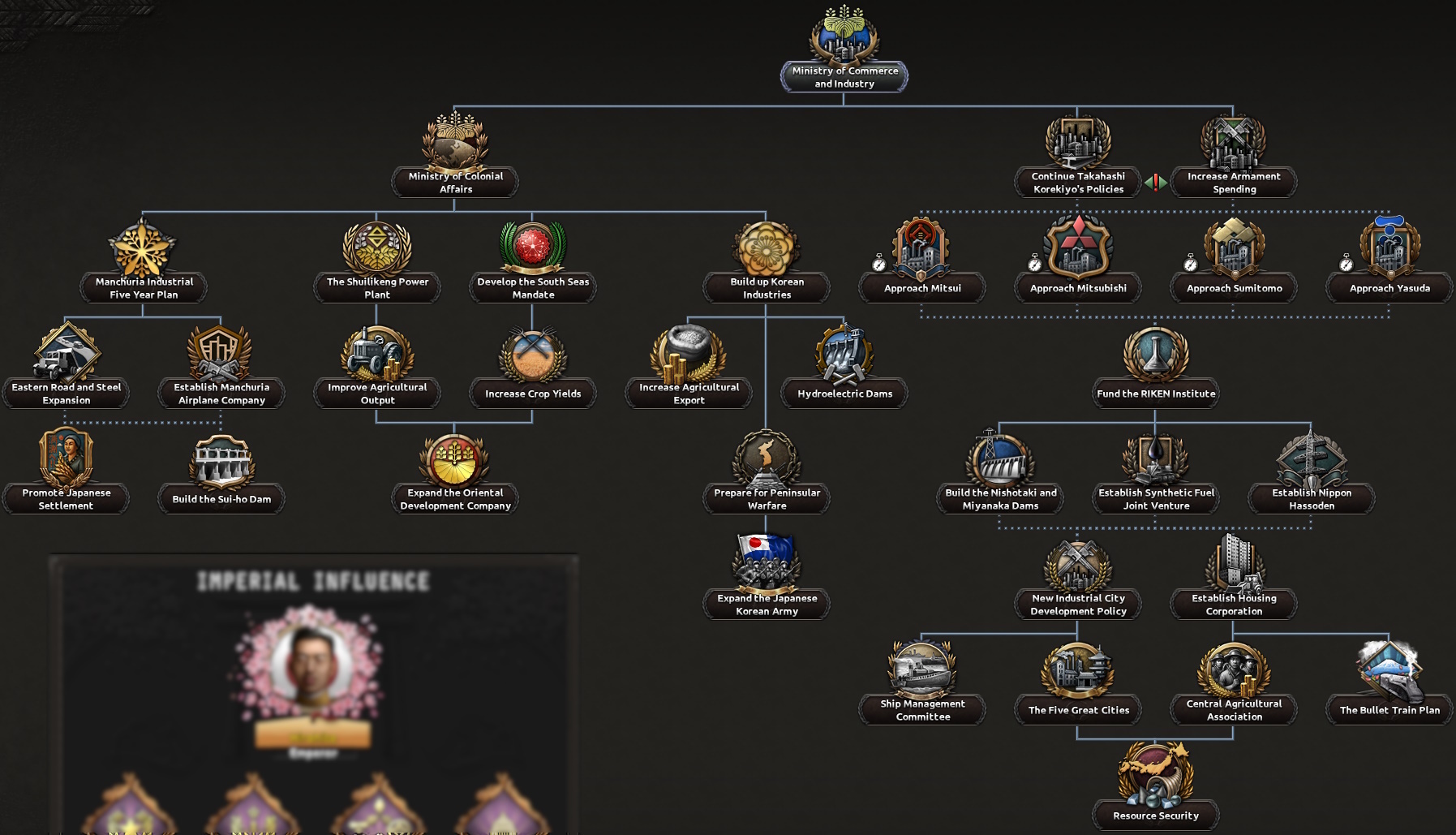
Japan’s industrial branch.
You can concentrate on exploiting colonial resources and puppet territories, or strengthen the home islands’ economy. The Ministry of Colonial Affairs sub-branch lets you invest in Manchukuo and Pacific colonies—adding civilian and military factories, dams, infrastructure, and resource prospecting while improving your domestic economy.
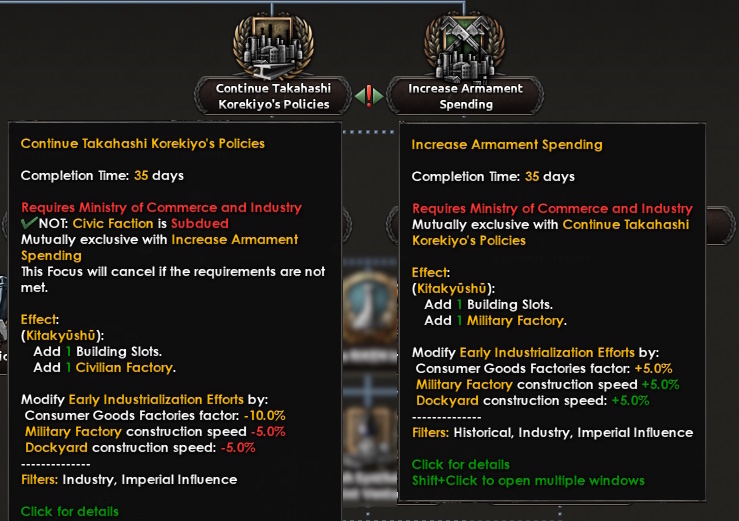
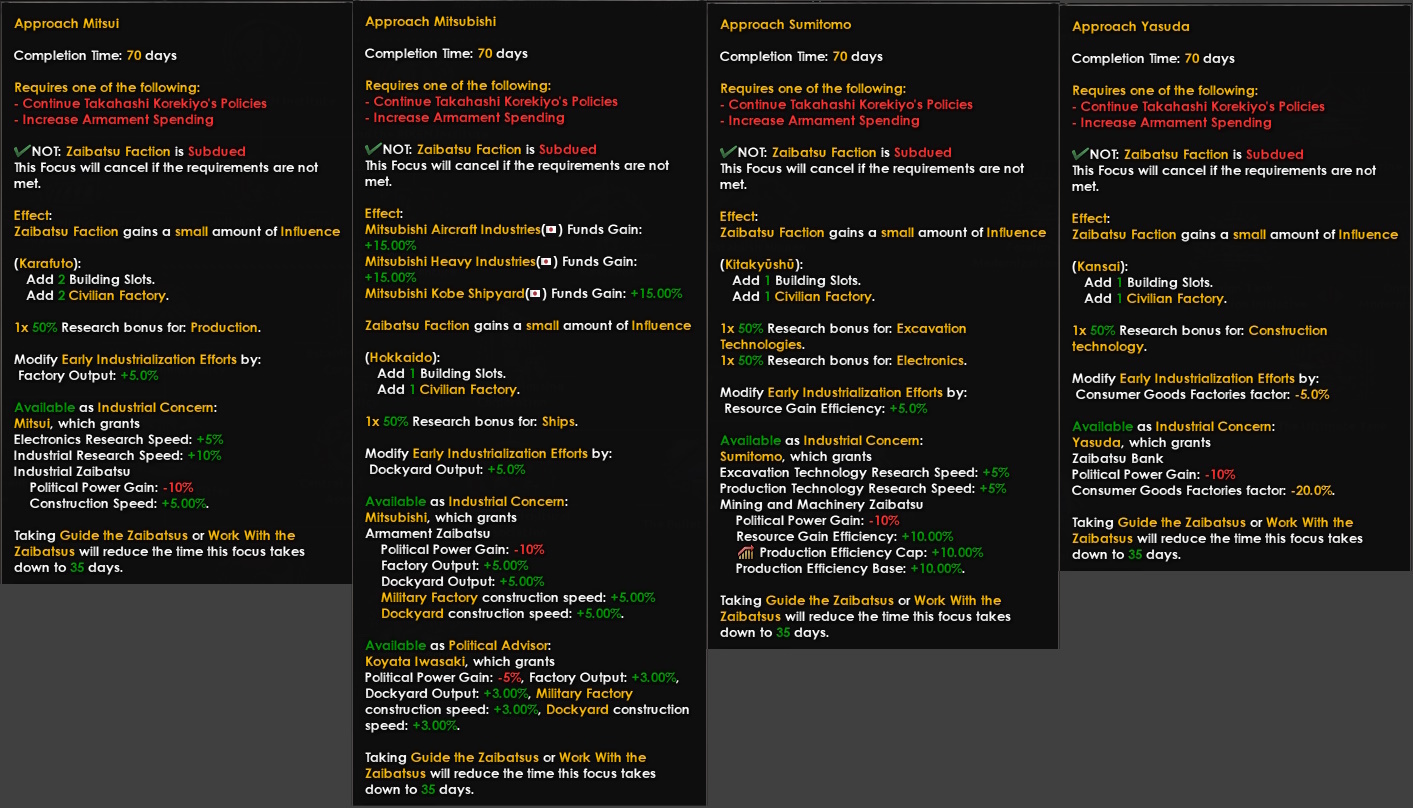
For the home islands you’ll choose between policies like continuing Takahashi Korekiyo’s economic approach or increasing armament spending. You can then court one or more of the major Zaibatsu industrial conglomerates—each unlocking at least one new Industrial Concern.
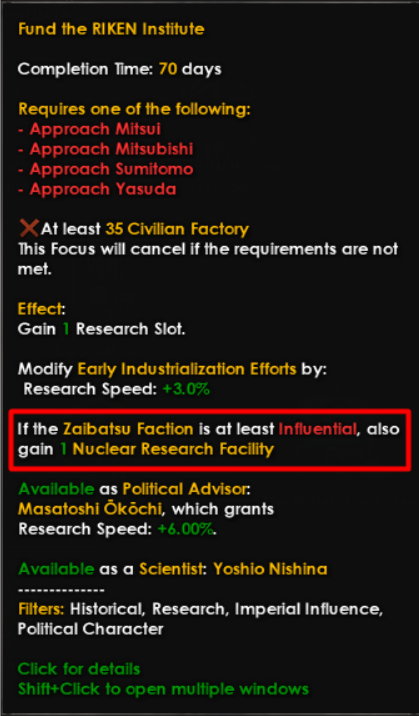
Funding the RIKEN Institute can, if the Zaibatsu faction is sufficiently influential, unlock a Nuclear Research Facility—an advanced industrial boon.
The final branch focus, Resource Security, transforms your Early Industrialization Efforts into The Economic Miracle, but meeting that milestone requires substantial prerequisites.
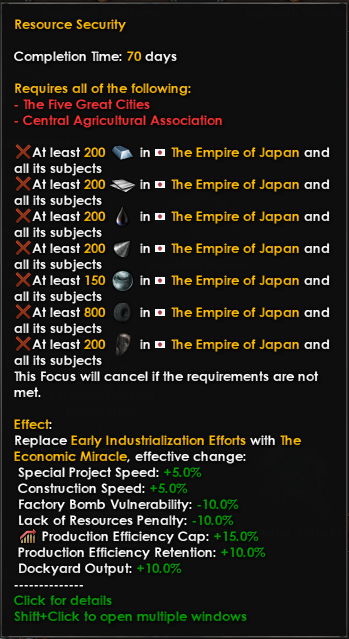
We also added several new Industrial Concerns and MIOs—small previews are available in the tree—which expand your production and logistical options. Strong industry is the backbone of any prolonged conflict, so these choices matter.
Military
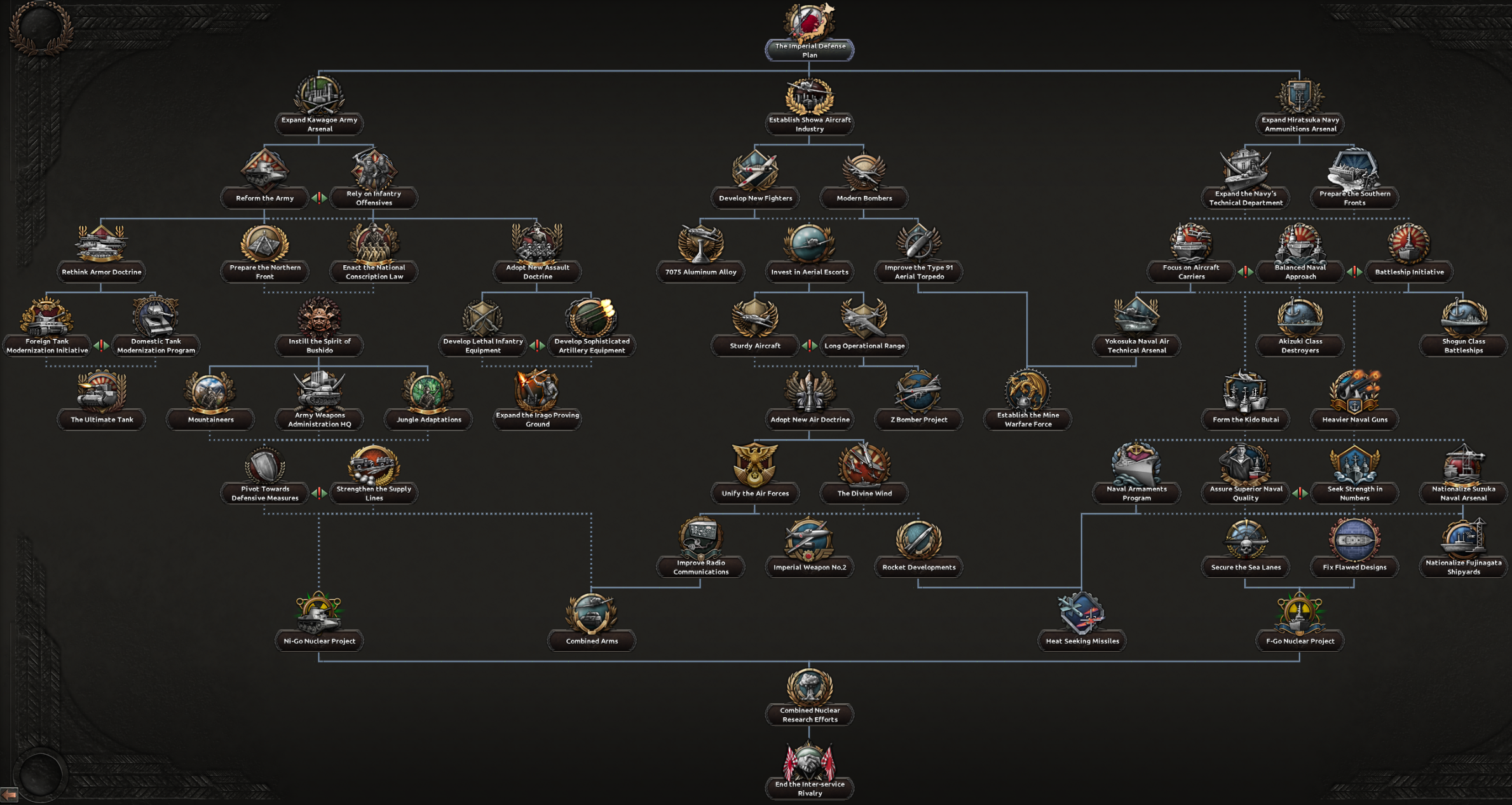
Japan’s armed forces prioritized rapid, decisive strikes. The tree’s common military root is The Imperial Defense Plan, which grants National Spirits when you declare wars that meet specific objectives. From there you diverge into the ground, air, and naval branches.
Army
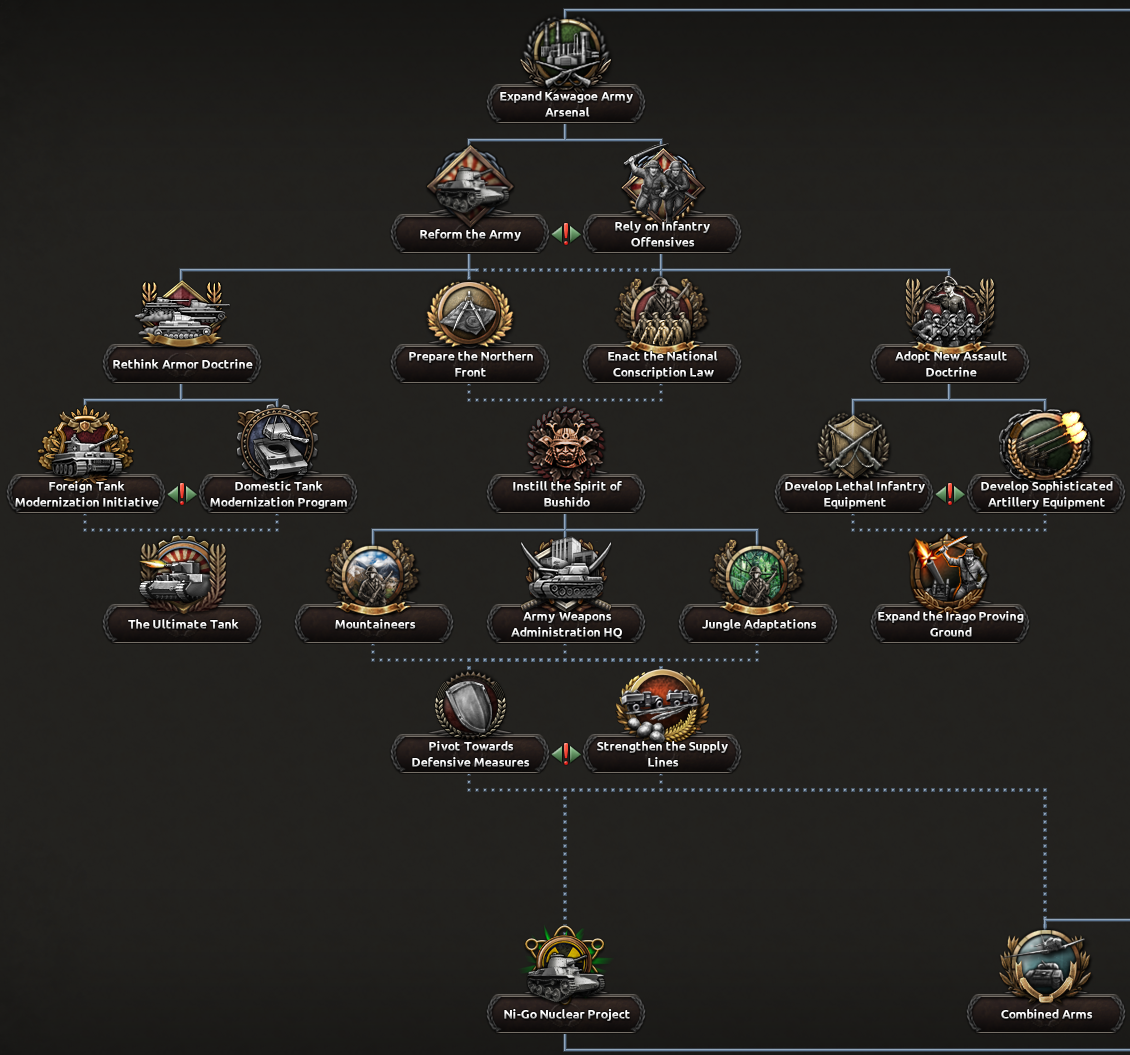
Early in the Army branch you must decide whether to emphasize armored forces with Reform the Army or to double down on infantry and combined arms through Infantry Offensives. Each path tunes your research and equipment priorities toward tanks or infantry and artillery respectively.
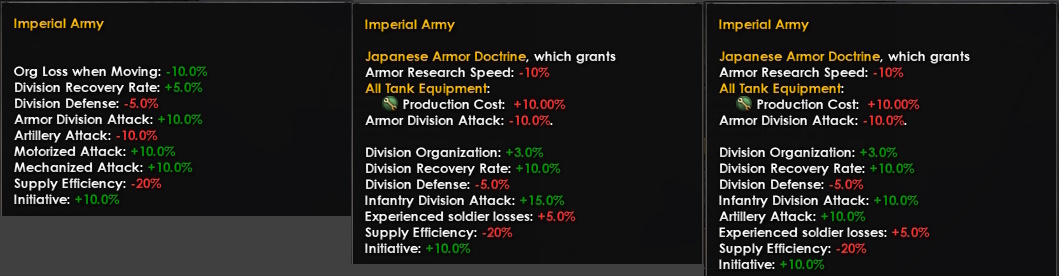
Imperial Army National Spirit variants after specialization in tanks, infantry, or artillery.
Bushido’s cultural influence is modeled by the Instill the Spirit of Bushido focus, which rallies troops and unlocks the Grand Banzai Charge tactic. Later choices include whether to Pivot Towards Defensive Measures or to Strengthen the Supply Lines, reflecting strategic trade-offs depending on how campaigns unfold.
Air Force
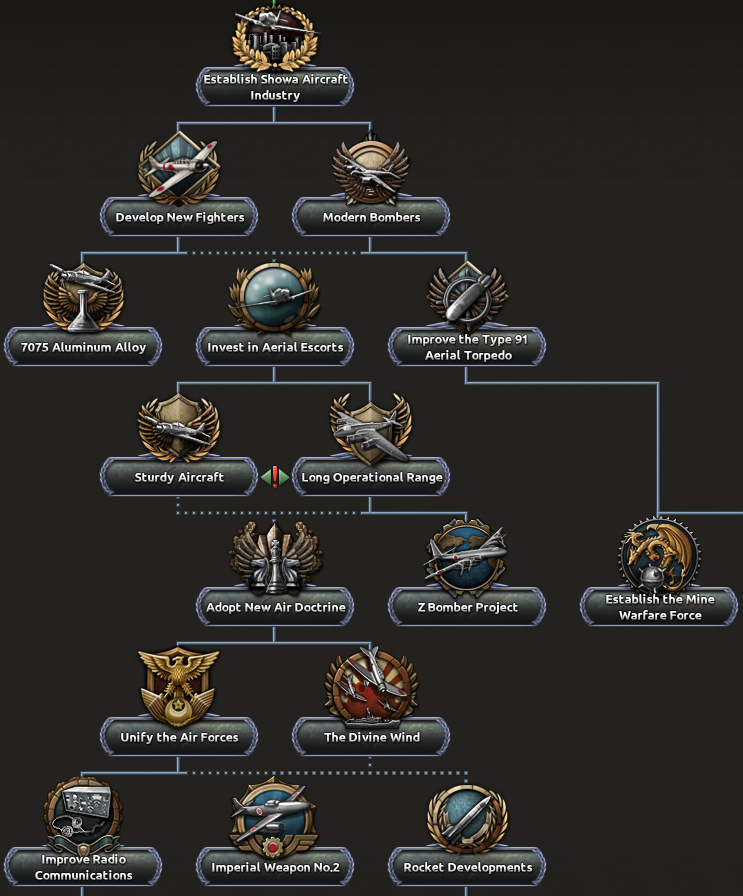
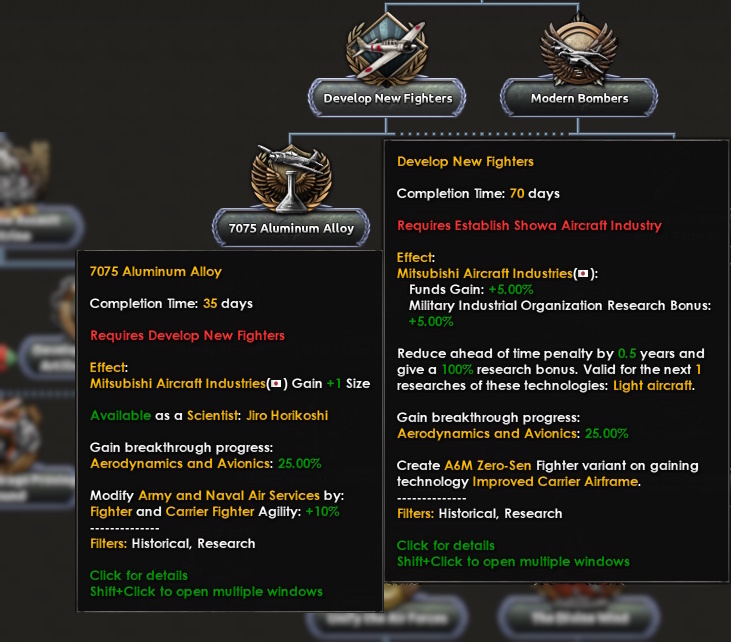
Japan players no longer must pick a single direction between historic aircraft choices. In the combined Army and Naval Air Service branch you can develop the Zero through Develop New Fighters and refine it with technologies such as the 7075 Aluminum Alloy. For ground campaigns in China, investing in modern bombers increases your operational reach and exploitation of air superiority.
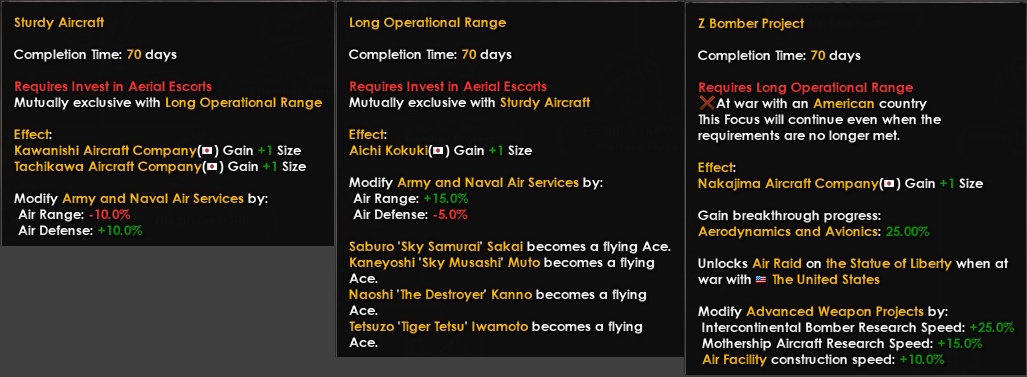
The tree also enables preparations for strikes like Pearl Harbor via Type 91 Aerial Torpedo improvements tailored for shallow harbors. In wartime you can fund aerial escorts and choose between tougher, shorter-range designs or lighter, long-range airframes—paving the way toward projects such as the Z Bomber, a strategic bomber program analogous to Germany’s Amerikabomber.
Ultimately, you can Unify the Air Forces, consolidating organization and eliminating penalties from divided command.
Navy
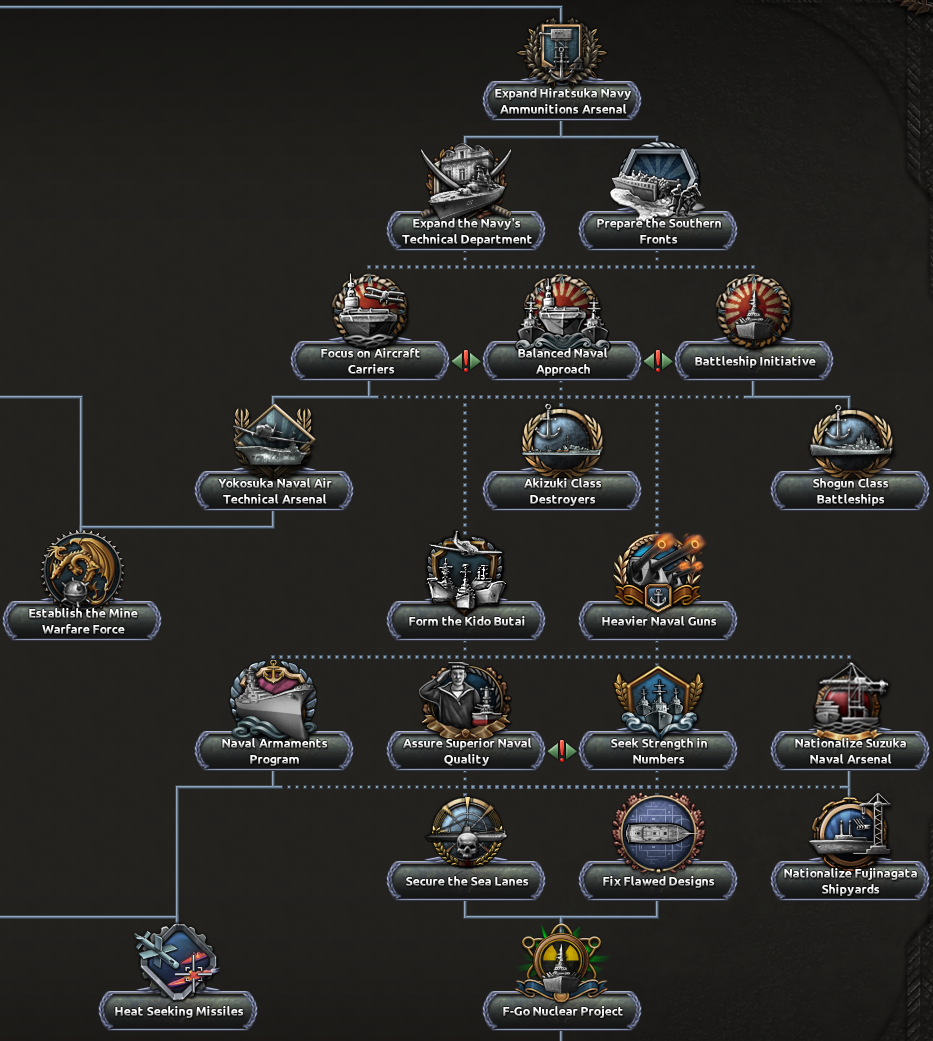
The naval branch begins with options such as expanding the Navy’s Technical Department for research bonuses and Prepare the Southern Fronts—which improves amphibious operations for South East Asia campaigns. Then comes a strategic fork: emphasize Aircraft Carriers, pursue a Balanced Naval Approach, or invest in a Battleship Initiative. Each choice unlocks different follow-up focuses and equipment rewards.
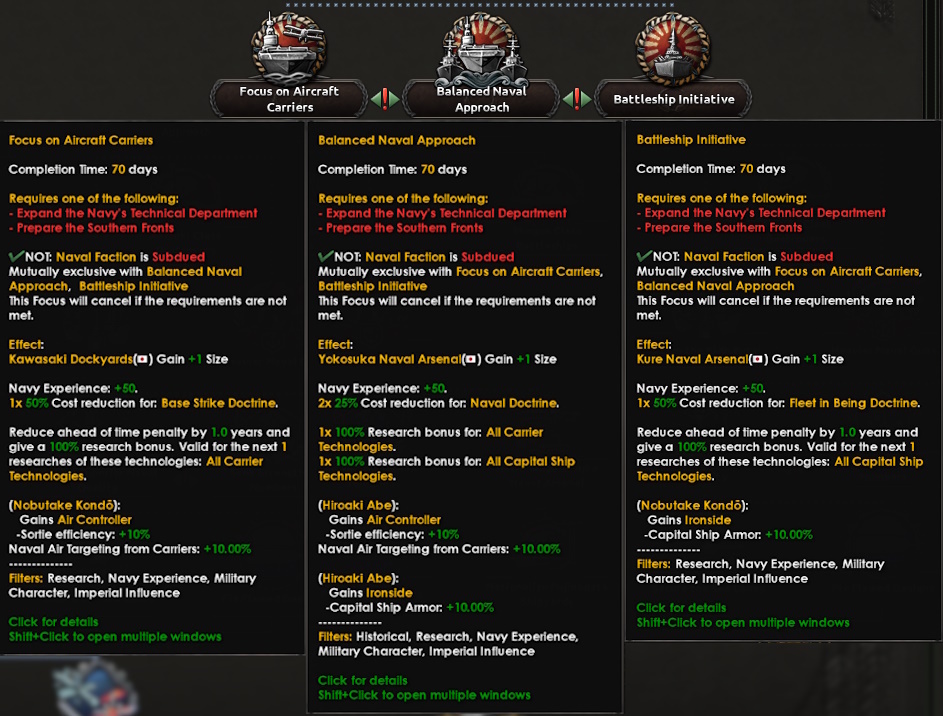
The Naval Armaments Program yields different bonuses depending on your chosen naval doctrine, allowing you to shape fleet composition and priorities to fit your strategic aims.
With the common branches covered, we’ll now turn to Japan’s political paths.
Historical Political Path
Hi, D3vil here to walk through the historical political branches. All Japanese political routes begin with the Kodoha preparing an attempted coup d’état to overthrow what they perceive as a decadent government and restore traditional order. One of their leaders must be released from house arrest during trial, giving you a short buffer to prepare.
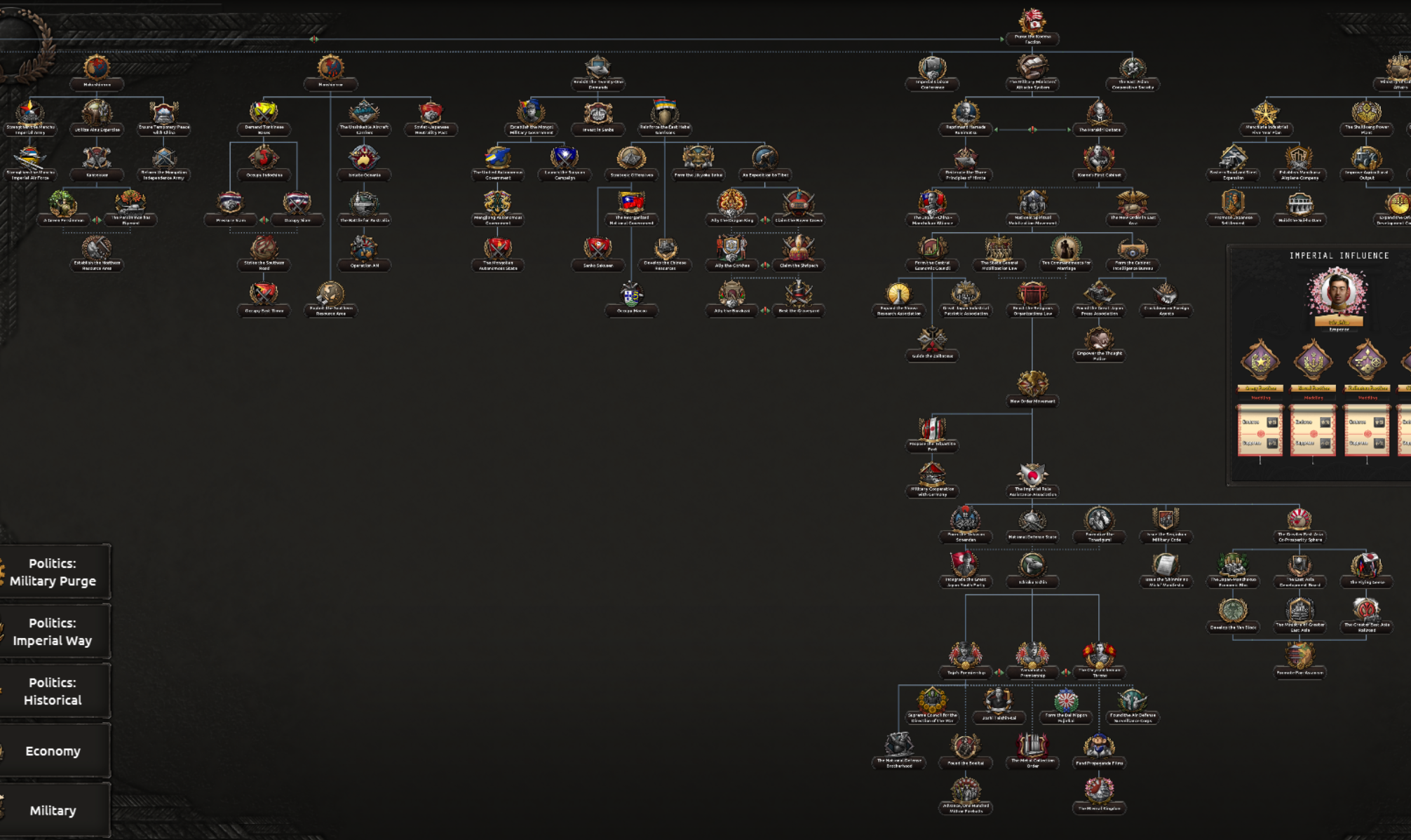
When the coup triggers, your chosen outcome automatically completes the first mutually exclusive political focus and steers you down one of the locked branches: historical, Kodoha, or anti-military (which can later become democratic or communist). Choosing a military crackdown on the Kodoha leads into the historical path.
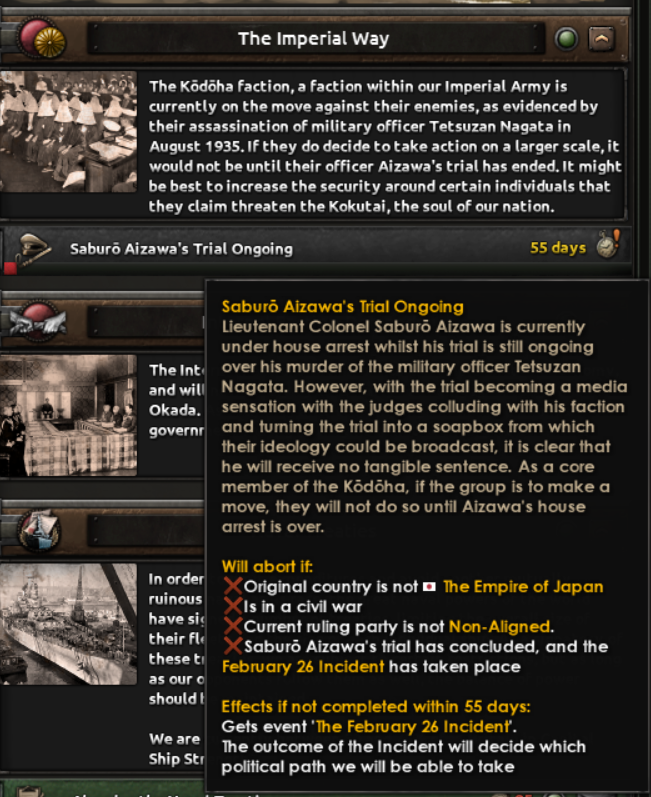
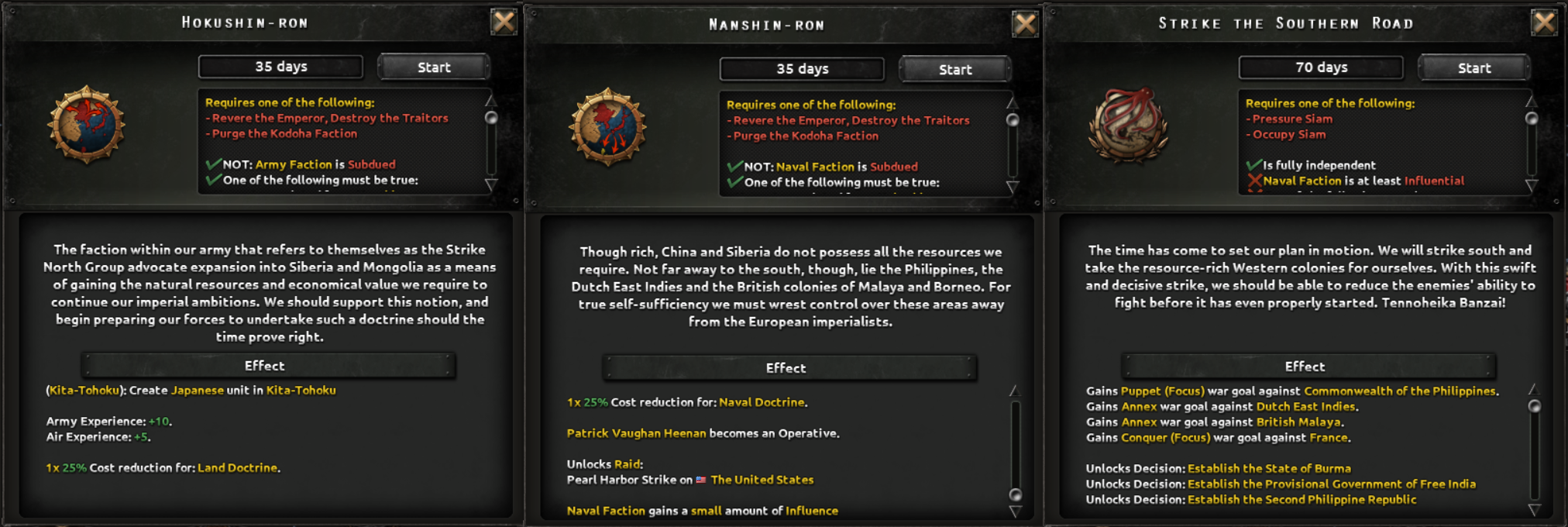
The historical political tree shares a foreign policy branch with the Kodoha path. That branch splits into three sub-branches focusing on northern expansion, southern expansion, and western/China affairs. Strike north and strike south are no longer strictly exclusive; they have timing and faction-influence requirements, and they open up dynamic operations—such as conducting a raid against the US base at Pearl Harbor.
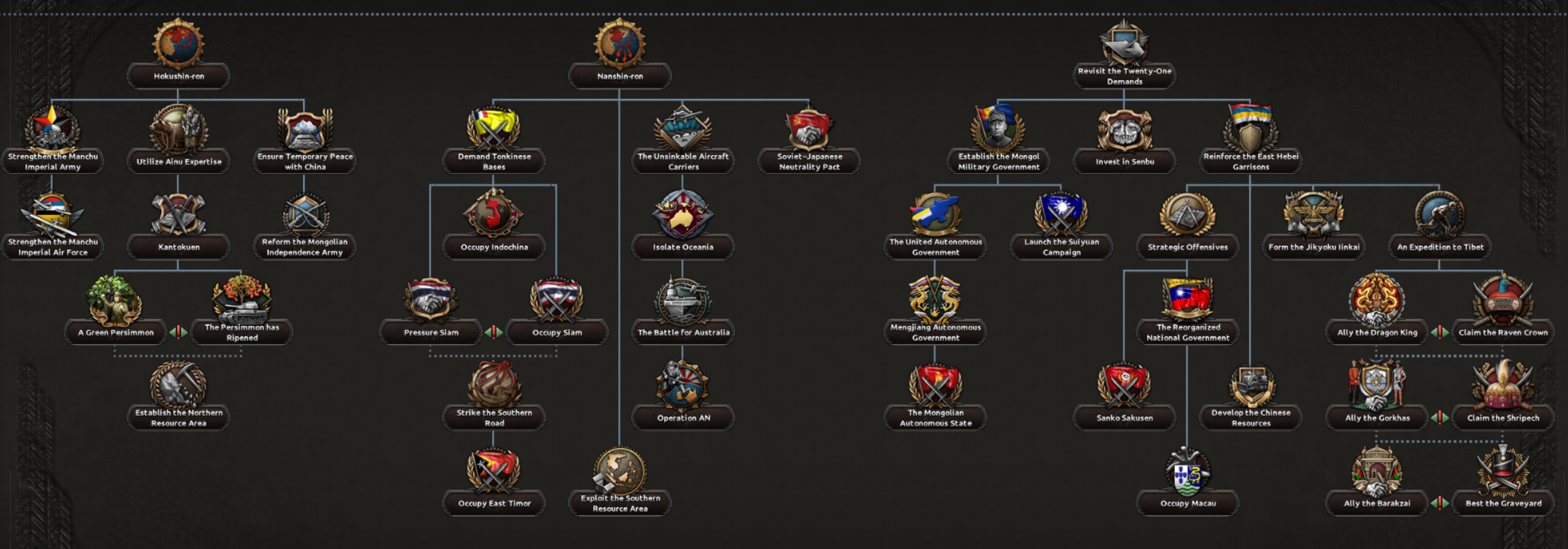
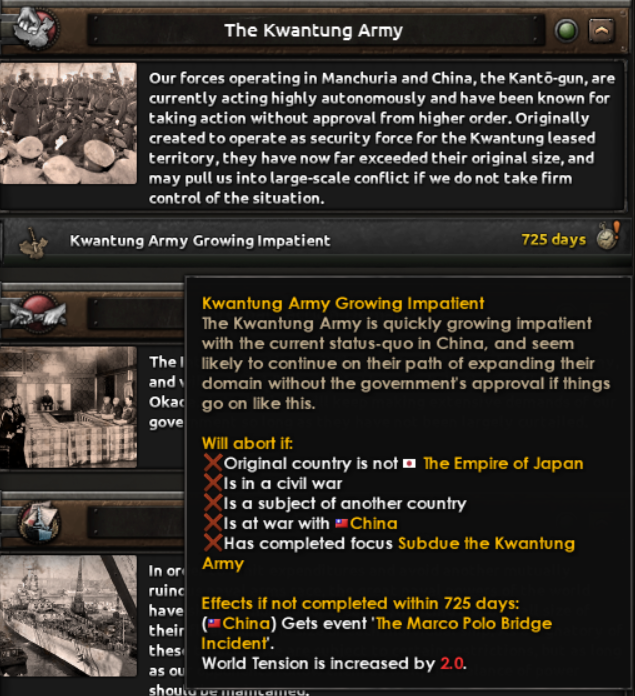
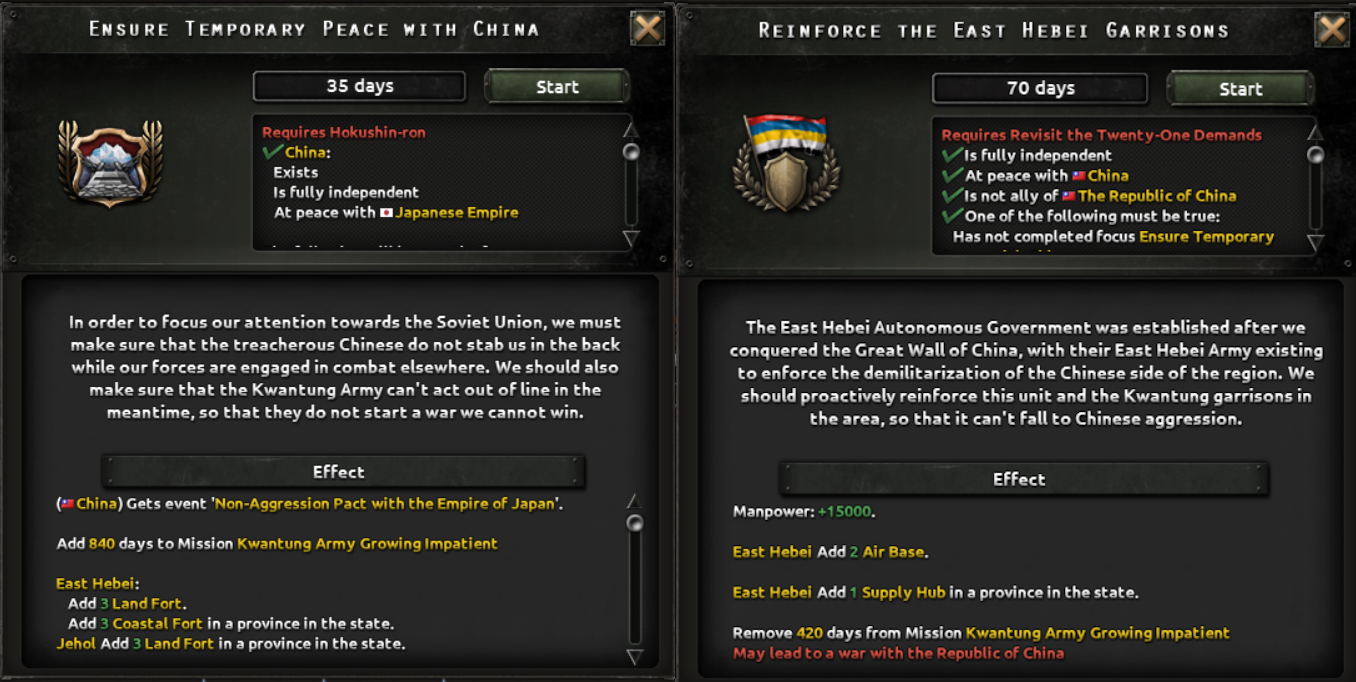
The Kwantung Army remains a wildcard: depending on your chosen sub-branch, it may precipitate conflict with China regardless of your immediate plans. Historical Japan cannot completely avoid intervention in China; you can delay or hasten that intervention through certain focuses or by strengthening local garrisons.
Focuses exist that either accelerate or delay the timing of intervention—seeking temporary truces or reinforcing East Hebei, for example—so you can influence when the Kwantung Army acts.
Beyond China, these branches permit coercion and occupation strategies across Asia and enable alternative approaches to conquest and administration.
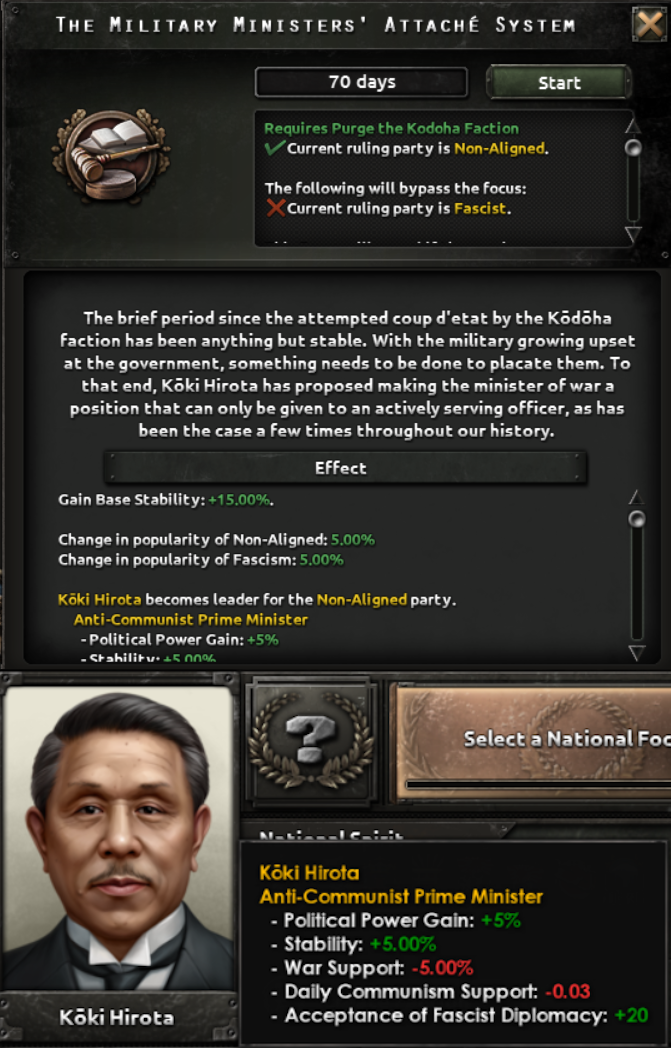
The internal politics branch models Japan’s turbulent leadership changes. Some historical prime ministers appear as country leaders and the Emperor is represented in a separate role; we omitted certain historical figures to streamline gameplay and focus on consequential choices. For instance, when Okada steps down historically, Hirota reintroduces the military minister attache system—an action that influences subsequent political developments.
Early political turmoil gives civilian ministers an opportunity to resist military domination. Players can choose to back the civilian cabinet—appointing Ugaki as a successor—or follow the historical route and empower the military, leading to Senjuro Hayashi’s short-lived cabinet and a rapid drift toward authoritarianism.
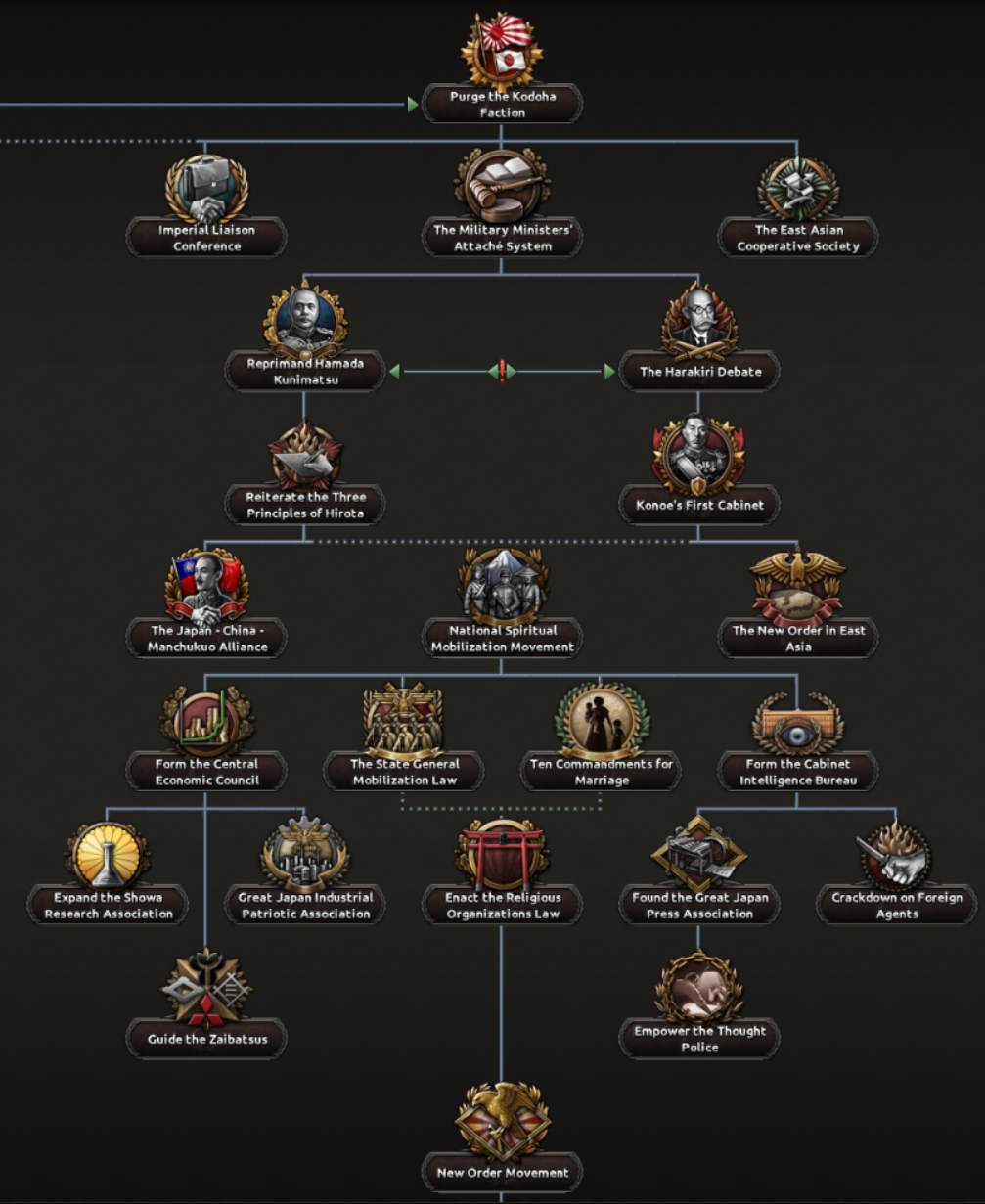
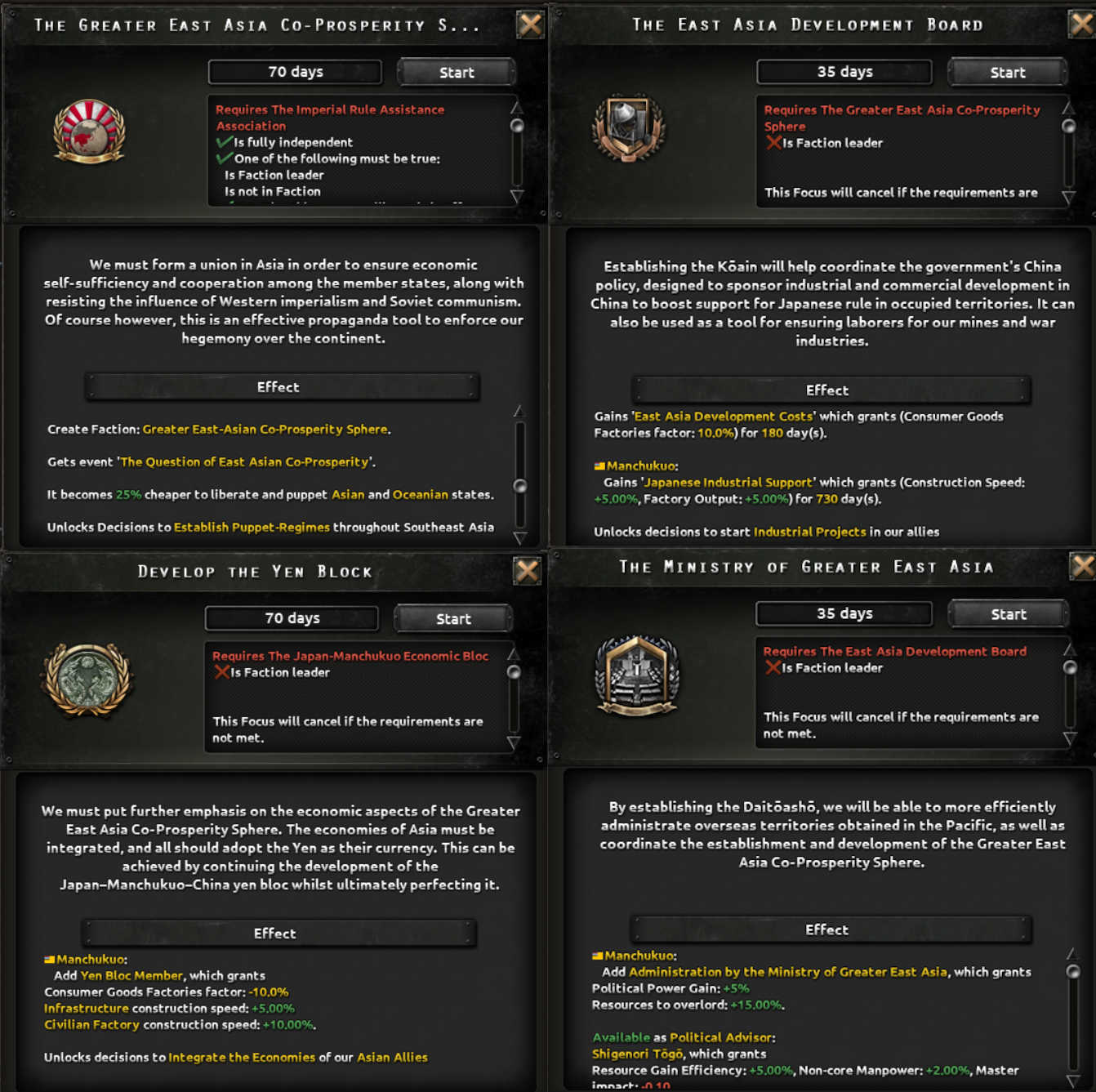
This stage also introduces factions that later evolve into the Greater East Asian Co-Prosperity Sphere (GEACPS) subbranch should you adopt the totalitarian route and sign the Tripartite Pact with Germany and Italy. That path unlocks development and exploitation options for newly acquired Asian territories.
Toward the late-game you face a pivotal decision about national leadership: depending on faction strength you may select Tojo or Yamamoto, or have the Emperor take direct control through the Taisei Yokusankai. The bottom of the tree focuses on mobilizing resources, propaganda, and steering wartime production and morale.
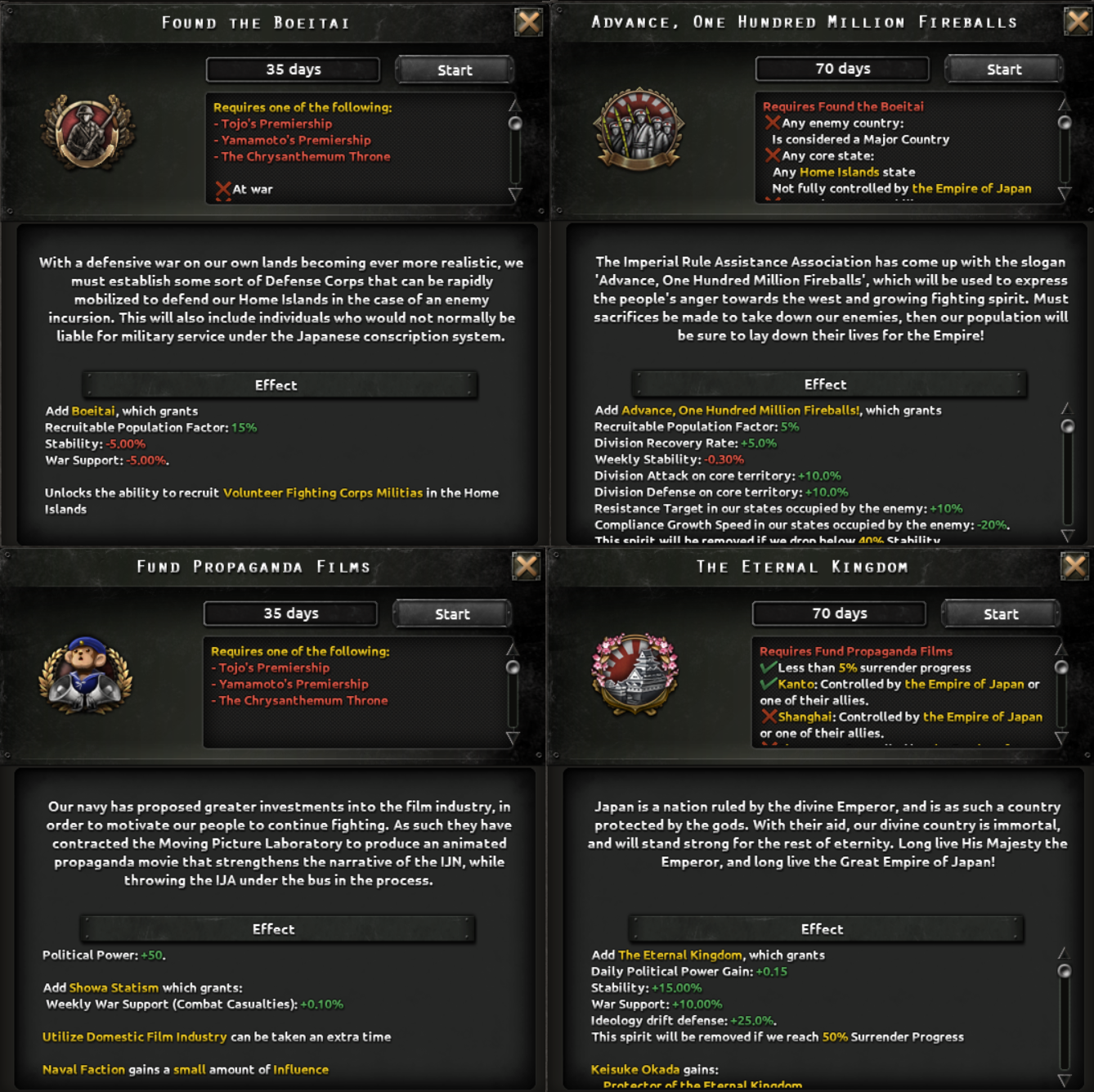
Depending on how your wars proceed, you may either proclaim a lasting empire or struggle to prevent the state’s disintegration.
That concludes the historical branch preview. Thank you for the feedback in our Dev Corners—stay tuned for the alternate-history section in the coming weeks.
Related articles
 HOI IV Developer Diary | Romania: A Flawed Democracy
 Developer Corner & Open Beta: Energy #2
 Hearts of Iron IV Dev Corner | Strikes!
 Hearts of Iron IV Dev Corner: Old Canada Questions Before New Canada
 Hearts of Iron IV Dev Corner | Energy
 Steam Autumn Sale 2026
 HOI IV Dev Corner | The Great Depression
 Hearts of Iron IV | Patch 1.19.3