Thirty Years Later, I Still Own the Mew From My Ultimate ’90s Pokémon Battle
For a specific generation of millennials, the late nineties were defined by a singular ritual: the mid-winter family pilgrimage to Disney World. By 1999, these excursions weren’t just about theme parks; they were defined by the hours I spent hunched over my Game Boy. Even now, I find myself reflexively packing a Nintendo Switch for every trip, despite the reality that parenting two young daughters leaves virtually no window for gaming. Back then, Pokémon wasn’t merely a pastime; it was a comprehensive lifestyle. As the franchise’s 30th anniversary approaches, I feel like that iconic Saving Private Ryan meme—rapidly aging into a relic of a bygone era. It sends my mind racing back to the height of the craze, when a chance encounter at 30,000 feet led to the most high-stakes battle of my youth.
My exact entry point into the phenomenon is a bit hazy, but I remember the anime’s U.S. debut in September 1998. In a household equipped with multiple VCRs and my father’s oversized camcorder, I became a self-appointed archivist. I obsessively recorded every episode onto blank VHS tapes, treating the series like a historical record that needed preservation. I rarely actually rewatched them—I’ve always had a low tolerance for repetition—but the act of collecting them felt vital. Those tapes survive today as a magnetic mess of non-sequential episodes and childhood nostalgia.

Pokémon Red and Blue arrived shortly after the show, and I was among the first in my social circle to dive in. I likely received my copy for Christmas that year, and I remember the agonizing weight of choosing a starter. I had my heart set on Pokémon Red because of the dragon on the cover, but since it was sold out, I “settled” for Pokémon Blue. Succumbing to box-art marketing, I chose Squirtle, chasing the dream of eventually owning a Blastoise.
By the time the trading card game launched in early 1999, I was a key figure in a clandestine playground society. Our school had banned Pokémon because it was a “distraction,” so we staged a quiet revolution. During recess, we’d retreat to the bushes to admire holographic cards and link up for battles. I was too risk-averse to trade my cards—terrified of making a bad deal—but I earned a reputation as a formidable tactician. I became the unofficial “gym leader” of Halliwell Memorial, offering advice and assembling a party that felt unbeatable.

Gaming was always my primary obsession. My most cherished memory occurred during a family trip to Disney World around the turn of the millennium. We flew out of T.F. Green International Airport in Rhode Island—a smaller, more manageable alternative to Boston’s Logan. Throughout the terminal, I was on autopilot, following my parents with my eyes glued to a screen. I was either wielding my red Game Boy Pocket or my yellow Special Edition Game Boy Color, both kept in a dedicated shoulder bag along with my essential Link Cable.

By this time, I had already conquered the Elite Four. I vividly remember my Moltres securing a narrow victory against the Champion’s Venusaur while the rest of my team lay fainted. In an era before online meta-guides, I obsessively studied elemental match-ups, favoring high-speed sweepers with diverse move sets. I entered the Indigo Plateau under-leveled, but my tactical focus saw me through on the first attempt.
While I had captured 150 species and essentially “platinumed” the game, Mew remained my white whale. As a compulsive rule-follower, I refused to use a GameShark to cheat, and I wasn’t allowed to attend official Nintendo events. Like every other kid, I spent hours attempting to use Strength on that mythical truck near the S.S. Anne, hoping the playground legends were true.
With no challenges left in Pokémon Blue, I turned to the “MissingNo.” glitch on Cinnabar Island to duplicate Rare Candies. I spent my time in a brainless loop, force-feeding my collection until every Pokémon reached level 100. I was the strongest trainer I knew, but I was desperately bored, having already crushed every NPC in Kanto.

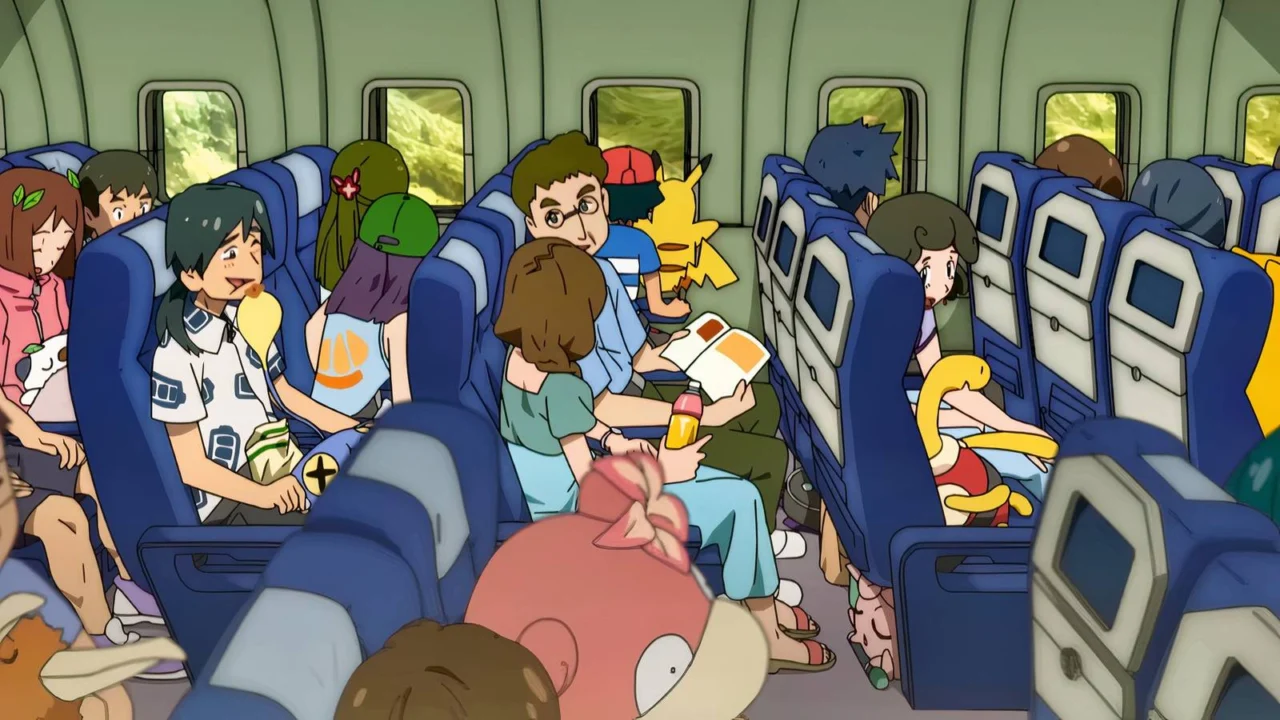
As I sat in seat 24B, the game’s chiptune score blasting through my headphones, a tap on the shoulder startled me. A boy about a year older than me—let’s call him Red—was holding up his own console. Our fathers quickly swapped seats so we could sit together. We compared notes on our starters and philosophies. When I proudly stated that I never used legendaries because it felt like a crutch, Red chuckled. “I have a Mew,” he said. “If you can beat me, it’s yours.”
Red challenged me further, asking if I knew the Link Cable “cloning” glitch. I was insulted—of course I did! And so, high above the East Coast, I entered the most pivotal battle of my childhood. My squad included my trusty Blastoise, a high-speed Jolteon, and a Tauros. My legendary Moltres had been replaced by a fierce Arcanine. The match was grueling. Red even laughed at my Blastoise’s move set—I had stubbornly kept Bubblebeam long after I should have upgraded to Surf—but I eventually secured the win.
Red was the rival I’d always wanted: skilled, but humble in defeat. He admitted he was more of a collector than a battler. True to his word, he initiated a trade—his Mew for my sacrificial Caterpie—and we timed the Link Cable disconnect perfectly. Just like that, my Pokédex was complete.
 Image: The Pokémon Company
We crossed paths again on the return flight, spending hours testing custom rules and level caps. We never exchanged contact info; we were just two trainers sharing a moment in time. Today, I find the modern entries in the series somewhat stagnant—Black 2 was the last one that truly captured me—but that childhood memory remains untarnished.
Holding my old hardware now, I’m struck by how small and clunky it feels. The screen is dim, and the interface is antiquated. Yet, as I navigate to Bill’s PC and scroll to Box 9, the Mew is still there. At level 100, with over a million experience points, it knows Psychic and Metronome. And sure enough, the original trainer is listed as Ben—a digital ghost of a stranger from a flight twenty-five years ago.
Source: Polygon
Related articles
 Sony Pulls Its Last UHD Blu-ray Player From Sale in Japan
 Players Launch Petition Hoping to Save Mass Effect 5
 Assassin’s Creed Black Flag Resynced Developers Confirm New Mode
 Best Visions to Use in Final Fantasy Resonance
 Activision’s Polish Studio Reportedly Developing Open-World RPG to Rival GTA VI and Cyberpunk 2077
 The 25 Best Switch 2 Games
 Amazon’s Mass Effect TV Series Reportedly Still in Production Despite BioWare Closure
 Shadow of the Tomb Raider Unexpectedly Launches on Switch 2, Making Full Trilogy Available