
The Year’s Biggest Anime Movie Event Is More Than Just a Sci-Fi Spectacle

Mecha anime existed long before the advent of Mobile Suit Gundam, yet few franchises have ever navigated the complex interplay of geopolitics and mechanized warfare with such depth. Since its 1979 debut, the series has anchored the genre, establishing the expansive Universal Century (UC) timeline—a future defined by the perpetual, ruinous conflict between the Earth Federation and Zeon space colonies. These unresolved tensions serve as the bedrock for the latest chapter in the saga, Mobile Suit Gundam Hathaway.
Five years have passed since the original film, and the highly anticipated sequel, The Sorcery of Nymph Circe, has finally arrived. Under the returning direction of Shukou Murase and the production team at Sunrise, this second installment of the planned trilogy elevates the material significantly. It masterfully weaves contemporary political anxieties into the narrative while delivering some of the most visceral and breathtaking aerial combat the franchise has showcased in years.
The story seamlessly picks up where it left off, deepening our exploration of Hathaway Noa’s duality. Now fully entrenched in his role as “Mafty,” the leader of an anti-Federation insurgency, Hathaway is no longer merely struggling with his identity; he is actively becoming the symbol of rebellion. The Sorcery of Nymph Circe meticulously examines the heavy toll that such a radical commitment demands.
Staying true to the predecessor’s ethos, Murase avoids traditional hero-versus-villain tropes, instead operating in a morally gray territory where intentions are often eclipsed by disastrous consequences. The conflict between Mafty and the Earth Federation is presented as a clash of deeply flawed ideologies, devoid of any obvious moral superiority. Hathaway’s insurgent campaign is painted as a volatile mix of genuine political grievance and reckless terrorism, while the Federation is shown to be just as fractured and corrupt as the dissent it violently attempts to quell.
This sequel amplifies that unease. While the first film pondered whether systemic rot could be purged through violence, The Sorcery of Nymph Circe interrogates the aftermath of that decision—and the possibility of living with one’s choices. This thematic tension is embodied by the return of key figures like the relentless Federation officer Kenneth Sleg and the enigmatic, precognitive Gigi Andalucia.
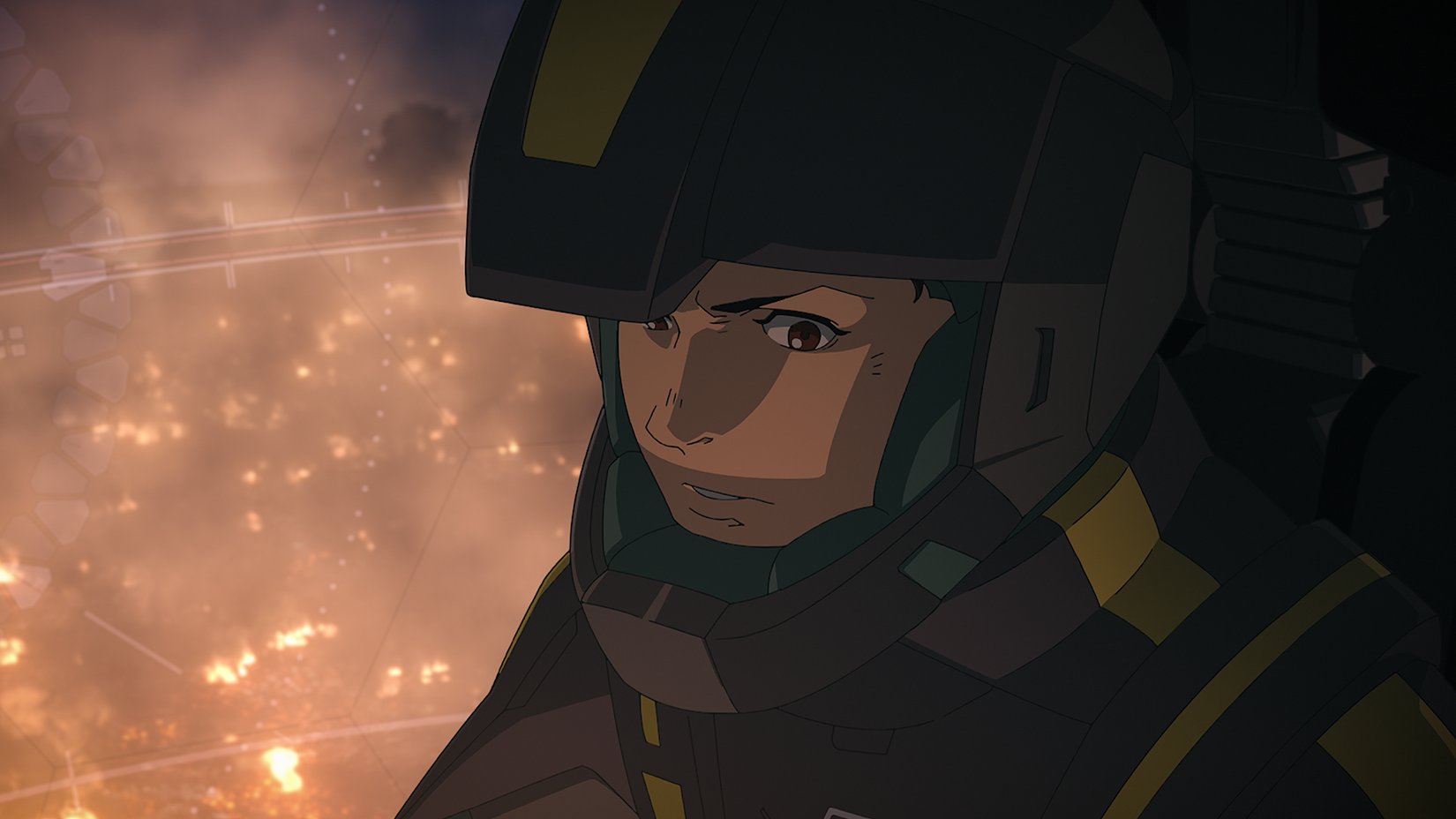 Image: Bandai Namco/Sunrise
The strained, romantic entanglement between Gigi and Hathaway remains a crucial narrative anchor. Despite the physical distance between them, Gigi functions as an unavoidable mirror to Hathaway—challenging his self-perception and highlighting the widening chasm between his idealized motives and his brutal actions.
This internal friction is underscored by the poignant, albeit brief, appearance of Bright Noa, Hathaway’s father. A veteran Federation officer who has spent decades upholding a system he knows is compromised, Bright serves as a vital foil to his son’s trajectory. Having weathered the same traumas featured in Char’s Counterattack (1988), Bright stands in stark contrast to Hathaway, representing the difficult choice to reform from within rather than destroy from without.
All these threads converge in signature, poetic Gundam fashion. Nymph Circe functions as a raw, astute political thriller disguised as an action epic. Murase masterfully utilizes core franchise elements—bureaucratic warfare, the dread of Minovsky particles, and the inertia of institutional power—to build toward a crescendo of high-stakes aerial dogfighting. The final duel between Hathaway’s Xi Gundam and Lane Aim’s RX-104FF Penelope is a masterclass in kinetic, desperate intensity.
 Image: Bandai Namco/Sunrise
While some viewers might be impatient with the film’s measured pace, waiting over an hour for the explosive action, to complain is to misunderstand the project. Gundam has never been solely about giant robots; it is defined by the humanity trapped within them and the systems that dictate their deployment. By refusing to rush to spectacle, Murase ensures that when the machines finally clash, the impact is earned and devastating.
Subscribe for deeper Gundam analysis
Seeking more context on the political weight and visual mastery of the Gundam saga? Join our newsletter for focused coverage on the ideologies, animation craft, and the lasting legacy of the Universal Century.
By subscribing, you agree to our Terms of Use and Privacy Policy.
Technically, the film is a triumph. Building upon the striking aesthetic of its predecessor, The Sorcery of Nymph Circe employs a more refined, photorealistic visual language. Murase delights in creating a sense of dissonance—placing his characters in environments that feel uncomfortably tangible, as if they are slightly out of place in their own world. This approach, reminiscent of his work on Ergo Proxy and Genocidal Organ, elevates the atmosphere to a level where the environment itself feels like a primary character.
Mobile Suit Gundam Hathaway: The Sorcery of Nymph Circe is a staggering achievement that lands with a profound emotional weight. As the credits roll, the anticipation for the final chapter is nearly unbearable, tempered only by the satisfaction of witnessing a filmmaker who understands precisely when to restrain his scope and when to allow the chaos to collide. It is a work that leaves its audience invigorated, uneasy, and deeply invested in the uncertain fate of the Universal Century.
Mobile Suit Gundam Hathaway: The Sorcery of Nymph Circe releases in theaters on May 15.
Source: Polygon
Related articles
 Dungeon Brawls Launches on Steam with Four-Player Co-op
 Valheim Receives Positive Reviews After Five Years in Early Access
 Bethesda Veteran Explains Why Studio Should Not Have Developed Starfield
 Ace Combat 8 Lead Teases New Story DLC—and Even Ace Combat 9
 Steam Hit Wardogs Confirmed for Console Release This Year
 Nintendo’s Major New Game Sale Sparks Unexpected Controversy
 Ubisoft PC Games to Launch on Steam Without Ubisoft Connect Launcher
 Level-5’s Futuristic Detective RPG Decapolice Will Now Launch In 2027