Since the 1980s, the Legend of Zelda franchise has served as Nintendo’s premier vanguard for innovation. Ocarina of Time on the Nintendo 64 pioneered the Z-targeting mechanic, a cornerstone of 3D combat that remains a gold standard in modern gaming. Later, Twilight Princess utilized motion technology to deepen the tactile connection to its fantasy world. However, it wasn’t until 2017’s Breath of the Wild that the series’ commercial performance finally mirrored its vast creative scale. Redefining player agency on such a monumental level was an arduous, non-linear journey.
In her latest work, Super Nintendo, esteemed games critic Keza MacDonald chronicles Nintendo’s evolution into a global cultural titan. This exclusive excerpt, provided by Penguin Random House in both text and audio, explores the transformative path from Skyward Sword to Tears of the Kingdom. Through insights from visionaries Eiji Aonuma and Hidemaro Fujibayashi, MacDonald highlights how Nintendo reinvented the industry. Super Nintendo is currently available at major retailers.
Audio excerpted with permission of Penguin Random House Audio from Super Nintendo by Keza MacDonald, narrated by the author. © 2026 Penguin Random House, LLC. All rights reserved.
Despite their immense prestige and status as touchstones for modern developers, the Zelda titles were rarely record-breaking bestsellers throughout the ’90s and 2000s. Ocarina of Time, the architect of the 3D action-adventure, moved approximately 7 million units—a formidable figure, yet eclipsed by Super Mario 64 (12 million) and Final Fantasy VII (11 million). Even the quirky puzzler Lemmings outperformed them all with 20 million sales. The Wind Waker struggled to reach 4.5 million, prompting a shift toward the gritty aesthetic of Twilight Princess, which eventually hit 7.5 million. For decades, Zelda was the sophisticated, “niche” masterpiece of the Nintendo catalog—until 2017 changed everything.
For years, the series followed a rhythmic, predictable structure. Players would traverse a gated world, conquer a dungeon, unlock a signature tool—like the hookshot or boomerang—and use that item to access previously locked regions. By the mid-2000s, this cycle had become almost too familiar. The following decade was marked by bold experimentation: the touchscreen mechanics of Phantom Hourglass and Spirit Tracks, and the kinetic, 1:1 swordplay of Skyward Sword. These titles often strained against the boundaries of Zelda‘s own conventions. From the locomotive travel in Spirit Tracks to the hardware-heavy multiplayer of Four Swords, Nintendo was clearly searching for a way to evolve the formula.
This internal friction was palpable in 2013’s A Link Between Worlds. While it revisited the beloved Hyrule of 1992, it introduced a radical change: items were rented from a shop rather than found in dungeons. This seemingly simple shift dismantled the linear gates of the past, granting players the autonomy to tackle challenges in any order. It was the first major crack in the traditional Zelda foundation, prioritizing player freedom over guided progression.

Reflecting on Skyward Sword, Eiji Aonuma noted that the game’s reception signaled a growing fatigue with the classic structure. He realized that while they had focused on “hand-holding” to ensure players never felt lost, they had inadvertently sacrificed the thrill of discovery. This realization became the catalyst for Breath of the Wild. While the original NES creators sought to offer boundless adventure, they were limited by 8-bit memory. Decades later, Aonuma and his team were no longer limited by hardware, but by the very rules they had invented. Breath of the Wild was the moment they finally broke free.
Perhaps it’s also fun to just get lost in the game and try to figure out what to do
Historically, Nintendo’s milestones redefined the medium. If Mario invented the platformer, Zelda established the open world. However, by 2015, the industry had hit a plateau. Open worlds had become ubiquitous but formulaic, often using “freedom” as a mere backdrop for linear quest markers. In developing Breath of the Wild, Aonuma and director Hidemaro Fujibayashi—a veteran who had guided the series since the Game Boy Color era—sought to shatter these modern tropes. They shifted the focus from scripted lore to emergent experience, ensuring the narrative never overshadowed the player’s personal journey.

The synergy between Aonuma and Fujibayashi is the heartbeat of modern Zelda. Aonuma’s seasoned perspective perfectly balances Fujibayashi’s inventive drive. Before a single landscape was rendered, they spent a year perfecting a reactive physics engine—a world where fire spreads with the wind and boulders obey gravity. When Link finally steps onto the Great Plateau, the game poses a question rather than a command. It invites players to explore any corner of Hyrule, rewarding curiosity at every turn. It was the realization of a forty-year-old dream: a world of genuine, unscripted liberty.

The impact was undeniable. Breath of the Wild didn’t just win over critics; it achieved unprecedented commercial success, selling over 31 million copies. Aonuma recalls his amazement at seeing players on YouTube utilize the game’s systems in ways the developers never envisioned. This success paved the way for 2023’s Tears of the Kingdom. By leveraging the same robust tools, the team discovered they could allow players to build everything from functional vehicles to flying cannons, further deepening the sandbox experience.
I thought it was a tradition for working on a Zelda game to turn into a kind of exercise in suffering
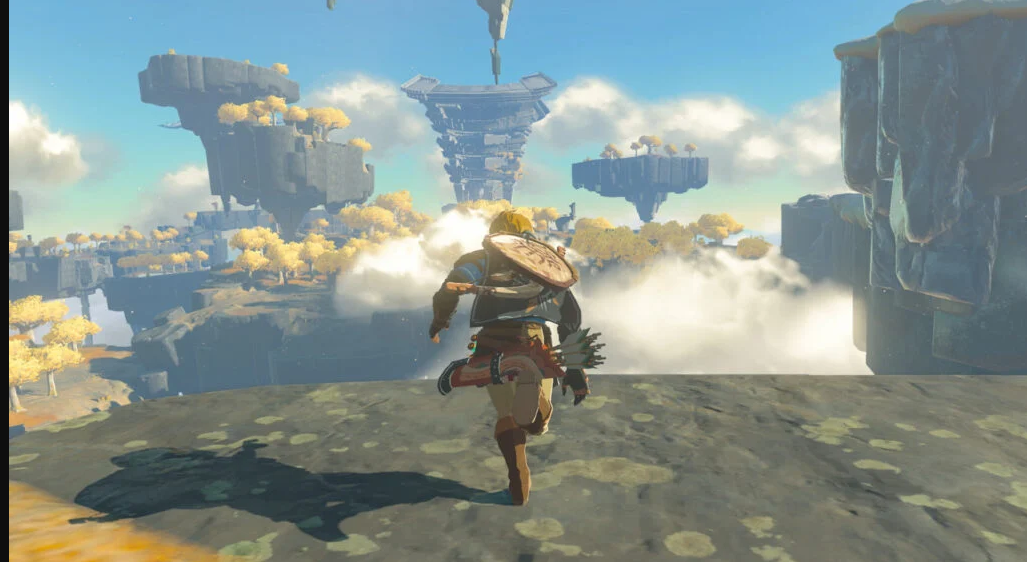
Tears of the Kingdom represents the ultimate synthesis of Zelda‘s history. It expanded Hyrule into the heavens and the subterranean depths, achieving the seamless verticality that Skyward Sword could only hint at. This evolution mirrors the broader story of gaming: a relentless quest to transcend technical limitations through sheer creative will. As Aonuma notes, the lifting of these restrictions has fundamentally changed game design. Where dungeons once required rigid entrances and exits, the world is now an interconnected whole, limited only by the player’s imagination.
POLY Report: Subscribe and never miss what matters
Get the best of Polygon delivered to your inbox, featuring breaking news and deep-dive gaming insights.
By subscribing, you agree to our Terms of Use and Privacy Policy.
Ultimately, the saga of The Legend of Zelda is a testament to the power of iteration. By shedding the “exercise in suffering” that once defined their process, Aonuma and Fujibayashi have created a framework where joy—both for the creator and the player—is the primary objective. Their work has transformed a series that was once a “connoisseur’s choice” into a global phenomenon, proving that when players are given the tools to play their own way, the possibilities are infinite.
Source: Polygon