
Square Enix’s Latest Murder Mystery Redefines the Cold-Case Thriller
The Roman statesman Marcus Tullius Cicero frequently contemplated the profound weight of antiquity. “To be ignorant of what occurred before you were born is to remain always a child,” he famously observed in his treatise on oratory. He argued that human life only gains true value when it is “woven into the life of our ancestors by the records of history.” It is a sentiment often resurrected in academic halls, and one can easily imagine it echoing in the mind of Takanari Ishiyara, the lead writer behind Paranormasight: The Mermaid’s Curse.
The Mermaid’s Curse serves as a formidable successor to 2023’s The Seven Mysteries of Honjo. Consistent with its predecessor, it is a visual novel peppered with investigative mechanics, blending rich Japanese folklore with a striking aesthetic that juxtaposes hand-drawn character portraits against authentic photographic backdrops. However, this sequel distinguishes itself with a more nuanced ensemble cast, refined deductive sequences, and a narrative scope that is significantly more daring. At its core, it is a meditation on the potency of storytelling and the vital necessity of situating one’s existence within a historical continuum.

The experience begins with a deceptively simple tableau. Yuza Minakuchi, a recent high school graduate, stands with a companion in a small vessel adrift on an ocean far more enigmatic than either realizes. One dives for fish, honoring a tradition spanning generations, yet both remain oblivious to the complex chain of events that placed them in that specific spot on that fateful day.
Following a jarring narrative shift, the game presents a pivotal choice: proceed with the unfolding drama or retreat to examine the catalysts of the past. The Mermaid’s Curse demands an obsession with history. This philosophy is baked into the mechanics; the “recollection” feature allows players to unlock new chapters only after revisiting earlier events and scrutinizing the legacy of Kameshina Island. By engaging with keywords from other characters’ lives, you peel back layers of local lore. While this might initially seem like a mere mechanical iteration of the systems found in Honjo, the game’s ambitions are far more intellectual.
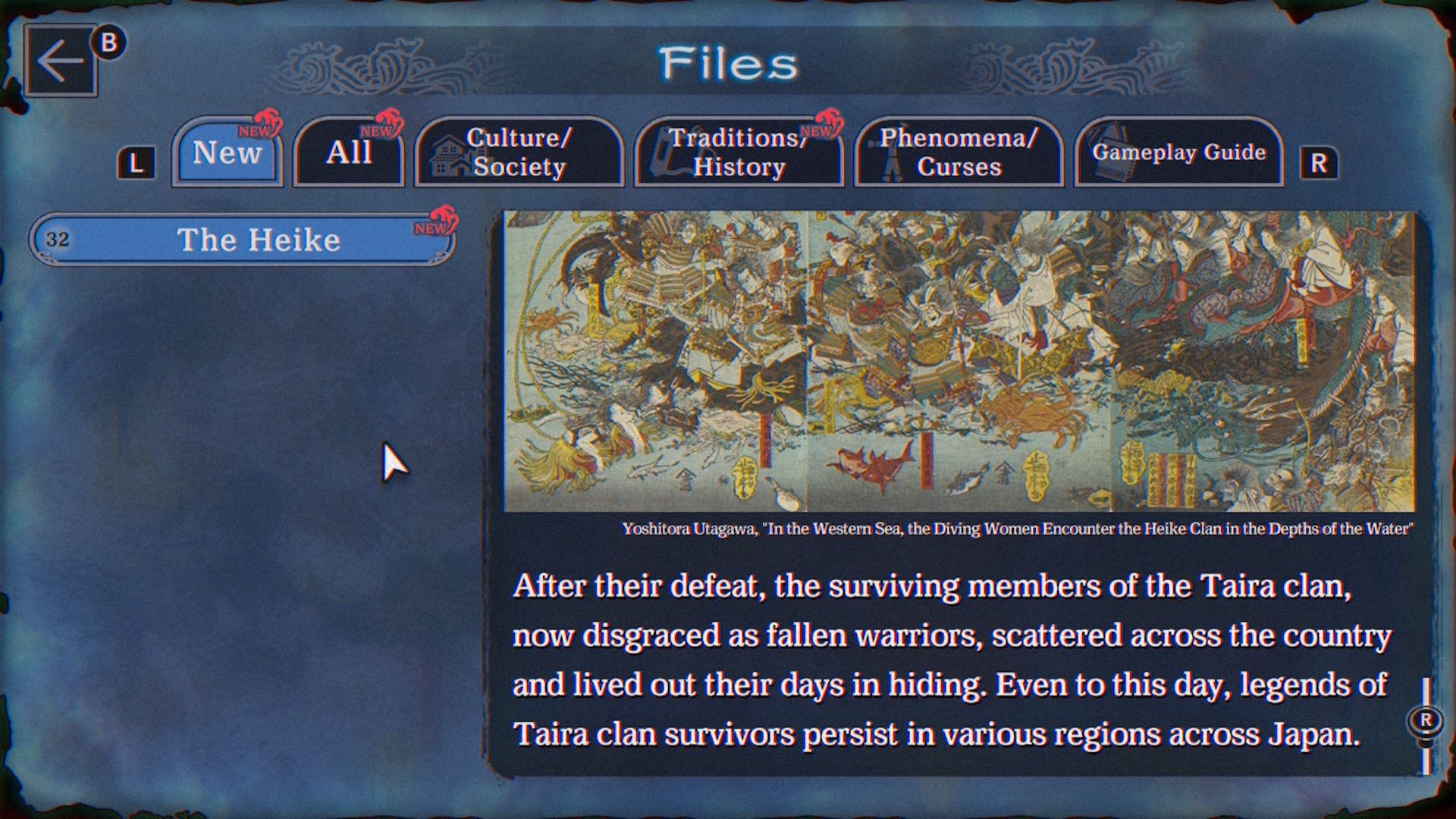
The narrative functions as a hybrid of a forensic cold-case inquiry and a historical dissertation. While every discovery impacts the immediate cast, deeper digging reveals how the present is irrevocably shaped by the tides of war, ancient power struggles, and the actions of ancestors. While The Seven Mysteries of Honjo used folklore as a vague mirror for timeless cruelty, The Mermaid’s Curse is much more surgical. It anchors its plot to a specific geography, illustrating how the echoes of the past dictate modern tradition, why certain outsiders are still maligned, and how ancient grievances can be weaponized for contemporary malice.
In this regard, the game feels remarkably prescient. While those in power have historically manipulated narratives to solidify their influence, The Mermaid’s Curse—set in 2026—feels almost subversive in its insistence on historical transparency. In an age where truth is frequently obscured or rewritten, the game’s assertion that genuine progress is impossible without historical literacy feels like a radical act.
There is an optimistic, perhaps even idealistic, streak to this philosophy. The game operates under the conviction that suppressed wrongs will eventually surface, granting the victimized at least the solace of recognition. Real life is rarely so tidy, yet The Mermaid’s Curse argues that the pursuit of truth is essential, regardless of the disruption it causes. Understanding the past isn’t just a hobby; it is a prerequisite for moving forward.
Of course, these themes would be hollow if the narrative failed to engage, but the storytelling here is masterful. The plot becomes increasingly labyrinthine just a few chapters in, showcasing a confidence that surpasses the first game. Where Honjo relied on early shock value and a high body count to hook the player, The Mermaid’s Curse trusts that its atmosphere and characters are compelling enough to sustain a slower, more deliberate burn.

While surprises and fatalities do occur, the game is unafraid to let the player spend an hour interrogating venal patriarchs or browsing encyclopedic entries on 15th-century maritime warfare. If Honjo was a “whodunnit” focused on unmasking a culprit, The Mermaid’s Curse is a “whydunnit” focused on the causality of Ise Bay. Every historical detail becomes a vital piece of the puzzle, making even the most academic lore feel high-stakes.
The characters, though built on familiar archetypes, are elevated by clever subversions. There is an amnesiac youth whose manic energy masks a profound melancholy, and a confrontational foreign student with latent psychic abilities. The standout is Yumeko Shiki, a “housewife detective” who possesses brilliant deductive skills but lacks the motivation to use them unless absolutely necessary. She is a refreshing departure from the “jaded investigator” trope, frequently using societal expectations of her gender to outmaneuver and dismantle her adversaries in sharp-witted exchanges.
Furthermore, the game’s strength lies in its periphery. The supporting cast, no matter how brief their appearance, adds to the sense of social claustrophobia inherent to small-town life. This interconnectedness ensures that when the plot reaches its crescendo, the consequences feel felt by the entire community rather than a secluded few.
Despite its supernatural trappings, Paranormasight: The Mermaid’s Curse is an exceptionally grounded and sophisticated piece of interactive fiction. It refines the quirks of its predecessor into sharp storytelling tools, demanding that the player actively synthesize information and respect the gravity of history. With its compelling narrative and fully realized characters, it stands as one of the most memorable and intellectually rewarding experiences of the year.
Paranormasight: The Mermaid’s Curse launches Feb. 19 on Nintendo Switch and Windows PC. This review was conducted on Nintendo Switch using a pre-release code provided by Square Enix.
Source: Polygon
Related articles
 New «Avengers: Doomsday» Teaser Features Two Captain Americas and Fantastic Four Baseball Game
 One Piece: Grand Gourmet Restaurant Sim Launches on Mobile and PC
 Jenna Ortega Wants to Step Away From TV Series After Wednesday and Explains Why
 Two New Trailers Released for Mamoru Oshii’s Armored Trooper Votoms: Die Graue Hexe Ahead of Nov. 20 Premiere
 Lawrence Makoare, Who Played Lurtz in The Lord of the Rings, Says He Is Joining The Hunt for Gollum
 GTA IV Gets Experimental Android Port
 High Plains Drifter, Clint Eastwood’s Western, Now Streaming Free on YouTube
 New Edition of Battlestar Galactica: The Board Game in Development, With Cylons Returning