
REDSEC Community Update: Armor
Hello everyone,
We’re thrilled to see so many of you diving into REDSEC. Years of work went into the mode, and watching your clips, reading your reports, and hearing your impressions has been incredibly valuable. Thank you for playing and for sharing your perspectives.
Since the launch of Battle Royale and Gauntlet we’ve gathered a wealth of feedback about armor—what it does, how it compares to Battlefield 6 Multiplayer (MP), and where behavior may be by design versus a bug. Below we’ll cover:
-
Our guiding principles for armor in REDSEC
-
How those choices relate to Battlefield 6 MP
-
A technical breakdown of the current armor mechanics from Ryan, our lead armor designer
When we built the Battle Royale experience our goal was to preserve as much parity with Battlefield 6 Multiplayer as possible, while accommodating the essentials of the Battle Royale format.
We want the skills and muscle memory you develop in MP—recoil control, engagement ranges, damage expectations—to carry over into REDSEC. At the same time, BR introduces distinct demands:
-
High stakes: A single encounter can end your run.
-
Loot-driven progression: Gear and upgrades are core gameplay loops.
-
Map scale & pacing: Encounters skew toward mid- and long-range, which aligns well with Battlefield’s design DNA.
Because of those differences, looted infantry armor in REDSEC intentionally departs from the standard MP tuning.
Armor in REDSEC is designed to increase time-to-kill (TTK) just enough to give players room to react in high-stakes fights. Our aim is for armor to affect survivability without fundamentally changing how weapons feel between modes.
Concretely, we keep core gun mechanics and soldier health damage consistent across modes and tune REDSEC primarily by adjusting damage against armor (extra HP) rather than changing soldier-health damage values.
This approach lets weapons remain familiar whether you’re in MP, Gauntlet, or Battle Royale, and it enables us to make REDSEC-specific changes by modifying damage-vs-armor values without destabilizing weapon balance elsewhere.
We feel the current armor tuning is an appropriate starting point for launch, but this is not final—we’ll continue to monitor data and community feedback and iterate as needed.
Now, here’s Ryan with a deeper technical explanation.
Hi—I’m Ryan.
I’ve worked on Battlefield design across multiple titles and community eras. I lead the armor system for REDSEC and will explain how armor interacts with weapon damage and how that differs from other Battlefield 6 experiences.
Basic reference numbers:
-
Gauntlet armor: 40 HP
-
Battle Royale armor: 80 HP total (two plates of 40 HP each)
Think of armor as additional health layered over your base soldier HP. Once armor is depleted, damage behavior matches what you’re used to in other Battlefield 6 modes.
Each weapon in Battlefield 6 has a damage profile determined largely by its caliber. A caliber (for example, 7.62x39mm) establishes a core damage curve that we may slightly tune when that caliber appears in different archetypes (rifles, carbines, LMGs), but their underlying behavior remains consistent.
In REDSEC, we conceptualize two related damage curves for each caliber: one against soldier health and one against armor.
Importantly, we only modify weapon damage versus armor in REDSEC. After armor breaks, weapon damage to soldier health behaves identically to MP across the same ranges.
We apply two systemic adjustments to how infantry weapons interact with armor in REDSEC.
Weapons have damage “steps” across range bands (max damage, then reduced damage as range increases). For damage vs. armor, we shift those drop-off thresholds outward by 10 meters.
Because REDSEC engagements commonly happen at longer distances (larger maps like Fort Lyndon), pushing these thresholds out helps weapons feel consistent with MP expectations while accommodating longer engagement ranges.
This change applies to all primary and secondary firearms.
For automatic weapons we reduce or remove the very close-range maximum damage step when calculating damage vs. armor. When a caliber has a carbine variant (e.g., 7.62x39mm vs. 7.62x39mm_Carbine) we align the caliber’s max damage vs. armor so carbines don’t receive a disproportionate boost at point-blank ranges.
Playtests showed that at extremely close ranges—where hit rates approach 100%—armor often felt absent against high-RoF weapons. You could land a near-perfect spray and see little to no effect from armor, or encounter inconsistent outcomes depending on the weapon.
This adjustment aims to temper high-RoF effectiveness at point-blank encounters so armor meaningfully slows TTK in face-to-face fights without fundamentally changing how the gun handles at other ranges.
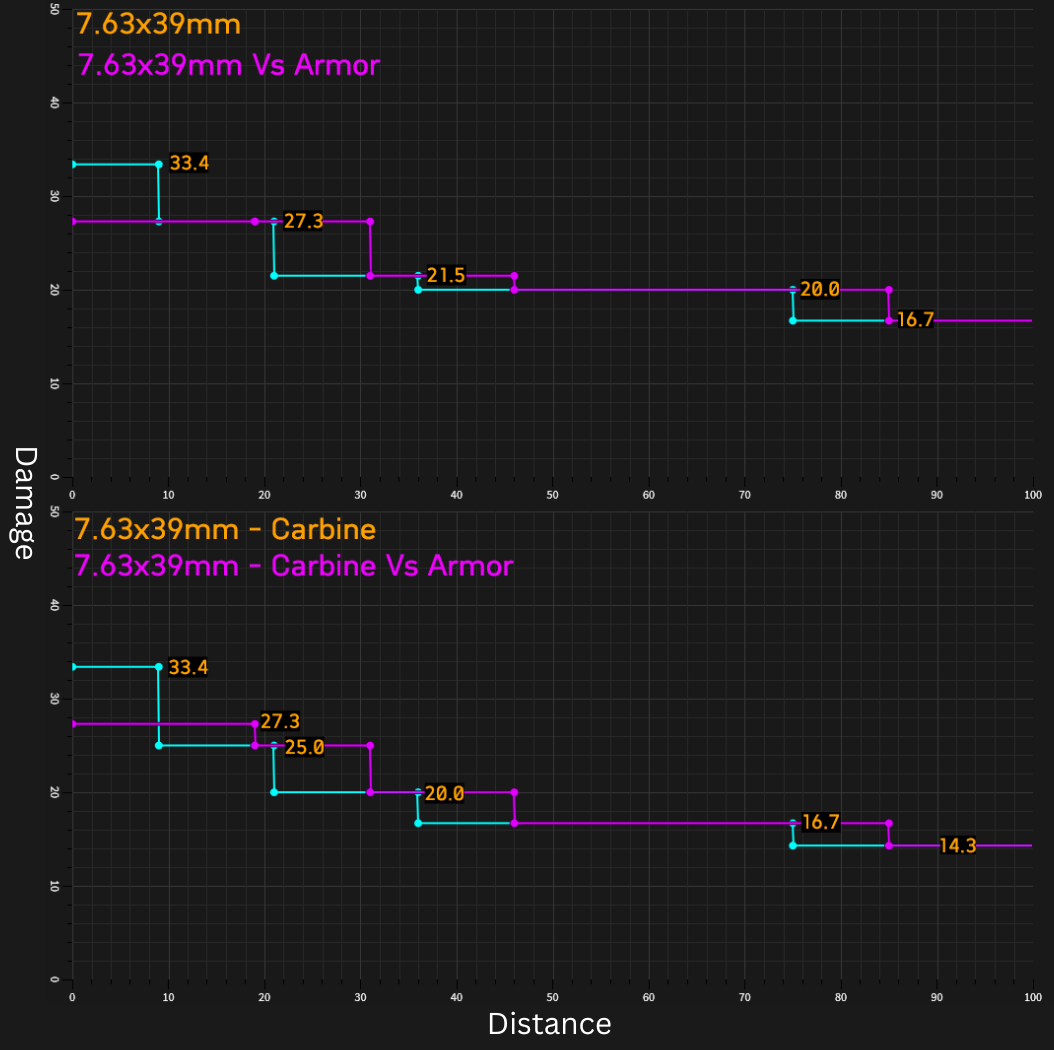
To illustrate, here are the damage steps for 7.62x39mm in soldier-health terms (example weapons ACE, RPKM):
-
33.4 damage out to 9 meters, then down to 27.3
-
21.5 damage at 21 meters
-
20.0 damage at 36 meters
-
16.7 damage at 75 meters
For the 7.62x39mm_Carbine (SIG553R) variant:
-
33.4 damage out to 9 meters, then down to 25.0
-
20.0 damage at 21 meters
-
16.7 damage at 36 meters
-
14.3 damage at 75 meters
Those steps correspond to shifts in bullets-to-kill (BTK)—for example, when a weapon moves from a 3-shot to a 4-shot kill band.
Against armor, each of the damage drop-off thresholds above is pushed outward by 10 meters. The extreme close-range damage (within roughly 9 meters) is flattened compared to soldier-health values so armor doesn’t simply evaporate at point-blank. For instance, a 33.4 value at close range is reduced to 27.3 vs. armor; carbine variants are adjusted to match that lowered value rather than being reduced further.
At longer distances, damage vs. armor will feel closer to MP expectations but with the protective buffer armor provides. At very close ranges, armor meaningfully increases TTK—especially against rapid-fire weapons—without making guns feel alien.
We’re satisfied with the initial armor approach for REDSEC’s launch, but this isn’t the endpoint. We’ll keep tracking telemetry across all skill brackets and modes, evaluate community reports, and investigate anomalies.
When you share armor feedback from Battle Royale, please include the specific weapon or weapon archetype involved and an approximate engagement range. For Gauntlet, include the exact mode. Those details help us diagnose balance and bug reports much faster. Please file bugs on our EA Forums and join discussions on the Battlefield Discord server.
Going forward, we’ll continue to prioritize adjustments to damage-vs-armor to preserve weapon feel across Battlefield 6 and be transparent about any changes we make.
Thank you for playing REDSEC, for investing time into matches, and for sending your reports (and those unforgettable squad wipes). Keep the feedback coming—we’re listening and iterating. See you in the next drop.
— The Battlefield Team
This announcement may be updated as we continue to gather community feedback and evolve our live service and content. We’ll do our best to keep you informed.
Related articles
 Battlefield 6 – Anticheat Metrics – July
 Battlefield 6 – Community Update – Tidal Strike
 Battlefield 6 EA Play Rewards
 BATTLEFIELD 6 UPDATE 1.4.2.5
 Battlefield 6 Season 4: Anti-Cheat Update
 Battlefield Community Survey: Top Gun Edition
 In Case You Missed It: Season 4 – Top Gun Has Officially Launched!
 Unleash Your Inner Top Gun in the Battlefield 6 Free Trial