
Pluribus Episode 8 Finally Reveals the Hivemind’s True Goal

Since the debut of Vince Gilligan’s high-concept sci-fi series Pluribus, audiences have been consumed by two primary enigmas. First, what is the ultimate endgame for the collective consciousness that has subsumed nearly all of humanity? And second, while the story focuses on a solitary, defiant woman navigating this eerie new landscape, what are the seven billion people currently tethered to the hivemind actually doing with their time?
“That’s a fascinating question,” Gilligan remarked during a recent conversation with Polygon. “It’s something we are still actively exploring in the writers’ room.”
In Pluribus episode 8, titled “Charm Offensive,” a preliminary answer emerges—delivered with a dry, almost blink-and-you’ll-miss-it subtlety. For viewers not paying close attention to the background details, the revelation could easily pass by unnoticed. Gilligan, along with executive producer and writer Alison Tatlock, sat down to dissect the hivemind’s true ambitions and their vision for the future of the species.
[Warning: Significant spoilers for Pluribus episode 8 follow.]
“Charm Offensive” catches up with protagonist Carol Sturka (Rhea Seehorn) in the wake of her psychological collapse at the end of the previous chapter. Following her desperate attempt to manipulate her handler, Zosia (Karolina Wydra), the collective—referred to in-universe as the Others—retreated from Carol’s Albuquerque neighborhood entirely. This mass exodus left her in a state of profound isolation. As Gilligan previously clarified, this wasn’t an act of malice, but rather a “time out” intended to curb her volatile behavior. After weeks of spiraling into self-destructive habits, Carol eventually paints a plea for their return on her street. When Zosia finally reappears, Carol’s stoicism shatters.
Throughout episode 8, Carol begins to navigate a fragile rapport with Zosia, finally probing into the mechanics of the hivemind experience. During a quiet moment peering through a telescope at the celestial origin of the signal, Zosia admits that while the Others remain ignorant of the alien race that initiated the link, they feel a profound debt of gratitude. Their mission is now to “pay it forward” and distribute this “gift” to any other sentient life in the cosmos. When Carol asks how they intend to achieve this, the dialogue cuts away, but the answer is hidden in plain sight.
A brief shot reveals Carol’s clandestine whiteboard, where she has scrawled a monumental discovery: “Building GIANT ANTENNA!!! Using all power in world to send signal to space!” The camera lingers only for a second before Carol obstructs the view, searching for a fresh marker, grounding a world-altering revelation in a mundane frustration.
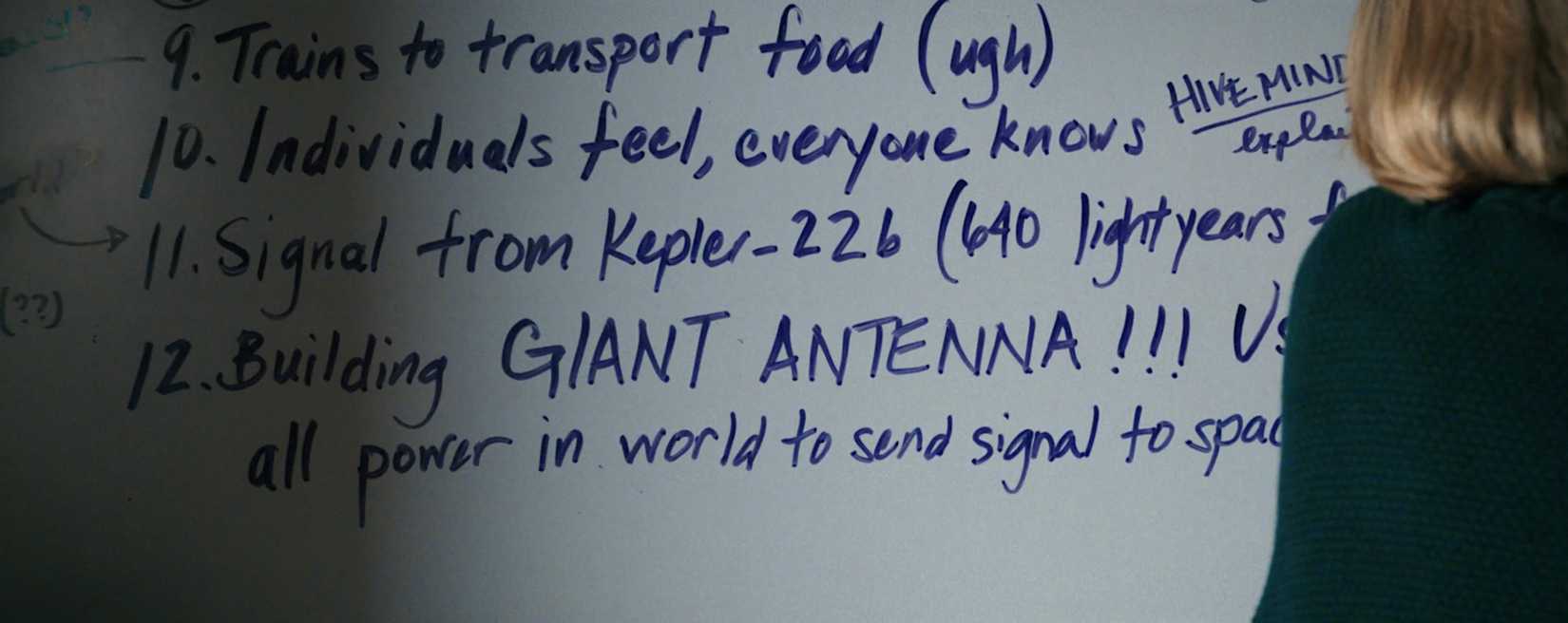
This low-key delivery highlights the show’s preference for Carol’s internal emotional journey over traditional blockbuster spectacle. Similar to how the series quickly dismantled the “cannibalism” cliffhanger, the whiteboard reveal suggests that while the stakes are planetary, the narrative remains intimate. We don’t see Carol’s immediate horror at the prospect of a galactic infection; instead, we see her documenting it as just another line item in her survival log.
To fill in the gaps, Tatlock explains that while the Others possess a “biological imperative” to expand, their motives aren’t purely predatory. “Their primary drive is to propagate this state of being,” Tatlock notes. “However, they are also genuinely invested in the welfare of the ‘Originals’ they’ve left behind. They care about the planet; they aren’t just locusts.”

“They view themselves as stewards of the Earth,” Gilligan adds, suggesting that the euphoria of the hivemind effectively erases selfish desire. “If they are as genuinely content as they claim to be, their only goals are survival, propagation, and perhaps eventually, simply existing in peace. But that lack of friction creates its own set of problems.”
Gilligan concludes with a characteristic observation on human nature: “I’ve always believed it’s the restless, unhappy people who drive the world forward. If you’re perfectly satisfied with your circumstances, you lose the impulse to innovate or change. In Pluribus, we’re seeing what happens when that impulse vanishes for almost everyone.”
The first eight episodes of Pluribus are available for streaming on Apple TV+. Reporting contributed by Jake Kleinman.
Source: Polygon
Related articles
 FX Releases First Behind-the-Scenes Video for Season 2 of Alien: Earth
 CDPR Reveals Number of Developers Working on The Witcher 3 Expansion
 Experts Explain How Ray Tracing Impacts GTA VI Visual Quality
 CD Projekt Red Begins Development on New Game Outside The Witcher and Cyberpunk Franchises
 The Video Games and More You Should Play This Weekend – September 4, 2026
 Dragon’s Dogma 2 Receives Performance Boost From 25 to 60 FPS
 Devil May Cry Creator Reveals His Biggest Fear Beyond the Death of Physical Discs
 Journalists Praise Silent Hill: Townfall Demo