One of the Century’s Most Disturbing Sci-Fi Series Has Finally Arrived on Netflix—With a Twist

When The Man in the High Castle debuted on Prime Video in 2015, it served as the streaming service’s inaugural foray into high-concept original science fiction. This ambitious project effectively paved the way for subsequent behemoths like Fallout and The Boys. A decade after its initial release, this haunting alternate history—which imagines a world where the Axis powers triumphed in World War II—has finally made its way to Netflix, introducing its dystopian vision to a vast new demographic of viewers.
For those contemplating a dive into this series, the recommendation is enthusiastic but comes with a specific caveat. While the show spans four full seasons, the narrative’s most potent and emotionally resonant material is concentrated in the first two. As the series progressed into its later years, the focus shifted toward sprawling sci-fi lore that often overshadowed the intricate, character-driven drama that made its inception so compelling.
Creator and initial showrunner Frank Spotnitz masterfully establishes the atmosphere from the very first frame. The series opens with a chilling, Game of Thrones-esque title sequence set to a somber, dissonant rendition of “Edelweiss.” This visual map depicts a fractured North America, partitioned into the Greater Nazi Reich and the Japanese Pacific States, separated by a lawless “Neutral Zone” along the Rockies. The immersion begins with a propaganda reel in a 1962 American cinema; its imagery of idyllic suburbs and aerospace achievements feels eerily familiar until the Stars and Stripes unfurls to reveal a swastika where the stars should be.
 Photo: Liane Hentscher/Amazon/Everett Collection
While Philip K. Dick’s original 1962 novel concentrated primarily on a Japanese-occupied San Francisco, the television adaptation broadens its scope to explore the interior of the American Reich. The show feels uncomfortably relevant in a contemporary landscape where extremist rhetoric has resurfaced in public discourse. It serves as a stark meditation on the ease with which individuals succumb to the status quo when it serves their personal comfort, and the harrowing catalysts required to break such complacency.
By the time the story begins, the two victors of World War II have entered a volatile Cold War, mirroring the historical tensions between the US and the USSR. Germany secured its dominance through the atomic destruction of Washington, D.C., and Japan is desperately racing to close the nuclear gap. This geopolitical tinderbox is fascinating in its own right, but the story takes a surreal turn when Juliana Crain (Alexa Davalos) encounters a forbidden artifact.
After her sister is executed by the Kempeitai, Juliana discovers a newsreel that defies reality: it contains footage of an Allied victory in World War II. This impossible film acts as a radicalizing force, sending her on a perilous mission to deliver the footage to the enigmatic “Man in the High Castle” (Stephen Root). The existence of these films suggests a reality where the Nazi machine is not invincible, making their suppression a top priority for the Reich. Juliana’s quest inadvertently pulls her boyfriend, Frank Frink (Rupert Evans), into a downward spiral, illustrating how heavy-handed fascism often creates the very insurgents it seeks to destroy.
 Photo: Liane Hentscher/Amazon/Everett Collection
The series balances its grim themes with profound moments of humanity. The depiction of a clandestine Jewish community observing the Mourner’s Kaddish stands as one of the most moving sequences in television history. Unlike the relentless bleakness of The Handmaid’s Tale, there is also a streak of dark irony, much of it provided by Robert Childan (Brennan Brown), a pretentious antique dealer who slowly realizes that his devotion to Japanese culture will never earn him their genuine respect.
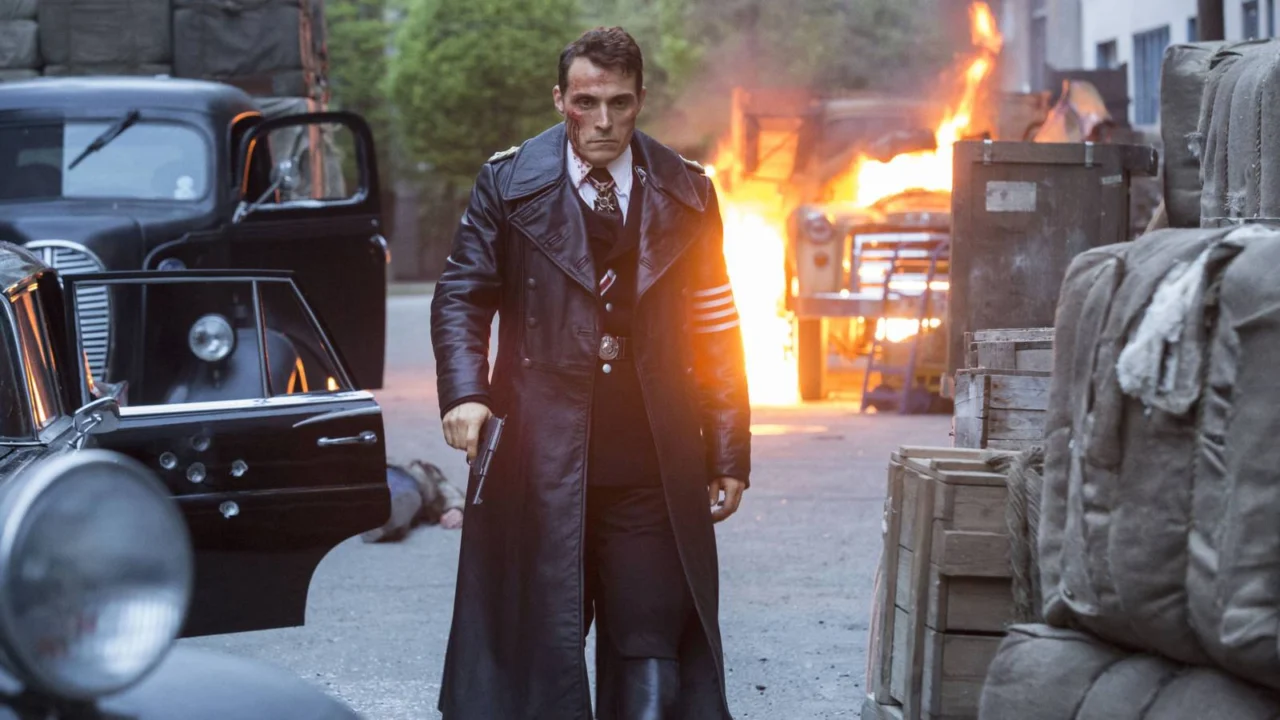
However, the show’s most compelling figure is Obergruppenführer John Smith (Rufus Sewell), a character created specifically for the screen. Smith embodies a twisted version of the American Dream, living a comfortable life on Long Island while ignoring the atrocities that secured his position. His world is shattered when his son—a dedicated member of the Hitler Youth—is diagnosed with muscular dystrophy, a condition that marks him for “mercy killing” under Reich law. This storyline reaches its poignant peak in the season 2 finale, a high-water mark the series never quite recaptures.
 Photo: Liane Hentscher/Amazon/Everett Collection
Behind the scenes, the production saw a different showrunner for every season. Erik Oleson, who later handled Carnival Row, managed a smooth transition in season 2. But season 3 saw a shift in priorities. While there are still flashes of brilliance, the narrative begins to lean too heavily into multiverse mechanics and Nazi plans for interdimensional conquest, losing the grounded, human stakes that fueled its early success.
For the ultimate experience, viewing the first two seasons provides a complete and powerful narrative arc. If you finish those and find yourself eager for more high-stakes alternate history, David Simon’s The Plot Against America on Max offers a similarly provocative look at fascism on American soil.
The Man in the High Castle is currently available for streaming on Netflix, Prime Video, and MGM Plus.
Source: Polygon
Related articles
 Musicians Talk About Vampire: The Masquerade – Bloodlines Remake, but Fans Remain Skeptical
 Battlefield 6 Developers Respond to Memes About Paid “AI Slop” Skins and Explain Design Choices
 SPINE Gets New Trailer Focused on Main Character Customization
 Unofficial Android Port of Call of Duty 4: Modern Warfare Reportedly Runs at 60 FPS in Gameplay Videos
 Cyberpunk 2077 Co-Op Mod in Development, Gameplay Trailer Released
 Toxic Arc Raiders Players Found a Way to Harass Others in PvE Mode
 First Look at Drova II Torn Lands, Sequel to the Pixel Art Gothic-Like RPG
 CDPR Didn’t Expect Such Big Interest in The Witcher 3 Remaster, Which Set a New Record