
Marathon Ranked Mode: We Did the Homework for You
The competitive landscape of Marathon is set to shift this weekend with the debut of its ranked mode, officially launching on March 21 at 1 p.m. EDT. To prepare the community for this tactical transition, Bungie has released a rather literal “homework assignment.” Navigating the ranked ladder isn’t as simple as dropping in, securing loot, and extracting; success requires a deep understanding of the scoring mechanics, or you risk stagnating—or worse, losing hard-earned progress.
In a recent social media update, the development team acknowledged that the ranked architecture might be intimidating for newcomers. To bridge the knowledge gap, they provided a “Ranked Calculation Worksheet” designed like a classroom handout, complete with fields for your name and date. We’ve analyzed the data to break down exactly how these variables affect your rank.
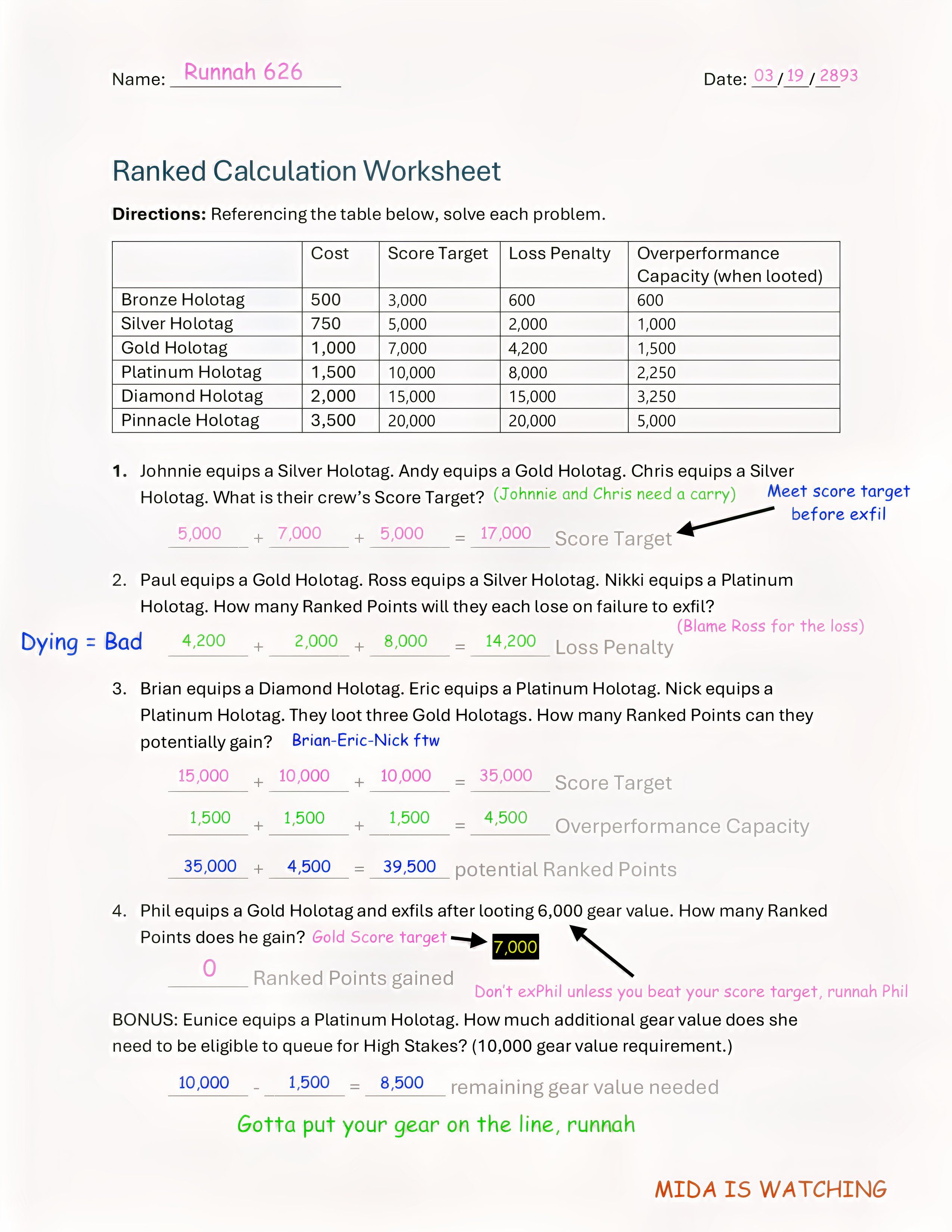
Central to this system are “holotags,” as detailed in Bungie’s latest developer blog. These tags are purchased from the armory and categorized into six distinct tiers: bronze, silver, gold, platinum, diamond, and pinnacle. Your access is restricted by your current standing, meaning you can only buy tags at or below your rank. Before a match, your squad’s combined holotag values establish a “score target.” This threshold represents the minimum amount of loot value your team must accumulate before attempting an extraction. Leaving early—a mistake humorously dubbed the “exPhil”—results in zero rated points for the session. Fortunately, an in-game loot meter provides a real-time indicator of when you’ve met your requirements.
The stakes are high: if your squad is eliminated, every player suffers a penalty to their “rated points” based on the collective loss values of your chosen holotags. However, if you successfully extract after hitting your target, you earn points proportional to the total value of the loot you brought back.
While standard looting contributes to your progress, hunting enemy players for their holotags is far more lucrative. Securing an opponent’s tag increases your “overperformance capacity.” For instance, a gold tag adds 1,500 points to your team’s potential score ceiling. Beyond PvP, you can bolster this capacity by collecting tag chips from defeated UESC hostiles or completing map-wide events. This design ensures that Marathon’s ranked mode rewards a holistic playstyle—balancing aggressive combat with environmental objectives and efficient looting.

Competitive entry is also governed by a “gear ante.” The Low Stakes queue, which serves as the entry point, requires players to be at least Level 25, carry a bronze holotag, and equip gear with a minimum liquidation value of 3,000 credits (typically a mix of green and blue rarity items). The High Stakes queue demands much more: a platinum holotag and a 10,000-credit gear investment—roughly equivalent to a full set of deluxe gear with some superior purple pieces.
Interestingly, the cost of a high-tier holotag can offset the gear ante. In one example provided by Bungie, a player using a platinum tag only needed to bring 8,500 credits worth of gear to qualify for High Stakes. The mantra here is simple: you have to risk your best equipment to earn the best rewards. Just keep a close eye on that loot meter—nothing is quite as painful as a successful extraction that yields zero points because you left the field too soon.
Source: Polygon
Related articles
 Soulslike Valor Mortis Released on PC and Consoles
 There Are No Ghosts at the Grand Combines Hotel Management with Ghost Hunting
 Planet Zoo 2 Released with New Trailer Showcasing Animals and Aquariums
 Classic The Far Side Comic Quote Resonates 34 Years Later
 Microsoft Announces ID@Xbox Showcase Featuring 20 Games
 Uncharted 2 Turns 17 as Players Recall Naughty Dog’s Acclaimed Sequel
 House of the Dragon Star Reveals When Final Season Filming Begins
 Vision and Ultron Return as Vision Quest Premieres on Disney+