
I’m Obsessed With the Korean Food in Tomodachi Life
Just days into my playthrough of Tomodachi Life: Living the Dream, I stumbled upon a shop on my island selling buchimgae—savory Korean pancakes packed with vegetables. I was genuinely surprised. “Wow, actual Korean cuisine in this game? That’s awesome.” Little did I know, this was just the tip of the iceberg.
Soon after, I unlocked yangnyeom chicken. Before long, my collection expanded to include sotteok sotteok (skewered rice cakes and sausages glazed in a sweet-spicy sauce), gim (dried, salted seaweed), and gamja-tang (a robust, spicy pork bone soup). Every time a new dish appeared, I felt like a pioneer discovering something revolutionary, immediately snapping screenshots to share with my friends.
I tried to recall if the original 3DS version I played over a decade ago featured similar culinary variety. It certainly didn’t. After some digging, I realized that the 3DS release was heavily tailored by region; the Korean version had Korean dishes, while others didn’t. With Living the Dream, however, those geographic boundaries seem to have vanished.
Naturally, I’ve made it my mission to feed these items to my islanders. I’ve been relentlessly feeding my own personal Mii every Korean dish I acquire, though I’m consistently let down by her lukewarm reaction. It’s even more disheartening that her favorite food is a tempura rice bowl—a dish I find rather uninspired. None of the Korean options have managed to crack her top-three favorites list.
I find myself constantly consulting online databases to track down the remaining items. I honestly get frustrated when I see dishes like ganjang-gejang (marinated raw crab) or samgyeopsal (grilled pork belly) listed, knowing they haven’t graced my store yet. I’m desperate to feed them to my Mii counterpart!
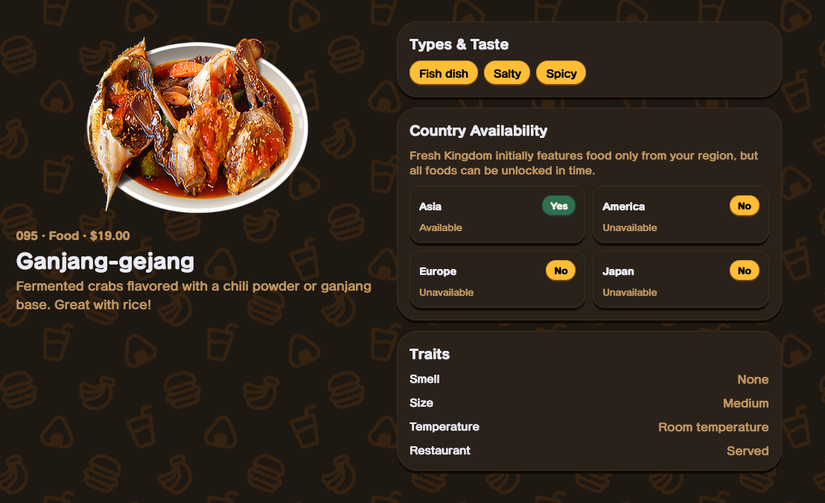
Unfortunately, most of these international dishes are difficult to obtain, as they aren’t sold in the standard shop. Instead, you have to rely on the daily marketplace or random events when helping Miis solve their problems. It’s become a full-blown scavenger hunt. Rather than chasing rare Pokémon, my current objective is tracking down elusive Korean delicacies in my North American save file. Adding to the challenge is the game’s strict anti-cheat policy; time traveling is penalized by locking your shops, making it impossible to speed up the process.
Subscribe to the newsletter for gaming food discoveries
Want more inside looks at cultural food moments and regional dishes hidden in games? Subscribe to our newsletter to keep discovering curated spotlights on in-game cuisine, regional easter eggs, and why these food finds matter in gaming worlds.
By subscribing, you agree to receive newsletter and marketing emails, and accept our Terms of Use and Privacy Policy. You can unsubscribe anytime.
Over a month in, and I’m still invested in my tomodachis. While I’m certainly interested in their interpersonal drama—two of my real-life friends who are married simply won’t get together in the game because they keep falling for Final Fantasy 7‘s Tifa Lockhart, which I honestly get—my main motivation is checking for new Korean dishes. I’m crossing my fingers for some mul naengmyeon (chilled buckwheat noodles). I’m hungry.
Tomodachi Life: Living the Dream captivates me in a way Animal Crossing: New Horizons does not
I’m enjoying Tomodachi Life: Living the Dream a lot more than Animal Crossing: New Horizons for one very important reason
1
Source: Polygon
Related articles
 Sony to Bring Back Ape Escape Franchise with New Developers
 Game Developer Explains Why Physical Discs Are Doomed
 The Video Games And More You Should Play This Weekend – October 9, 2026
 Kingdom Come Creator Explains Why AI Is Needed in Games
 Board Game Publisher Go On Board Launches PC Game Studio
 Vikings Creator Series Bloodaxe Sets 2027 Premiere Date
 Asha Sharma Praises Gears of War: E-Day Developers as Players Criticize the Game
 Hacker Cracks Denuvo in Two Games and Bypasses Dead Space Remake Protection