
How a disastrous vampire thriller finally broke Hollywood’s worst habit 20 years ago

The 2006 cinematic effort BloodRayne occupies a peculiar intersection of genres: it is simultaneously a vampire gothic, a video game translation, a medieval brawler, and a prime example of a prestigious Academy Award winner delivering an utterly disinterested performance. Yet, above all else, BloodRayne is the definitive “January movie”—and not in a complimentary sense. While tight, effective pulp like The Commuter or The Beekeeper represents the high-water mark for early-year releases, BloodRayne, which debuted on Jan. 6, stands as the archetypal failure of the “dump month” in both creative and commercial terms.
Critically savaged with a meager four percent positive rating on Rotten Tomatoes, the film limped to a global box office total of less than $4 million. In a move that perfectly mirrors its chaotic production, it somehow spawned two direct-to-video sequels that lacked even the bizarre celebrity wattage of the original. Nevertheless, over the two decades since its release, BloodRayne has inadvertently influenced the study of January cinema by providing a stark counter-narrative to the clichés of the season.
Historically, the post-holiday lull has served as a graveyard for studio misfires, often overshadowed by award-season heavyweights. During the 1990s, the month was so desolate that a Star Wars re-release was its biggest highlight. However, BloodRayne arrived just as January was attempting a commercial rebranding. The preceding year, 2005, had seen surprising hits like Coach Carter and White Noise. This momentum continued into 2006 with the financial success of Hostel and Underworld: Evolution.
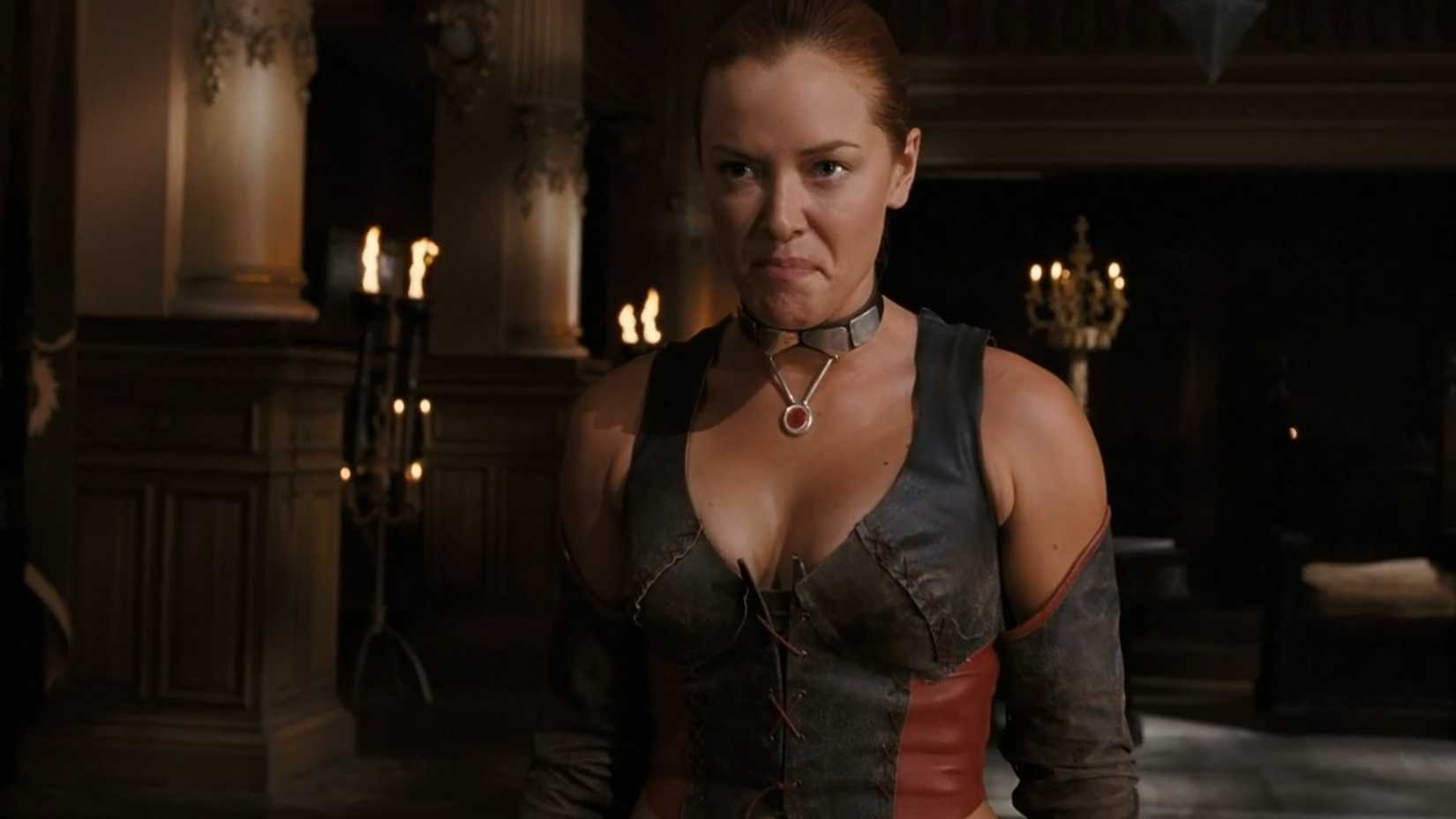 Image: Boll KG Productions
It is with Underworld—another franchise centered on a leather-clad, sword-touting heroine—that BloodRayne shares its most obvious, albeit clumsier, DNA. As the lowest-grossing release of its month, BloodRayne solidified director Uwe Boll’s reputation as an ersatz Paul W.S. Anderson: a filmmaker determined to merge action and horror through the lens of video game intellectual property, regardless of the quality.
Following House of the Dead and Alone in the Dark, this was Boll’s third foray into gaming adaptations. Despite a screenplay by the talented Guinevere Turner (who co-wrote American Psycho) and an inexplicably diverse cast—including Michael Madsen, Michelle Rodriguez, Meat Loaf, and Ben Kingsley—the film showed little technical progression. The plot follows Rayne, a half-vampire “dhampir,” on a quest to retrieve enchanted artifacts to defeat her father, the vampire king Kagan (Kingsley). She is joined by the Brimstone Society, a group of monster hunters who seem as confused by the plot as the audience.
On paper, a bloody medieval vampire romp sounds like the perfect post-holiday palate cleanser. However, Boll’s execution lacks even the basic fundamentals of visual storytelling. Simple narrative transitions are botched; for example, an escape sequence is presented as a disorienting flashback despite occurring only seconds prior in the story’s chronology.
 Image: Boll KG Productions
The combat choreography is particularly painful to witness. The cast appears undertrained and hesitant, moving with a cautiousness that suggests they were more worried about accidental injury than delivering a convincing performance. Boll’s editing only compounds the issue, frequently cutting away from the impact of sword strikes, leaving the viewer to piece together how characters were suddenly impaled.
Two decades of distance haven’t been kind to BloodRayne. While it avoids the over-reliance on lackluster CGI seen in modern streaming fodder, it remains fundamentally garish and cheap. There are faint traces of Turner’s original vision—a more fluid approach to sexuality and some subversive subtext—but she later claimed that only a fraction of her work survived Boll’s aggressive rewrites. In Turner’s own words, it remains one of the worst films ever produced, a testament to Boll’s unique “auteur” status where the primary goal seems to be the pursuit of cinematic mediocrity.
While Paul W.S. Anderson faced similar criticism early on, his January offerings like Resident Evil: The Final Chapter eventually showcased a level of craftsmanship that Boll never touched. In the years following BloodRayne, January has evolved, hosting genre-bending successes like Cloverfield and M. Night Shyamalan’s Split, alongside reliable action vehicles for stars like Gerard Butler and Liam Neeson. The season is no longer the wasteland it once was, regardless of what viral nostalgia videos might suggest.
 Image: Boll KG Productions
Ultimately, BloodRayne represents the extinction of a specific brand of low-effort action-fantasy. While the Underworld franchise survived the era, the subgenre of “video game movie as tax shelter” largely vanished. By being so profoundly inept, BloodRayne acted as a bottom-feeder that helped clear the ecosystem, allowing the January movie to transform into something more respectable by comparison. It didn’t just inhabit the dump month; it effectively broke it.
Source: Polygon
Related articles
 Journalists Preview First 30 Minutes of New Resident Evil Game
 Sony Threatens Players With Legal Action Amid Disc Protests
 Gamers Find Way to Beat Modern Warfare 4 Developer Records
 What Quests Should You Complete Before Mass in The Blood of Dawnwalker?
 Microsoft Announces September Xbox Game Pass Lineup Featuring Call of Duty
 Witch Hat Atelier Manga Is One-Third Finished and Could Run for 12 Seasons
 Marvel to Introduce New Wolverine Replacement
 GTA VI Trailer Outpaces Netflix Films in Popularity Across 87 Countries