How a 2008 Stoner Comedy Classic Inspired the Goriest Horror Movie of 2026

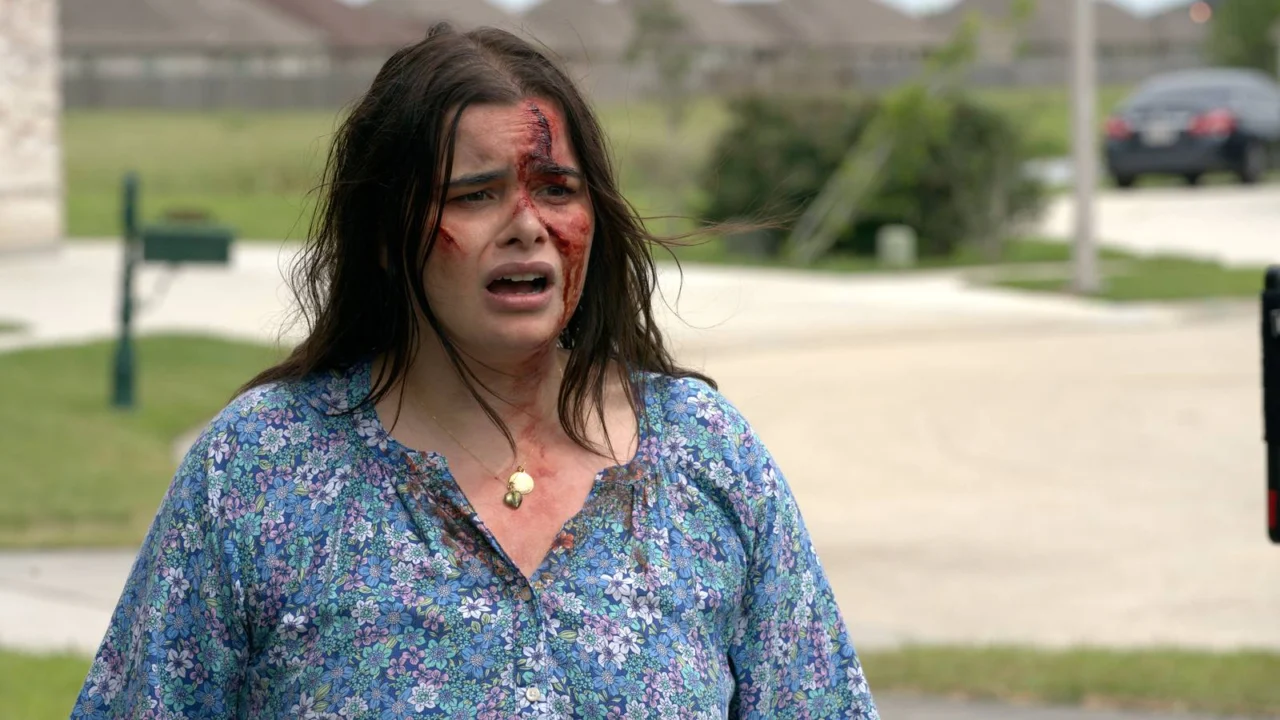
In their bold reimagining of Faces of Death, directors Daniel Goldhaber and Isa Mazzei (the creative forces behind Cam and How to Blow Up a Pipeline) transplant the 1978 cult-classic “shockumentary” into the high-stakes digital landscape of today. While the original John Alan Schwartz film built its infamy on the premise that its staged brutality was authentic, the 2026 update follows Margot (Barbie Ferreira), a social media content moderator who uncovers a series of grisly clips echoing the original’s aesthetic. Convinced she’s stumbled upon genuine snuff films, her investigation leads her directly into the lair of Arthur (Dacre Montgomery), setting the stage for a visceral, genre-shifting finale that transitions from a modern internet-noir thriller into a brutal, blood-drenched slasher.
For Goldhaber, helming this climactic confrontation was the pinnacle of the production.
“It was an absolute dream come true,” he reflects.
For Ferreira, the experience was chaotic, exhausting, and strangely liberating.
“It was easily the most exhilarating part of my career,” she shares. “There was a sense of total abandonment of inhibitions. We were just caked in sticky, foul-smelling blood, sweat—mine, Dacre’s, everyone’s. It was raw.”
To pull back the curtain on this showdown, we sat down with Goldhaber, Mazzei, Ferreira, and Montgomery to discuss the logistical hurdles, the significance of the Florida setting, and the unlikely stoner-comedy influence that shaped the fight’s choreography.
[Ed. note: Spoilers follow for the conclusion of Faces of Death.]“I had to come in built”
“The stakes are incredibly high after such a calculated cat-and-mouse game,” says Montgomery. “The pursuit between Arthur and Margot culminates in this violent convergence.”
Throughout the film’s first act, the protagonists remain tethered to their screens—Margot in New Orleans and Arthur in Florida. Their digital collision turns physical when Arthur lures her to his home under false pretenses, drugging her to secure his next subject. When Margot manages a harrowing escape and subsequent return to the murder house, the story erupts into a desperate, messy struggle for survival. Margot ultimately triumphs, uploading Arthur’s confession before collapsing in a state of traumatized victory.
Image: IFCWhile the brawl evokes the legacy of classic slashers, Goldhaber looked to a different genre for inspiration.
“I’ve always admired the fight sequence in Pineapple Express,” he explains. “It’s brilliant because it depicts people who have no actual combat training clumsily tearing into one another. It’s grounded, visceral, and deeply satisfying. I wanted to replicate that—a fight between two people who are clearly out of their depth, yet desperate to survive.”
To achieve this, Ferreira committed to a rigorous physical regimen, including heavy weightlifting, to ensure she could convincingly hold her own against Montgomery.
“I was hitting 200 pounds on the squat rack before filming,” she says. “If I was going to brawl with a grown man, I had to come in built.”
“They were whaling on each other for two days nonstop”
To capture the scene’s urgency, the team filmed the confrontation during the earliest days of production.
“It was intense,” admits Montgomery. “Beyond the physical exertion, the environment was heavy—we were surrounded by these disturbing, hyper-realistic mannequins. It felt incredibly jarring, even in a controlled setting.”
The intensity on set was matched only by the actors’ willingness to commit to the choreography. “Barbie and Dacre were absolutely relentless,” Goldhaber notes. “They spent two days straight whaling on each other. Barbie even lost her voice from the effort.”
Image: IFCFor the actors, the grueling nature of the shoot actually fostered better performances. “Barbie matched and exceeded my energy,” Montgomery says. “It pushed me, and it lent the scene a terrifying realism, as we both threw ourselves into it without holding back.”
“We were confined to a garage for 48 hours, unable to roam because of the mess from the fake blood,” Ferreira adds. “It turned us into caged animals—just scraping and fighting for every frame.”
“Florida’s just a place where a serial killer lives”
The decision to film on location in Florida provided a natural, unsettling backdrop that amplified the movie’s themes. Mazzei recalls placing the film’s morbid props—severed limbs and grotesque displays—against the backdrop of an idyllic, sun-drenched suburban lawn as a perfect metaphor for the film’s subversion of domestic life.
When asked why Florida was the essential setting for the film’s climax, Goldhaber is blunt.
“Florida’s just a place where a serial killer lives.”
Faces of Death is currently in theaters.
Source: Polygon
Related articles
 Valor Mortis Confirmed for PS5 and Xbox Series X/S with 60 FPS Support
 Activision Shuts Down Fan-Made Call of Duty Projects Featuring Black Ops 2 and Zombies Maps
 Space Horror Game Directive 8020 to Feature Online Co-op
 Physical GTA 6 Editions Becoming Difficult to Purchase as Rockstar Warned
 DOOM Composer Discusses Conditions for His Return
 Valor Mortis: ‘An Unheard Farewell’ Quest Walkthrough
 PlayStation Store Price Increases Raise Global Concerns Among Gamers
 Arc Raiders ‘When Everything Falls’ Quest Walkthrough