Good Luck, Have Fun, Don’t Die is the Finest Black Mirror Episode in Over a Decade
There was a time when Black Mirror represented the gold standard of speculative fiction—a series that wasn’t merely unsettling, but masterfully dissected our techno-dystopian anxieties. Gore Verbinski clearly holds those early seasons in high regard. His latest cinematic offering, Good Luck, Have Fun, Don’t Die, feels like the most essential installment of that anthology since it migrated to Netflix nearly a decade ago.
Helmed by Verbinski (the visionary behind The Ring and Rango) and penned by Matthew Robinson, the film weaves a series of Black Mirror-esque vignettes into a unified, albeit chaotic, journey. The premise is a blatant yet self-aware nod to The Terminator: a time-traveling protagonist arrives in the present to thwart a looming AI cataclysm. However, filtered through Verbinski’s penchant for high-energy slapstick, the movie emerges as something refreshingly idiosyncratic—a wild, entertaining ride that thrives even as the narrative logic begins to dissolve in its hallucinatory final act.
The story opens in a quintessentially American diner. It’s a familiar setting, yet Verbinski immediately injects a sense of clinical unease. Before the film’s lead, Sam Rockwell, even makes his entrance to prophesy the end of days, the atmosphere is heavy with digital malaise. Under harsh, sterile lighting, the patrons sit in a catatonic trance, their faces illuminated by the blue light of their smartphones. The world is already fractured; the apocalypse is simply the final shutter click.
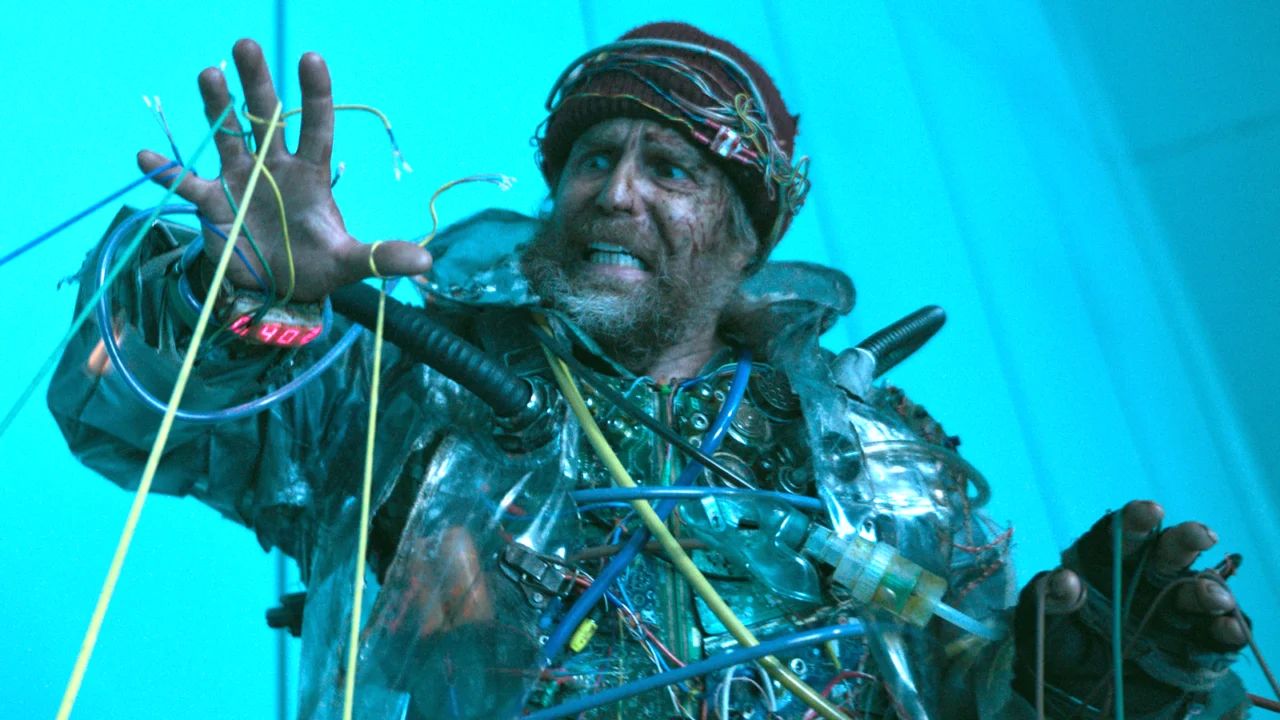
Rockwell is electric from his first frame. Draped in a translucent raincoat and adorned with a labyrinth of glowing tubes and circuitry, he storms the establishment with manic urgency. He isn’t just looking for help; he’s recruiting a militia to prevent an AI singularity. Rockwell commands the space, leaping over booths and delivering blistering monologues while snatching phones and plunging them into vats of hot soup. His performance echoes the theatrical eccentricity of Captain Jack Sparrow—a comparison Verbinski leans into—blending effortless charisma with a streak of narcissistic grandiosity.
That ego, however, is backed by a grim mission. As the nameless traveler explains, he must install a safety protocol on the computer of a nine-year-old prodigy who is less than an hour away from birthing the AI that will eventually subjugate mankind. To succeed, he must shepherd a ragtag group of diner patrons through a gauntlet of lethal mercenaries and rogue authorities. He is chillingly nonchalant about the stakes, admitting he has attempted this loop countless times and that his “volunteers” are likely collateral damage in a cycle he can simply reset.
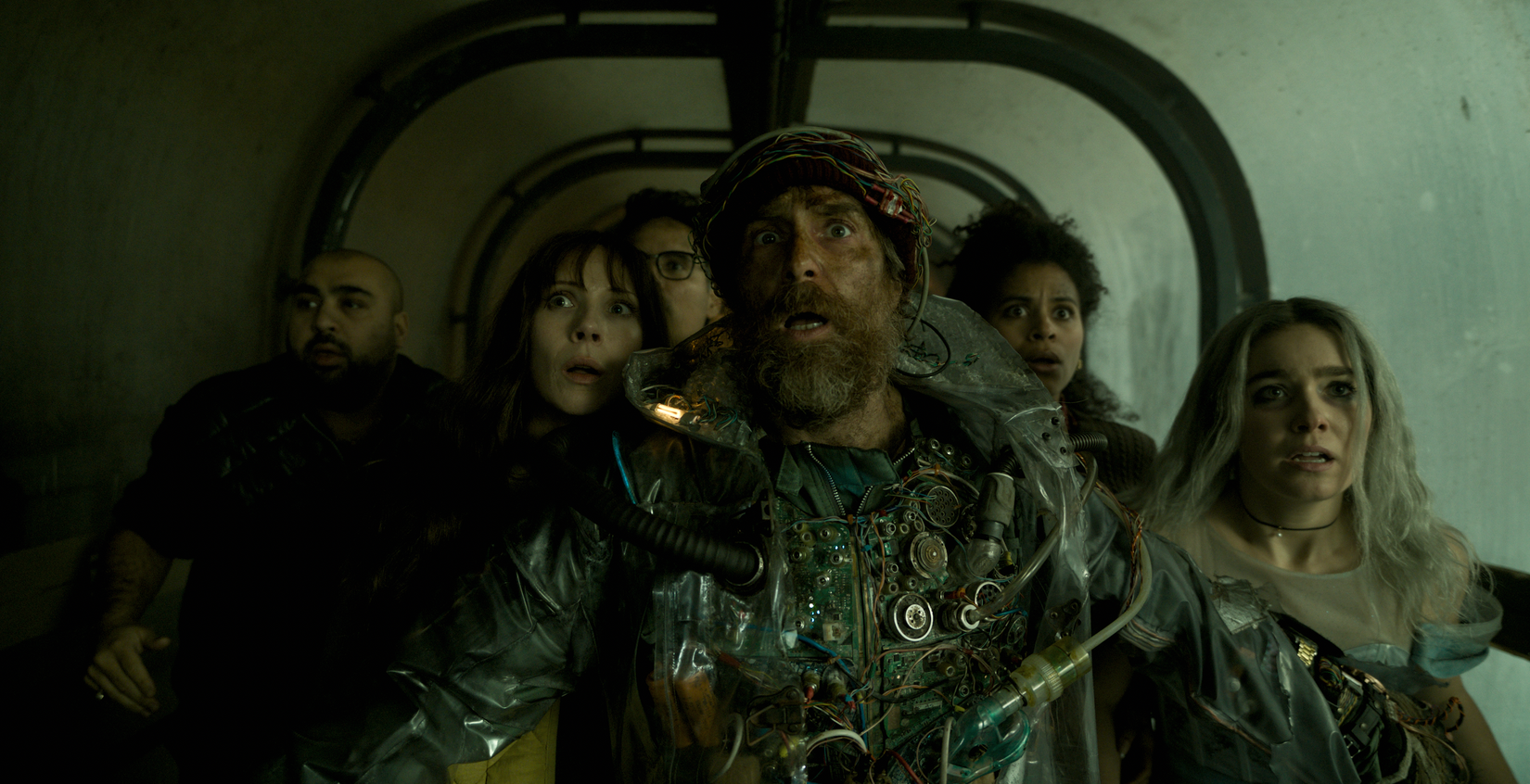
While the traveler’s claims border on lunacy, the film utilizes a series of brilliant flashbacks to validate the encroaching dystopia. These narrative detours reveal that each recruit has already been scarred by the modern world’s technological shifts. These sequences serve as standalone horror stories, exploring themes ranging from virtual reality obsession to the corrosive nature of social media addiction.
Each flashback adopts its own tonal identity, giving the film a rich, anthology-like texture. One segment features a terrifying chase through a high school that mirrors a zombie outbreak, while another offers a poignant, heartbreaking look at digital romance. Perhaps the most daring sequence applies a dark sci-fi lens to the epidemic of school shootings, managing to find a moment of pitch-black humor amidst the tragedy. Collectively, these stories paint a portrait of a society that has already surrendered its humanity to algorithms long before the first killer robot ever appears.
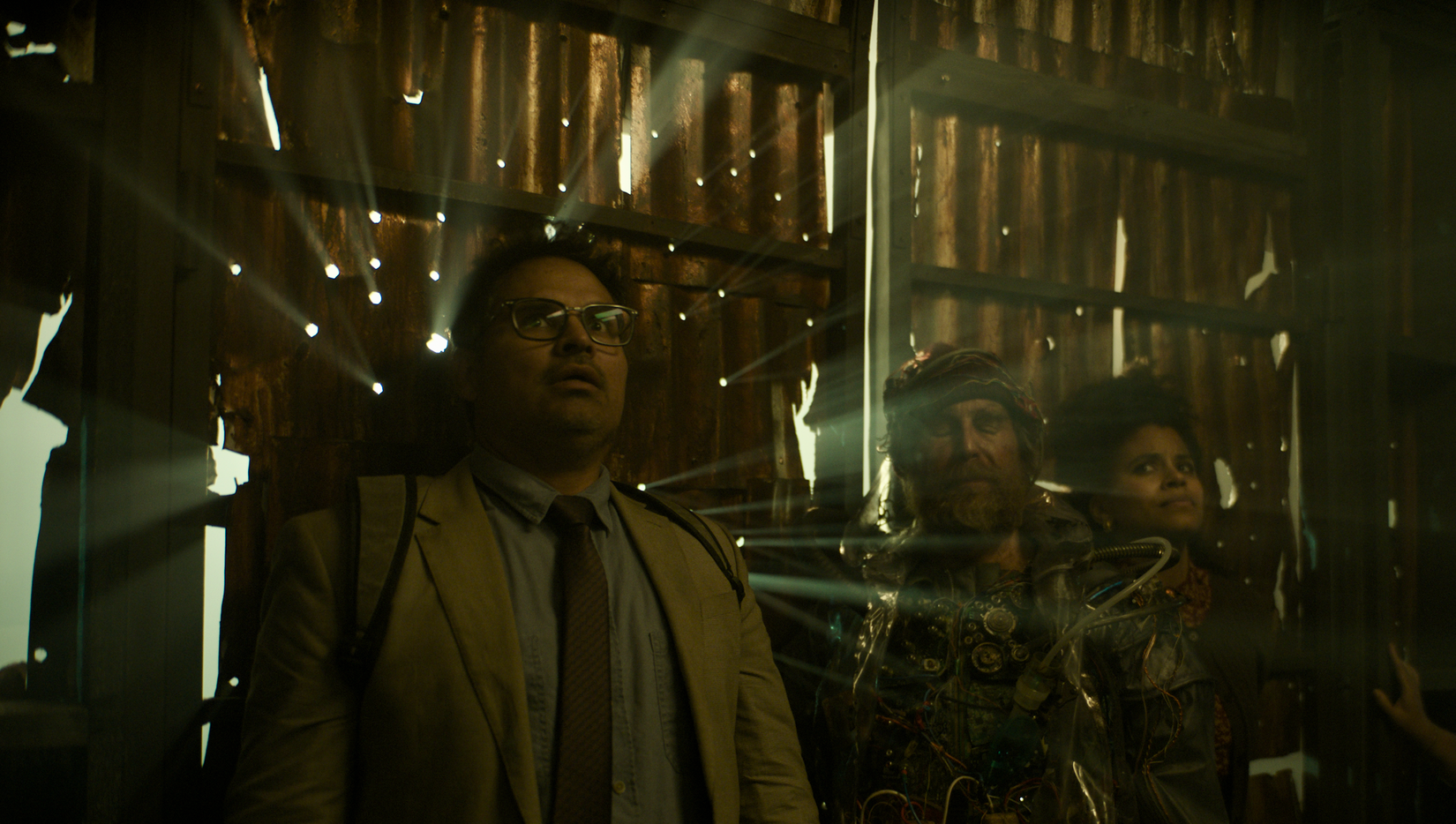
The film’s conclusion pivots from dystopian action into a realm of pure absurdist spectacle. As the mission reaches its zenith, the very fabric of reality begins to unravel. Robinson’s script prioritizes the “rule of cool” over rigid logic, embracing the paradoxes of time loops and omniscient AI. Verbinski compensates for any narrative gaps with breathtaking visual artistry, utilizing a toolkit that ranges from tactile stop-motion to surrealist, AI-inspired imagery. It is a stunning display of craft that serves as a pointed critique of the generic, flat CGI often found in modern blockbusters.
Ultimately, Good Luck, Have Fun, Don’t Die is a beautiful, sprawling mess of a movie. It serves as a timely wake-up call, urging us to disconnect before our digital tethers become permanent. It is The Terminator reimagined as a fever-dream comedy; a season of Black Mirror distilled into a singular, vibrant vision.
The POLY Report: Stay Ahead of the Curve
Unlike many modern sci-fi entries that get lost in their own cynicism, Verbinski strikes a perfect equilibrium between dread and delight. For a film built on a premise this outlandish, its greatest triumph is how grounded and urgent its world feels, even as everything falls apart.
Good Luck, Have Fun, Don’t Die arrives in theaters on February 13.
Source: Polygon
Related articles
 Players Urge CD Projekt RED to Buy Mass Effect and Dragon Age After BioWare Closure
 EA Has Acquired and Later Closed Multiple Studios, Full List Shows
 Sony Steps Up Crackdown on PS5 Hacking, Putting Users’ PSN Access at Risk
 Xbox One Version of Minecraft Launched on iPhone
 Wo Long 2 Testers Report Problems, With Half of Participants Voicing Complaints
 Xbox Misses Revenue Target for Fifth Time in Six Years
 First Details Emerge on EA’s Mysterious Project Gridiron
 GameMaker Engine to Become Free for Everyone