George Lucas’s Sci-Fi Debut Remains His Most Intriguing Work 55 Years Later

Long before George Lucas introduced audiences to the twin suns of Tatooine or the permafrost of Hoth, his directorial debut imagined a sterile, tech-infused dystopia far more oppressive than anything governed by the Star Wars Empire.
Initially released in March 1971, THX 1138 has spent over half a century existing largely as a footnote to Lucas’s more famous galactic saga. While the filmmaker frequently peppered references to his first film throughout the Skywalker films, the movie itself shares more DNA with the literary warnings of Aldous Huxley and George Orwell than it does with the whimsical adventures of Ewoks. This makes it a fascinating, rare departure in the creator’s filmography that remains essential viewing for science fiction purists.
 Image: Warner Bros./The Everett Collection
Envisioning Earth in the 25th century, THX 1138 depicts a bleak subterranean existence where physical intimacy is outlawed and all human emotion is neutralized through state-mandated narcotics. Survival centers entirely around labor, overseen by unyielding robotic police units.
Robert Duvall stars as the titular THX 1138, a factory hand tasked with assembling volatile, radioactive androids. His world is disrupted by his roommate, LUH 3417 (played by Maggie McOmie), who initiates a quiet rebellion by tampering with their medication. Once the chemical fog lifts, they experience genuine desire—an act of defiance immediately flagged by pervasive surveillance systems. The consequences are brutal: LUH is executed, and THX is condemned to a white-room purgatory. In a final surge of humanity, THX attempts a daring breakout, not just from his cell, but from the entire subterranean civilization.
 Image: Warner Bros.
The thematic links to Huxley’s 1932 masterpiece Brave New World and Orwell’s 1984 are palpable. Lucas weaves together the drug-fueled compliance of a false utopia with the anti-intimacy mandates of a totalitarians state. Even the religious iconography—a portrait of Jesus used for secular confessionals—echoes the chilling presence of a “Big Brother” figure.
However, Lucas distinguishes the film through exceptional world-building. THX 1138 is defined by its clinical, antiseptic aesthetic, where every frame emphasizes a society that values rigid efficiency over the sanctity of life. This reaches a visual peak during the prison sequence, where the characters are adrift in a shoreless, featureless white void that offers no sense of orientation or escape.
The manufacturing hubs also stand in stark contrast to his later work. While the droid foundries in Attack of the Clones feel mechanical and lived-in, the factories here are chillingly immaculate and devoid of spirit. This atmosphere is heightened by the grim reality that the workers are essentially disposable, often vaporized in frequent industrial accidents without a second thought from their superiors.
 Image: Warner Bros./The Everett Collection
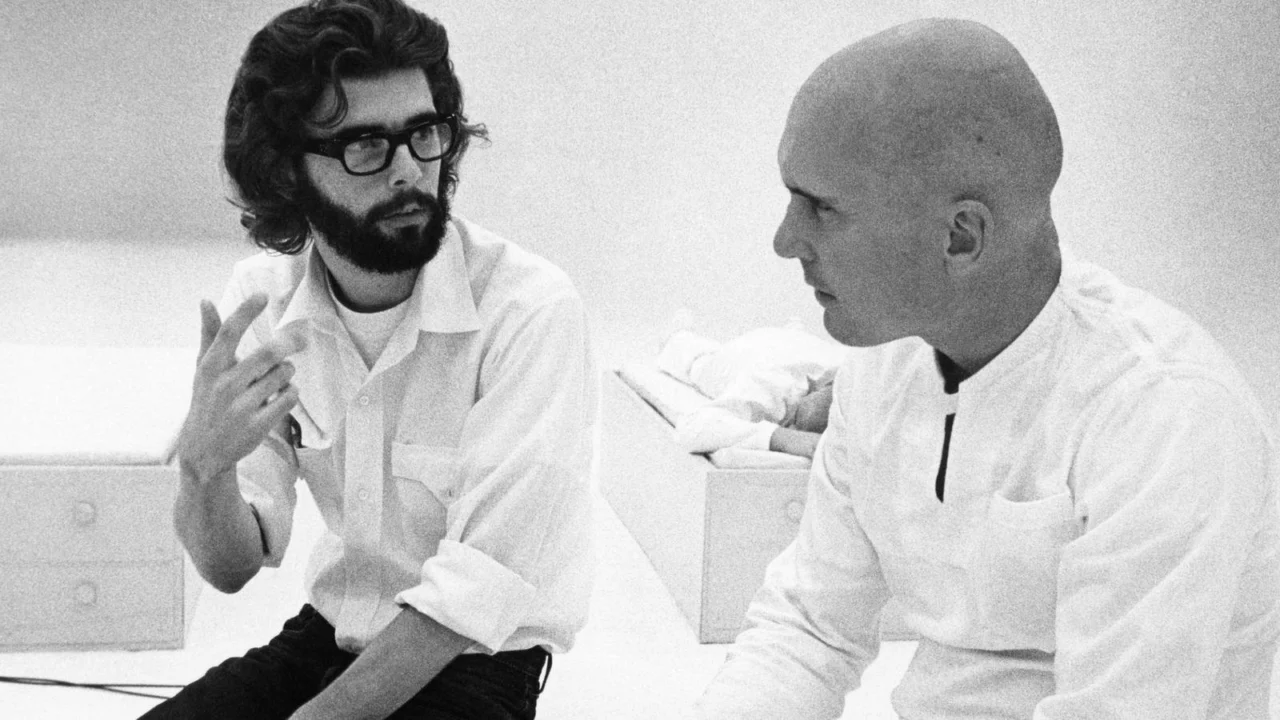
To reinforce this sense of dehumanization, Lucas required the entire cast to shave their heads, creating a jarring androgyny that strips away individuality. The robotic enforcers remain a visual highlight; their polished, chrome, and entirely vacant faces—reminiscent of the T-1000—serve as haunting icons of unfeeling authority.
While the film’s deliberate, monotone pacing can occasionally feel hypnotic to the point of sluggishness, it serves as a captivating look at a version of George Lucas that largely vanished after 1977. When viewed alongside his second film, the nostalgia-heavy American Graffiti, these early projects hint at a reality where Lucas might have enjoyed a diverse, experimental career similar to that of Steven Spielberg.
That path, however, was never taken. Lucas ultimately dedicated his life to the granular mythology of the Force and the evolution of digital cinema (even retrofitting THX 1138 with CGI enhancements in 2004). Nevertheless, his debut remains a striking anomaly—a window into the provocative sci-fi vision he possessed before he was forever claimed by a galaxy far, far away.
Source: Polygon
Related articles
 SPINE Gets New Trailer Focused on Main Character Customization
 Unofficial Android Port of Call of Duty 4: Modern Warfare Reportedly Runs at 60 FPS in Gameplay Videos
 Cyberpunk 2077 Co-Op Mod in Development, Gameplay Trailer Released
 Toxic Arc Raiders Players Found a Way to Harass Others in PvE Mode
 First Look at Drova II Torn Lands, Sequel to the Pixel Art Gothic-Like RPG
 CDPR Didn’t Expect Such Big Interest in The Witcher 3 Remaster, Which Set a New Record
 9 Best Single-Player Zelda-Like Games Nobody Plays, Ranked
 Resident Evil 2 on Switch 2 Is My New Favorite Way to Play Capcom’s Horror Masterpiece