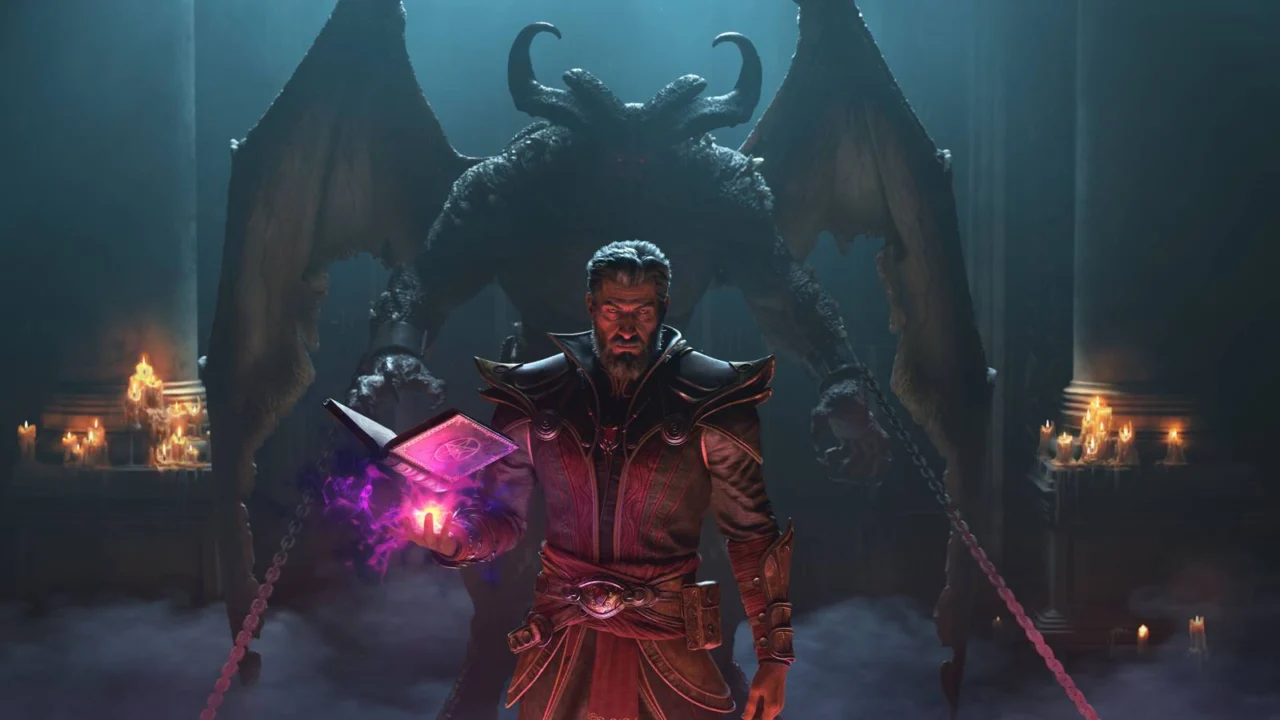
Diablo 2’s Warlock is a revolutionary addition unlike any other in the game’s 26-year history
In a move that caught the gaming world entirely off guard, Blizzard Entertainment recently unveiled and immediately released a brand-new character class for Diablo 2: Resurrected. Titled Reign of the Warlock, this premium expansion introduces the first significant content update for the iconic action-RPG in nearly a quarter-century. For a title that defines the genre, adding a fresh archetype like the Warlock is nothing short of a historic milestone.
On the surface, Reign of the Warlock serves as a centerpiece for Diablo’s 30th-anniversary festivities and a calculated piece of cross-promotional synergy. The Warlock is set to headline the Lord of Hatred expansion for Diablo 4 this April, while the mobile-centric Diablo Immortal is slated to receive its own iteration later this year. Meanwhile, Diablo 3 enthusiasts find themselves left out of the anniversary celebrations, though many remain steadfast in their belief that they are already enjoying the series’ most refined entry.
Despite its role as a marketing catalyst, Reign of the Warlock is surprisingly substantial. While it stops short of introducing a new narrative Act—a point of contention given its $25 price tag—it delivers a fully realized class complete with intricate skill trees, specialized gear, professional voice acting, and modern visual effects. Early impressions suggest this version of the Warlock is distinct from its counterparts in Immortal and Diablo 4. Accompanied by updated endgame systems and various quality-of-life enhancements, this is a genuine expansion for a decades-old masterpiece, leaving the Diablo 2 community in a state of shock.
 Image: Blizzard Entertainment
The motivation behind this intensive development effort likely lies in the game’s enduring scale. During a recent 30th Anniversary Spotlight, developers highlighted that Diablo 2 still commands an audience of millions. If Reign of the Warlock proves successful, it could pave the way for even more ambitious updates. Effectively, Blizzard is reclaiming its territory in the ARPG space, positioning Resurrected as a direct competitor to titles like Path of Exile that have long catered to the hardcore Diablo 2 faithful.
This evolution creates a fascinating paradox: how do you modernize a game whose primary appeal is its preservation? Blizzard is borrowing a strategy from World of Warcraft Classic by utilizing a “segmented” ecosystem. The Reign of the Warlock content exists as its own separate era. This allows purists to continue their journey in the vanilla environment, free from modern conveniences like stackable materials or advanced loot filters. However, this separation comes with a caveat: the Warlock’s era does not support the original legacy graphics mode, a feature that remains exclusive to the base Resurrected experience.
 Image: Blizzard Entertainment
The Warlock himself is a masterclass in thematic adaptation. While he is fundamentally an occult summoner, the Diablo 2 iteration feels grounded in the game’s signature grit. This addition acts as a narrative bridge, establishing the origins of the dark magics that eventually evolve into the unrestrained power seen in later chronologies. The class offers three distinct specializations: the Chaos tree provides high-impact fire sorcery; the Eldritch tree facilitates a unique “battle mage” playstyle involving telekinetic weaponry and defensive curses; and the Demon tree focuses on subjugating hellish minions.
In practice, the Warlock offers a rhythm unlike any other class in the game. Balancing the management of enslaved Goatmen while simultaneously diving into melee combat creates a kinetic, rewarding experience. It breathes new life into the hunt for powerful weapon drops, offering a hybrid playstyle that feels both fresh and deeply rooted in the Diablo 2 mechanical philosophy.
 Image: Blizzard Entertainment
Of course, replicating the exact design sensibilities of the year 2000 is an impossible task. As Chris Wilson, founder of Grinding Gear Games, noted in a recent commentary, the Warlock feels slightly “modernized” because it lacks the “filler” or intentionally weak skills found in original classes. There is a sense that the character was reverse-engineered to align with Diablo 4, rather than being a purely organic extension of the classic game’s limitations.
Nonetheless, what Blizzard has achieved here is remarkable. The Warlock avoids feeling like an anachronism by leaning into design principles that remain timeless. It possesses a certain “interesting friction” that makes it feel like it belongs in the past, yet it provides enough novelty to satisfy modern expectations. Whether Blizzard will eventually expand this experiment into a full story Act remains to be seen, but for now, the Warlock stands as a rare and unexpected gift for one of gaming’s most dedicated fanbases.
Source: Polygon
Related articles
 Cult Shooter Black Gets Fan-Made Android Port
 Details Emerge on Canceled Mass Effect Universe, Reportedly With Hitman-Style Missions and a Setting 600 Years After Shepard
 Xbox COO Helen Chiang leaves Microsoft after 21 years
 Aaron Paul Originally Had a Larger Role in Clayface Before His Part Was Reduced to a Cameo
 Pixel Body Horror Game Look Outside Is Coming to Consoles
 Paramount’s Scream 7 Becomes a Streaming Hit on Prime Video
 New Details Emerge About Marvel’s Zodiac Series, Featuring Spies Against People With Superpowers
 Fallout Day 2026: All the Major Announcements from Bethesda’s Fan Event