
Battlefield 6: January Anti-Cheat Metrics
Greetings, Soldiers,
We have been closely monitoring the active discourse regarding how the Match Infection Rate (MIR) is calculated, especially as cheat developers strive to circumvent our security measures. While maintaining the secrecy of our specific protocols is vital, we want to provide transparency regarding the underlying architecture of this metric. MIR accounts for both confirmed cheaters—who are promptly banned—and suspected individuals identified through an expanding array of behavioral signals and detection layers. These include indicators that may not serve as definitive proof on their own, such as community reports and shared gameplay footage.
Every session containing at least one confirmed or highly suspected offender is categorized as “infected.” We determine the final MIR by weighing these infections against the total volume of matches. As our Javelin and Battlefield engineering teams refine our detection capabilities—introducing new signals while updating or retiring legacy ones—the MIR fluctuates automatically. This dynamic approach ensures our data remains accurate as we navigate a continuously shifting landscape of digital threats.
Because MIR serves as a retrospective metric designed to minimize data rework, it requires a period of “maturation” to reach full stability. This is why we focus on previous-month data in our transparency reports. For instance, with a month of additional telemetry, the MIR for December 31st was refined to 2.28%, down from the initial 3.09% cited in our December update.
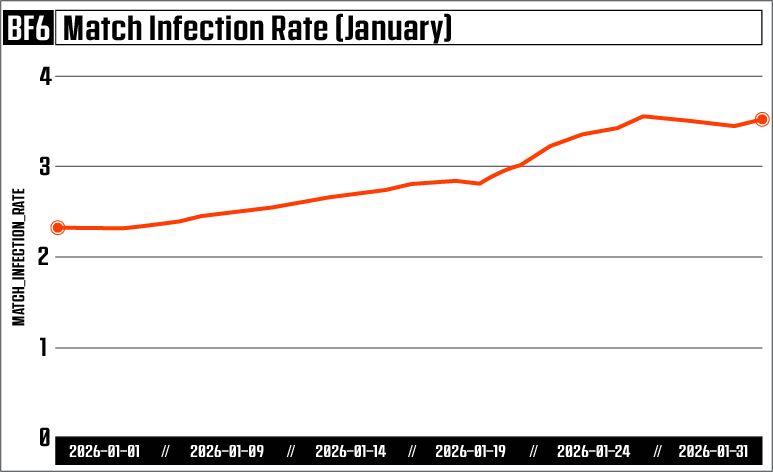
Match Infection Rate (MIR): This represents the percentage of total matches compromised by at least one bad actor. This figure includes suspected cheaters, even in cases where current evidence levels are not yet sufficient for immediate enforcement.
In January, the MIR opened at 2.38% and trended upward throughout the month, concluding at 3.60% by January 31st. This increase was driven by two primary factors: first, a major breakthrough in identifying six “Stealth” cheat variants designed to avoid high-impact detection; and second, the deployment of a more aggressive ban-acceleration protocol that began testing on the 18th and went live on the 26th.
Throughout January, EA Javelin Anti-Cheat successfully neutralized 384,918 attempts to compromise game integrity before they could affect live matches. We continue to monitor 224 distinct cheat programs, hardware-based bypasses, and their associated distribution networks. Currently, 212 of these entities (94.64%) are reporting significant service disruptions, detection alerts, or have been forced entirely offline.
We remain committed to analyzing your feedback and will return with February’s data in the coming weeks.
Maintain your integrity—we’ll see you on the Battlefield.
Related articles
 Battlefield 6: Community Update on What’s Coming in Season 5
 Battlefield Community Survey – Siege of Las Vegas
 Battlefield x Dead Space Crossover Event: A Guide to the New Nightmares
 Steam Free Trial Extended!
 Live Q&A on Battlefield Discord, October 20: Siege of Vegas and Season 5
 Battlefield 6 Full Game Trial*
 Game of the Year Edition
 Battlefield 6 | REDSEC Season 5