
Why Super Meat Boy Struggles as a 3D Platformer
After a decade and a half of subjecting players to grueling, frame-perfect trials, the Super Meat Boy franchise has finally encountered a challenge of its own making: the leap into the third dimension. Super Meat Boy 3D seeks to modernize an indie legend by translating its famously punishing 2D platforming into a 3D space that remains just as merciless. It is a logical, perhaps even inevitable, evolution for the brand, yet like one of the game’s many hazards, sticking the landing is much harder than it looks.
While the game understands the destination it needs to reach, Super Meat Boy 3D frequently falters in the journey. Developed by Sluggerfly in partnership with Team Meat—notably continuing without the involvement of series co-creator Edmund McMillen—this latest outing feels significantly less refined than its 2D predecessors. Imprecise character movement and rigid camera perspectives add an unwelcome layer of frustration to an already steep difficulty curve. Rather than a bold reinvention, the project feels like a headlong dive into familiar hazards without the grace of the originals.
The core proposition of Super Meat Boy 3D is transparent: it is the same high-stakes meat-grinder, now with depth. Beneath the shift in perspective lies the same skeleton that helped ignite the indie revolution back in 2010. Controlling the titular cube of raw beef, players must navigate lethal gauntlets in a desperate quest to rescue Bandage Girl from the villainous Dr. Fetus. Combat is non-existent; your only tools are agility and stubbornness as you weave through buzzsaws and spikes that liquefy you upon the slightest contact.
The series’ signature subversion of platforming tropes survives the transition. In most games, death is a temporary setback to be ignored; here, it is a grizzly record of your failure. Every surface becomes painted with the blood of your previous attempts, and the end-of-level replay showcases a chaotic swarm of all your past deaths occurring simultaneously. It remains a psychological battle against a game that delights in your struggle, complete with condescending loading screens that mock your lack of skill. It may be 2026, but the game’s heart is firmly rooted in the antagonistic design of the early 2010s.
When the mechanics click, the satisfaction remains potent. Each of the five primary worlds—and their even more sadistic Dark World counterparts—functions like a digital obstacle course. The level design is intentionally malicious, featuring “gotcha” moments that punish overconfidence. There is a specific thrill in the trial-and-error loop, where a stage that once felt impossible eventually becomes a 20-second blur of muscle memory and instinct.
 Image: Sluggerfly/Team Meat, Headup/Gcores Publishing
The 3D environment grants the developers a broader canvas for inventive platforming gimmicks. Dodging between intersecting train cars or timing leaps across oscillating electrical beams brings the series closer to the creative spirit of Nintendo’s 3D masterpieces. While certain experiments—like late-game gravity manipulation—falter, the game is generous enough to let you bypass certain levels to reach the world bosses. It is a rare moment of leniency in a game otherwise defined by hostility.
However, moving through these worlds often feels like a chore. Meat Boy’s expanded moveset, including an air dash and limitless wall jumping, results in controls that feel slippery compared to the surgical precision of the 2D originals. This lack of friction might delight speedrunners looking for unintended skips, but for the average player, it makes the character feel floaty and erratic. Nailing a pixel-perfect landing is difficult when the physics engine feels like it’s working against you.
Everything about Super Meat Boy 3D is unrefined compared to the surgical precision of the series’ 2D entries.
Technical shortcomings further dampen the experience. Fixed camera angles frequently obscure depth, making it nearly impossible to judge jumps in 3D space accurately. You might aim for a platform only to find yourself falling through a gap that was invisible from your current perspective. Additionally, Meat Boy’s tiny size on screen often causes him to get lost among the visual noise of the larger, busy levels. These issues are exacerbated by clipping bugs that can trap you inside level geometry—making the dedicated “self-destruct” button an essential tool for survival.
The difficulty curve is equally haphazard. Instead of a steady climb, the challenge oscillates wildly; an incredibly punishing auto-scrolling chase early on is followed by bosses that can be defeated in mere seconds. This inconsistency contributes to an overall sense of messiness that contrasts poorly with the series’ reputation for tight design.
The most disappointing aspect of Super Meat Boy 3D is its lack of ambition. Historically, the transition from 2D to 3D is an opportunity to redefine a franchise. Super Mario 64 wasn’t just a 3D version of a 2D game; it reimagined how players interact with digital environments. Super Meat Boy 3D, by contrast, plays it safe. It treats the extra dimension as a superficial novelty rather than a fundamental shift in gameplay.
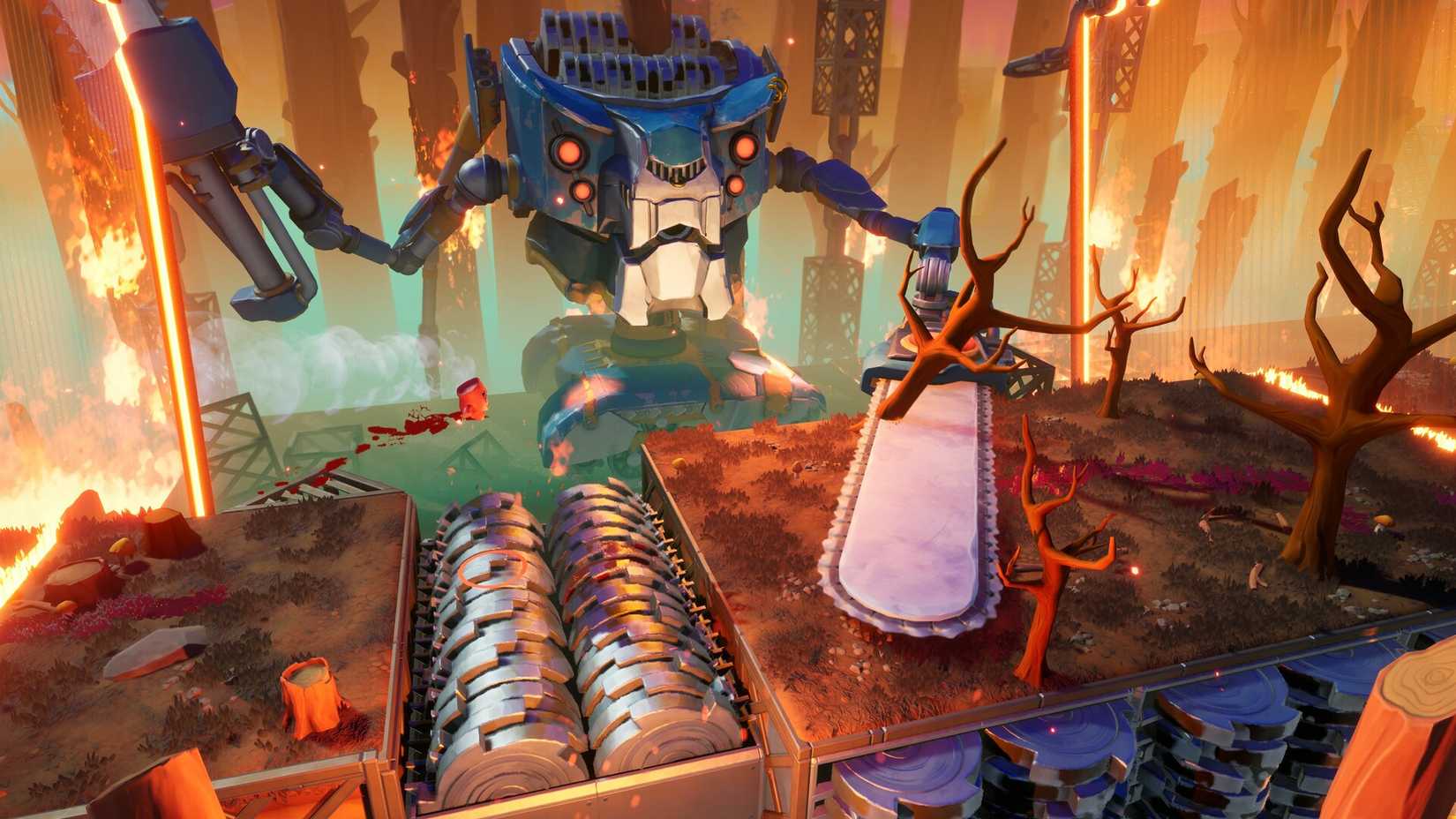 Image: Sluggerfly/Team Meat, Headup/Gcores Publishing
Even the experimental spinoff Dr. Fetus’ Mean Meat Machine felt more inspired, despite its mixed reception. It applied the Meat Boy ethos to a completely different genre. Super Meat Boy 3D, however, feels like a series that has run out of questions to ask. It is stagnant, stuck in a creative loop that mirrors its own repetitive death cycles.
For those simply seeking a fresh injection of masochistic platforming, Super Meat Boy 3D provides a sufficient fix. It is packed with traps, hidden bandages, and par times that will keep completionists busy for hours. But as a broader evolution of the genre, it falters in the transition. It misses its mark, and in this series, that only leads to one thing: a messy splat and a prompt to try again.
Super Meat Boy 3D launches March 31 on Nintendo Switch 2, PlayStation 5, Windows PC, and Xbox Series X. This review was conducted on Windows PC via a prerelease code provided by Headup. For more on our editorial standards, see the Polygon ethics policy.
Source: Polygon
Related articles
 Blizzard Explains World of Warcraft Forever Development Approach and Community Relations
 Third Trailer Released for The Apothecary Diaries Anime Film
 Sony Reveals PlayStation Plus Free Games Lineup for October
 Disco Elysium Co-Creator Reveals Red Rooster, a Physics-Focused RPG
 Cozy SnowRunner Alternative Over the Hill Released on Steam
 First Look at Xbox Nano Controller, Microsoft’s Smallest Gamepad
 Steam Releases Co-Op PvE Extraction Shooter Set in Anomalous Zones
 GTA Co-Creator Explains Why Rockstar Canceled Spy Action Game Agent