The New Action Game That Feels Like a Playable Mission: Impossible Stunt
There exists a rare tier of indie auteurs who I believe deserve an unlimited budget just to see how far their creativity could reach. If Strange Scaffold’s Xalavier Nelson Jr. is one such visionary, then Neil Jones—widely recognized as Aerial Knight—sits firmly alongside him. Jones possesses a unique talent for engineering action titles that feel exponentially larger than their technical boundaries. His 2021 breakout, Aerial_Knight’s Never Yield, reimagined the conventional auto-runner as a stylish, slow-motion parkour spectacle. It functioned as a minimalist homage to Mirror’s Edge, capturing the sheer velocity and aesthetic of a high-octane film without needing a Hollywood treasury. While it wasn’t the most sprawling experience, its brilliance lay in its restraint, allowing the player’s imagination to bridge the gaps between its lo-fi visuals and high-concept thrills.
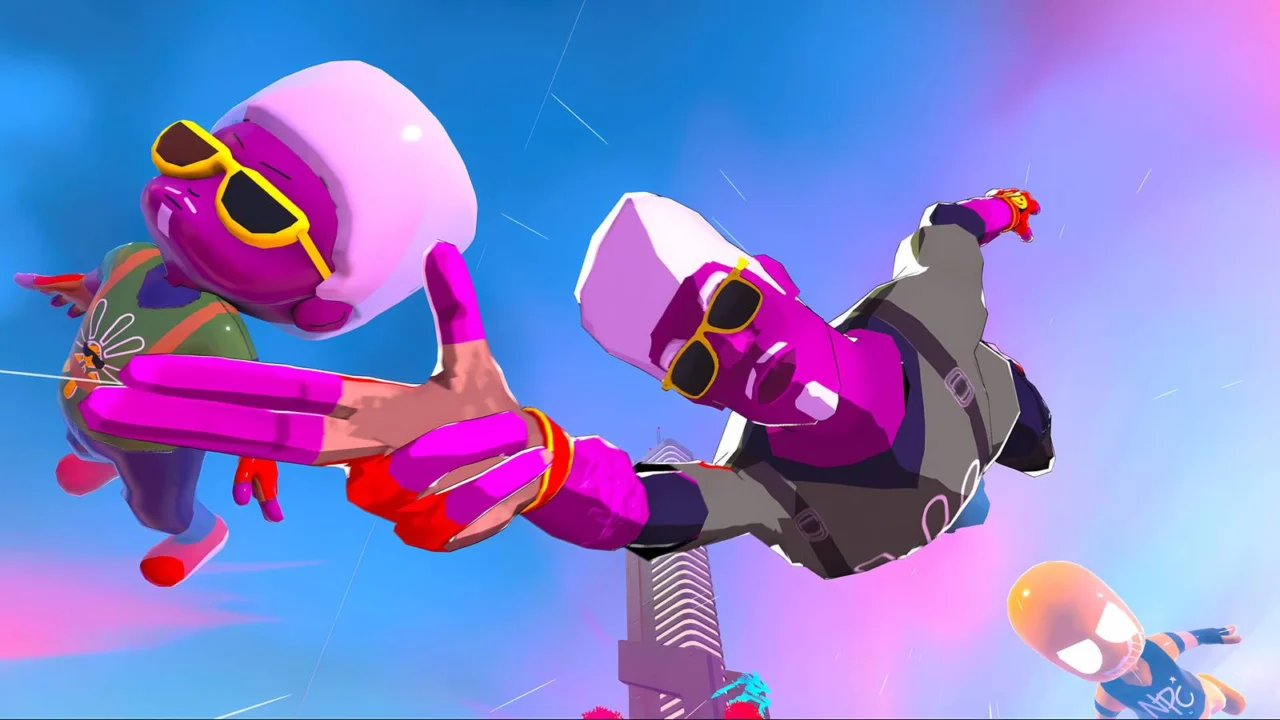
Jones has effectively captured lightning in a bottle once again with his newest endeavor, Aerial_Knight’s DropShot. This concentrated action experience isolates a classic Mission: Impossible-style skydiving sequence and expands it into a lean, rhythmic shooter. Although it prioritizes speed over narrative depth and occasionally stumbles with its mechanical quirks, DropShot succeeds by deconstructing the blockbuster set-piece, extracting every ounce of adrenaline from its core premise.
Where his previous title was defined by horizontal momentum, DropShot is an exercise in verticality. Players assume the role of Smoke Wallace, a dragon hunter whose arsenal consists entirely of lethal, literal finger guns. The narrative is secondary to the sensation: you are plummeting from the heavens, engaging in mid-air dogfights with rival hunters and mythical beasts. It feels like stepping into the shoes of a world-class stuntman, perfecting a high-stakes aerial maneuver across a series of bite-sized levels that rarely exceed ninety seconds.
The objective is elegantly simple: survive the descent while eliminating threats from a first-person perspective. Achieving a perfect run requires surgical precision, as Smoke’s “ammunition” is finite. Reloading demands that you strike or shoot balloons floating in the air, turning each level into a high-speed resource management puzzle. You’ll weave through acceleration rings and dodge airborne wreckage, all while trying to choreograph the perfect path to clear the screen before you reach the ground.
DropShot deconstructs the cinematic stunt, isolating the core elements that make a spectacle truly captivating.
This unwavering focus on the core sensation of falling is where the game truly shines. DropShot masterfully communicates the friction of the wind and the weight of the plunge, making every pivot and aim-adjustment feel tactile. The feedback from each shot is surprisingly heavy, giving the impression that your finger guns pack the punch of heavy artillery. It’s a testament to how smart design can simulate a high-budget experience without the need for photorealistic rendering.
However, that same narrow focus occasionally leaves the game’s edges feeling unpolished. The play area is restricted by an invisible perimeter; straying too far triggers a short countdown that leads to an instant forfeit. Without a clear visual indicator of where these boundaries lie, it’s easy to fail a level simply by oversteering. Furthermore, some interactive elements, like speed boosts during boss encounters, are occasionally placed dangerously close to these “dead zones.” The randomized power-ups also feel hit-or-miss; you might trigger a devastating area-of-effect attack exactly when the sky is empty, leading to a wasted advantage.
 Image: Aerial_Knight
Despite these minor frustrations, DropShot is an admirable feat of conceptual engineering. Jones effectively bridges the gap between modern cinematic action and the arcade heritage of titles like Space Harrier. By abstracting the spectacle, he reveals a classic shoot ’em up core that feels both nostalgic and fresh. It serves as a reminder that the limitations of a project can often be its greatest strength, forcing a developer to find the soul of the gameplay.
While I would still love to see what Aerial Knight could achieve with a massive budget, there is something profoundly meaningful about his current output. DropShot strips away the excess to find the essential rhythm of the action hero. It’s a lean, vibrant intersection of filmic energy and interactive play that proves you don’t need a billion dollars to make a player’s heart race.
Aerial_Knight’s DropShot is currently available on PlayStation 5, Xbox Series X, and PC. This review was conducted on PC via a pre-release code provided by the developer. You can review our ethics policy for more information on our editorial standards.
Source: Polygon
Related articles
 New «Avengers: Doomsday» Teaser Features Two Captain Americas and Fantastic Four Baseball Game
 One Piece: Grand Gourmet Restaurant Sim Launches on Mobile and PC
 Jenna Ortega Wants to Step Away From TV Series After Wednesday and Explains Why
 Two New Trailers Released for Mamoru Oshii’s Armored Trooper Votoms: Die Graue Hexe Ahead of Nov. 20 Premiere
 Lawrence Makoare, Who Played Lurtz in The Lord of the Rings, Says He Is Joining The Hunt for Gollum
 GTA IV Gets Experimental Android Port
 High Plains Drifter, Clint Eastwood’s Western, Now Streaming Free on YouTube
 New Edition of Battlestar Galactica: The Board Game in Development, With Cylons Returning