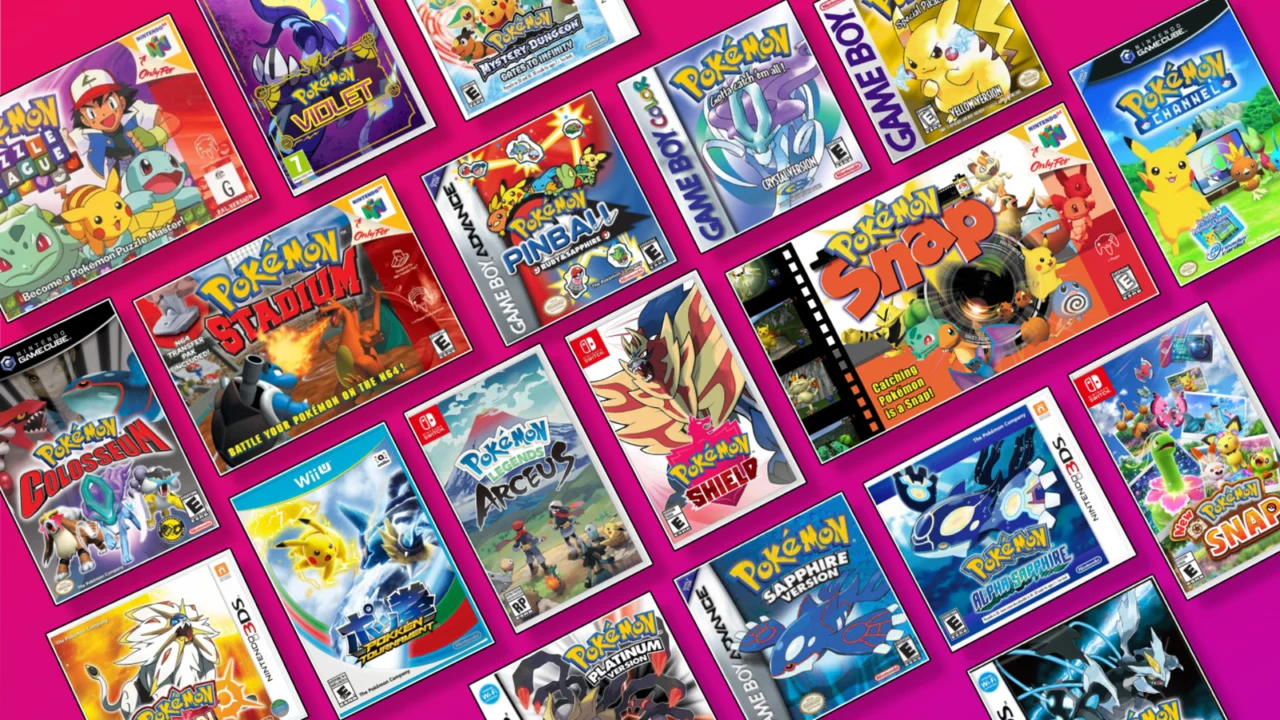
Ranking Every Pokémon Generation From Worst to Best
Pokémon has officially entered its third decade, reaching an age where it might reasonably expect a bit of phantom joint pain after stooping to retrieve a stray Poké Ball. Over those thirty years, the franchise has evolved through distinct eras—or generations. Each time a new core RPG arrives, it signals the dawn of a fresh epoch. These four-year cycles don’t just bring new monsters; they unleash a tidal wave of experimental spinoffs and creative side-projects that define the brand’s identity for that period.
Rather than retreading the tired path of ranking the mainline RPGs in a vacuum, we’re celebrating Pokémon’s milestone birthday by looking at the bigger picture. How does every generation perform as a cohesive whole? We aren’t just weighing the heavy hitters; we’re judging the spinoffs, the remakes, the DLC, and the mobile ventures that defined those specific years. By examining the franchise in its totality, we can see how the series has truly matured (or stumbled) across three decades of monster-catching history.
9
Generation 7: Pokémon Sun and Moon

Highs: Ultra Sun and Ultra Moon, Let’s Go! Pikachu and Eevee, Magikarp Jump
Lows: Pokémon Masters EX, Pokémon Quest
I’ve always championed Pokémon’s more daring departures. Sun and Moon, for instance, deserves praise for dismantling the predictable gym circuit in favor of Island Challenges that leaned into its Hawaiian-inspired vibes. However, even the most devoted Alola fans must admit this was an ambitious swing that didn’t quite clear the fences. The “Ultra” follow-ups refined the concept, but the foundation remained somewhat shaky.
Beyond the core games, Gen 7 felt like a frantic transition period. It was trapped in the awkward liminal space between the 3DS’s sunset and the Switch’s sunrise. By the time the Switch arrived, fans were clamoring for the next big leap; instead, we received Pokémon Let’s Go! Pikachu and Eevee. While these Kanto remakes were divisive, they successfully translated the Pokémon Go phenomenon into a home console experience. The rest of the era was marred by microtransaction-heavy mobile titles like Pokémon Masters EX and the blocky Pokémon Quest, both of which signaled a shift in the franchise’s commercial priorities. A lone bright spot remains Magikarp Jump—a bizarrely charming idle game that stands as one of the series’ most focused mobile triumphs.
8
Generation 5: Pokémon Black and White

Highs: Pokémon Conquest, Mystery Dungeon: Gates to Infinity
Lows: Pokémon Rumble Blast, Pokémon Rumble U, PokéPark 2
The Black and White era is defined by its audacity. In a move that remains the gutsiest in series history, The Pokémon Company benched all 151 original monsters to launch with an entirely new roster. It was a polarizing gamble that yielded both design disasters and instant icons like Chandelure. With a narrative that had actual weight and the introduction of genuine sequels (B2W2) rather than a mere “third version,” Gen 5 earned the undying loyalty of a specific subset of the fandom.
This “hit or miss” energy extended to the spinoffs. The era was populated by niche experiments destined for cult status, most notably Pokémon Conquest, an improbable but brilliant tactical crossover. While Gates to Infinity was dismissed at launch, it has since been reclaimed by Mystery Dungeon enthusiasts. Unfortunately, the filler was particularly bland. Titles like Pokémon Rumble Blast and PokéPark 2 felt like uninspired attempts to keep the brand relevant during the Wii U’s struggles. Gen 5 is very much a “if you know, you know” generation, but a handful of hidden gems aren’t enough to propel it higher.
7
Generation 9: Pokémon Scarlet and Violet

Highs: Pokémon Legends: Z-A, TCG Pocket
Lows: Pokémon Friends, Hidden Treasure of Area Zero DLC
It’s tempting to bury Gen 9 based solely on the technical catastrophe that was Scarlet and Violet. However, beneath the frame-rate drops and glitches, the core RPGs were actually quite inspired. They offered a genuine open-world experience where monsters felt like part of an ecosystem, and the non-linear structure provided a much-needed breath of fresh air. Once they were decoupled from the original Switch’s hardware limitations via upgrades, their quality became much harder to ignore.
The real issue lies in the ecosystem surrounding Paldea. The Pokémon Company’s focus shifted heavily toward aggressive mobile monetization. While Pokémon Sleep was a cute experiment in health gamification, it was weighed down by microtransactions, as was the otherwise polished TCG Pocket. Outside of the mobile sphere, the console offerings were thin, with Detective Pikachu Returns failing to recapture the magic of the original. Thankfully, Legends: Z-A arrived to prove that the series could still innovate with real-time action. With Pokémon Pokopia on the horizon, Gen 9 might yet redeem its uneven start, but for now, it remains mid-tier.
6
Generation 2: Pokémon Gold and Silver

Highs: Pokémon Crystal, Pokémon Stadium 2, Pokémon Puzzle League
Lows: Pokémon Mini
Nostalgia beckons me to place the Johto era at the top. Gold, Silver, and Crystal pulled off the impossible: a sequel that felt bigger, bolder, and more iconic than the cultural juggernaut that preceded it. The post-game reveal of Kanto remains one of the greatest “mic drop” moments in gaming history. For many, this represents the peak of the Game Boy era, refining the mechanics of Red and Blue into something nearly perfect.
When looking at the generation in its entirety, however, the offerings were sparse. Outside of the masterful RPGs, we only received a few notable titles like Stadium 2 and the surprisingly addictive Puzzle League. Much of the company’s energy was diverted into the Pokémon Mini—a niche handheld that few remember today. While this meant fewer “duds” than modern generations, it also meant less variety. Gen 2 represents a period of laser-focused excellence over broad experimentation, which is admirable, but places it squarely in the middle of this list.
5
Generation 8: Pokémon Sword and Shield

Highs: Pokémon Legends: Arceus, New Pokémon Snap, Pokémon Unite
Lows: Brilliant Diamond and Shining Pearl
Gen 8 is where the franchise’s armor first showed major cracks. As the debut RPGs for a HD console, Sword and Shield faced intense scrutiny for their visual fidelity. While the criticism was loud, the games themselves were solid; the Wild Area was a revolutionary stepping stone, and the Galar region’s British flair was delightful. But truthfully, the mainline entries weren’t the stars of this show.
The heavy lifting was done by Pokémon Legends: Arceus, a radical reinvention that stripped the series down to its core—catching and exploring—and made it feel new again. Coupled with the long-awaited New Pokémon Snap and the surprisingly deep MOBA Pokémon Unite, Gen 8 was a powerhouse of successful spinoffs. The only major blemish was the Diamond and Pearl remakes, which felt like a significant step backward in terms of ambition. It was a transitional generation, but one that paved the way for the series’ future.
4
Generation 6: Pokémon X and Y

Highs: Pokémon Go, Pokkén Tournament, Omega Ruby and Alpha Sapphire
Lows: Pokémon Rumble World
Pokémon X and Y represented the last time the mainline RPGs felt truly “prestige.” The jump to full 3D on the 3DS was handled with grace, utilizing the hardware’s perspective to make Kalos feel grander than any previous region. More importantly, it introduced Mega Evolutions—a battle gimmick so strategically satisfying that every subsequent attempt (Z-Moves, Dynamax, Terastallization) has lived in its shadow.
The peripheral games were equally strong. Pokkén Tournament brought high-fidelity fighting to the brand, while Omega Ruby and Alpha Sapphire were top-tier remakes that added meaningful new content. However, the undisputed king of Gen 6 was Pokémon Go. It wasn’t just a game; it was a cultural reset that brought the world together in a way that mirrored the ’90s “Pokémania” era. While it ushered in some of the series’ more frustrating modern monetization habits, its impact on the brand’s global relevance is impossible to overstate.
3
Generation 4: Pokémon Diamond and Pearl

Highs: HeartGold and SoulSilver, Pokémon Battle Revolution, Pokémon Mystery Dungeon: Explorers of Time
Lows: Pokémon Rumble, PokéPark Wii
Diamond and Pearl were quintessential “safe” sequels, but they arrived just as the DS was becoming a juggernaut. They were perfectly serviceable, yet they aren’t the reason Gen 4 ranks so high. That honor goes to HeartGold and SoulSilver. These titles are frequently cited as the absolute pinnacle of the franchise, masterfully blending the nostalgia of Johto with the modern mechanics of the DS. They set a gold standard for remakes that the series has struggled to reach since.
Beyond the core adventures, the era was defined by consistency. While PokéPark and Rumble were forgettable, Battle Revolution gave fans the high-definition battles they craved on the Wii, and the Mystery Dungeon series reached its emotional and mechanical peak with Explorers of Time and Sky. Gen 4 was a time when Pokémon felt invincible, anchored by what remains the best pair of remakes ever made.
2
Generation 3: Pokémon Ruby and Sapphire

Highs: FireRed and LeafGreen, Pokémon XD: Gale of Darkness, Pokémon Mystery Dungeon
Lows: Pokémon Channel, Pokémon Dash
If we are strictly judging core RPGs, Ruby and Sapphire make a compelling case for the top spot. They took everything that worked on the Game Boy and exploded it into vibrant color on the GBA. The introduction of abilities, natures, and double battles fundamentally changed the franchise forever. Hoenn felt alive with secret bases and contests, and FireRed and LeafGreen proved that looking backward could be just as exciting as moving forward.
But Gen 3 truly shines in its spinoff portfolio. This was the “Golden Age” of side games. We got the moody, narrative-driven Colosseum and XD: Gale of Darkness on the GameCube, the birth of the beloved Mystery Dungeon series, and even a stellar Pinball sequel. Despite a few duds like Pokémon Channel, this era proved that Pokémon wasn’t just a handheld RPG—it was a versatile universe capable of supporting almost any genre. It was a peak period of creativity and quality that has rarely been matched.
1
Generation 1: Pokémon Red and Blue

Highs: Pokémon Snap, Pokémon Stadium, Pokémon Pinball
Lows: Hey You, Pikachu!
Putting the Kanto era at number one might seem like the “boring” choice, but it’s the only logical one when you look at the sheer hit rate of the late ’90s. Red and Blue were miracles of design—tightly woven adventures that used their technical limitations to create a world that felt infinitely larger than it actually was. They aren’t just RPGs; they are masterpieces of environmental progression and monster design that have remained the blueprint for three decades.
Even more impressive was the innovation found in the spinoffs. Within a few short years, we received Pokémon Stadium, which brought the 8-bit battles to life in 3D; Pokémon Snap, which turned the FPS genre into a peaceful photography sim; and the Trading Card Game for Game Boy, which remains one of the best deck-builders ever made. Every single project felt like a fresh discovery, expanding the boundaries of what a “Pokémon game” could be. It wasn’t just about nostalgia—it was about a franchise that came out of the gate with a level of quality and inventiveness that changed the industry forever. The first generation didn’t just start the fire; it built the hearth that still keeps the franchise warm today.
Source: Polygon
Related articles
 Saber Interactive Head Calls AA Games Like Hellraiser: Revival the Future of the Industry
 Two Skyrim-Themed Elder Scrolls Online Add-Ons Now Free in Base Game
 Microsoft CEO Satya Nadella’s pay falls 6% to $90.6 million as Xbox misses a proxy target
 Fatekeeper Becomes a Steam Hit With 500,000 Sales From a 13-Person Team
 RTX 4070 Runs Bloodborne in PS4 Emulator, and Fans Show Sony What Players Want
 Enthusiast Ports GTA IV to PS5, With Part of the Work Done by AI
 Doom Meets BioShock and Overwatch in the Coolest New Shooter in Years
 The Video Games and More You Should Play This Weekend – October 23, 2026