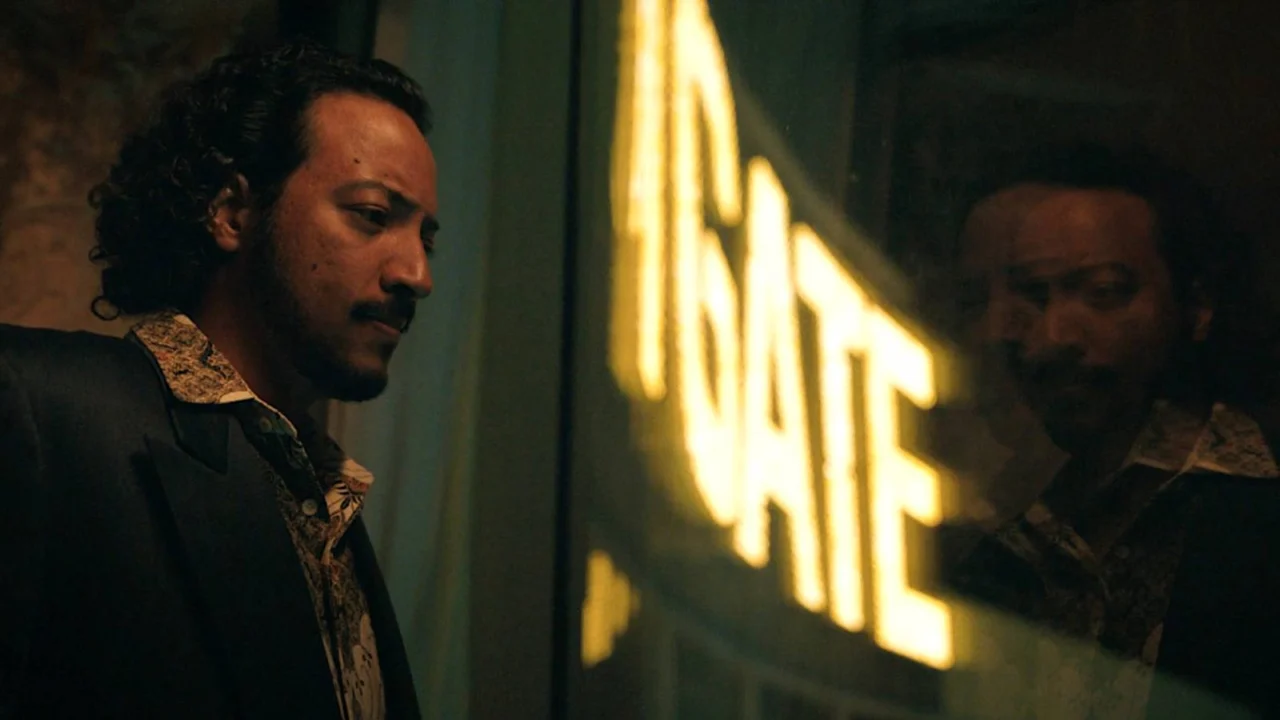
Pluribus Star Reveals His Character’s Secret Backstory Is Hidden in His Name

In Vince Gilligan’s speculative drama Pluribus, a global transformation leaves “the most miserable person on Earth” even more alienated, and her attempts to reverse it only deepen her isolation. To offset that anger, Gilligan and his writers introduce a character who thrives in the new reality: Koumba Diabaté, a man who treats the changed world as a kind of utopian playground.
Pluribus episode 6, “HDP,” reunites protagonist Carol Sturka (Rhea Seehorn) with the suave and generous Koumba Diabaté (Samba Schutte, known for Our Flag Means Death), who brings crucial new information to the table. Polygon spoke with Schutte for a spoiler-free look at his standout sequence in “HDP” — a deliriously Bond-esque moment that delighted both the character and the actor — and separately conducted a spoiler-heavy conversation about Diabaté’s hidden past, the pivotal choice he faces in the episode, and what anchors his relationship with Carol.
Ed. note: Significant spoilers ahead for Pluribus episode 6.

The series establishes that most of humanity has been subsumed by an alien-linked hivemind of placid contentment; only a small band of apparently immune “Originals” resist. Carol’s efforts to rally those Originals against the Joined have been met with anything from bemusement to outright disagreement — and Diabaté’s response is the latter, offered with warmth rather than spite.
In “HDP,” Carol travels to Las Vegas convinced she has uncovered proof that the Joined are monstrous: they’ve been consuming processed human remains. Diabaté reluctantly tells her that this revelation is not news to the other Originals — they’ve known for some time and even convene twice-weekly Zoom meetings from which Carol is excluded. He also reveals that the Joined possess a way to assimilate Originals, but that he’s chosen not to join — at least for now. We explored that choice, and more, with Samba Schutte.
This interview has been edited for length and clarity.

Polygon:
The fact that Diabaté declines to join the hivemind fits his demeanor, but it contrasts with most Originals. What motivates that choice — is it more than the pleasures he enjoys in the new world?
Samba Schutte:
I think the series is ultimately a study of how people respond to dramatic change. Some characters deny it, like Laxmi. Others embrace it wholeheartedly, like Kusimayu, who wants to be one of them. Carol seeks to reverse it through science. Manousos reacts with violence. Diabaté occupies a different position: he sees the upside and the downside and wants to be helpful, but he also genuinely loves the life he’s found.
He’s something of a humanitarian — or at least he sees himself as a steward of humanity. He understands the Joined’s perspective and he understands Carol’s anger. That dual insight makes him a bridge, but it doesn’t erase his desire to keep his autonomy. He values freedom, the pleasures and privileges his choices bring, and he isn’t ready to surrender that for a collective existence.

Polygon:
Diabaté treats Carol with a kindness that humanizes her for viewers who might find her behavior trying. You mentioned discussing his history with Vince Gilligan, and that he has a background of scarcity. Where does his empathy come from?
Samba Schutte:
If you watch episode 2, there’s a rational streak to him — he often calmly reframes Carol’s arguments. He’ll point out that the new world lacks racism and many other cruelties, which drives Carol crazy — I remember Rhea’s notes being basically “GAAAAH!” for every scene we share. But underneath his logic is someone who understands loneliness. He doesn’t want Carol to be isolated; he recognizes her vulnerability and wants to be an ally.

Polygon:
How much of his backstory did you define, with or without Vince?
Samba Schutte:
A lot of it came from small discoveries. When I first read the sides, the character was billed as “Mr. Koumba,” and I realized that in Mauritania Koumba is typically a woman’s name. That detail sparked an idea: in my culture, a man carrying a traditionally female name often signals a complicated family history — perhaps a missing mother figure. I told Vince about it and he loved the nuance. It felt right to build a man who grew up without conventional family ties and now surrounds himself with extravagance and companionship of a different kind.
That accidental detail opened a lot of doors for me as an actor: the way he collects experiences, the way he relishes luxury, the little performative choices that suggest he’s making up for an absence in his past.
Polygon:
How does working on Pluribus compare to your experience on Our Flag Means Death?
Samba Schutte:
Our Flag was a joy — working with Taika Waititi, Rhys Darby, David Jenkins, getting dirty and silly on a pirate set was a dream. Pluribus, though, has been special in a different way. I’ve been a longtime fan of Vince Gilligan, and the company he keeps on set is like family: decades of collaboration, high professionalism, and real generosity. Rhea called to welcome me and even rehearsed with me; everyone was open and collaborative. That environment helps everyone bring their best work.
Playing Diabaté is the opposite of Roach from Our Flag — he’s polished, indulgent, and exuberant. I got to wear flashy watches, jewelry, even a Super Bowl ring, fly on Air Force One — it’s a role of pure showmanship. And to have Vince allow me to root the character in Mauritania, reflecting where I’m from, was a gift. I don’t recall seeing a Mauritanian character on American television before, and it felt meaningful to bring that into the fabric of the show.
Pluribus episodes 1–6 are available to stream on Apple TV. New episodes premiere on Fridays.
Source: Polygon
Related articles
 “Gangsterland” starring Tom Hardy renewed for a third season
 Martin McDonagh Presents “Wild Horse” Starring Malkovich and Rockwell in Venice
 Werner Herzog dedicates the film “Bad Lieutenant” to David Lynch
 First still from the film “The Luckiest Girl Alive” featuring Kate and Rooney Mara
 First still from the film “The Luckiest Girl Alive” featuring Kate and Rooney Mara released
 Friday the 13th Screenwriter Victor Miller Dies
 “Borat” screening cancelled due to racist jokes
 «Obsession» Star Inde Navarrette to Be Submitted for Oscar Consideration