
Why All You Need Is Kill’s Premise Translates Perfectly Across Three Adaptations

Hiroshi Sakurazaka’s All You Need Is Kill achieved a level of global recognition that most Japanese creators only dream of when it was transformed into a Hollywood blockbuster starring Tom Cruise and Emily Blunt. While Edge of Tomorrow successfully introduced the light novel to a massive international audience, it suffered the common fate of Western adaptations: the film largely bypassed the source material’s darker, more existential core, utilizing the premise merely as a framework for a traditional action spectacle. A new anime adaptation finally arrives to bridge that emotional gap.
Helmed by director Kenichiro Akimoto, this latest iteration of All You Need Is Kill honors the original narrative while offering a more hauntingly intimate lens than its big-budget predecessor.
The story unfolds in a near-future Japan struggling to recover from the arrival of the Darol, a colossal, enigmatic extraterrestrial flora. When the Darol triggers a biological catastrophe that decimates the population, a volunteer named Rita is caught in the crossfire. Upon her death, she discovers she is trapped in a relentless temporal loop, forced to relive the same day of carnage over and over. Her solitary struggle changes when she encounters Keiji, another survivor ensnared in the same recursive nightmare. Bound by their shared trauma, the two must navigate a cycle of endless violence in a desperate search for hope amid the wreckage of civilization.

The narrative strength of All You Need Is Kill lies in its exploration of the psychological toll of immortality through repetition. “The central conflict eventually boils down to a tragic necessity: you must sacrifice someone you love to break the cycle,” Akimoto explained during an interview with Polygon. “It’s a moral crucible that forces the audience to ask what they would do in such a position. I felt that shifting the perspective to Rita allowed for a more nuanced exploration of that burden.”
While the film features the high-octane mechanical warfare fans expect from the manga, its true focus remains on character introspection. The death loop serves as a mirror, reflecting Rita’s history and the exhaustion that comes with infinite survival. Every aspect of her journey, from her tactical partnership with Keiji to her visual identity, is deeply rooted in her past.
“This project marks Izumi Murakami’s debut as a character designer, and Rita’s look evolved significantly throughout production,” Akimoto noted. “We spent a lot of time discussing her temperament and history. While the early concepts leaned toward photorealism, her striking red hair eventually became the defining element of her design.”
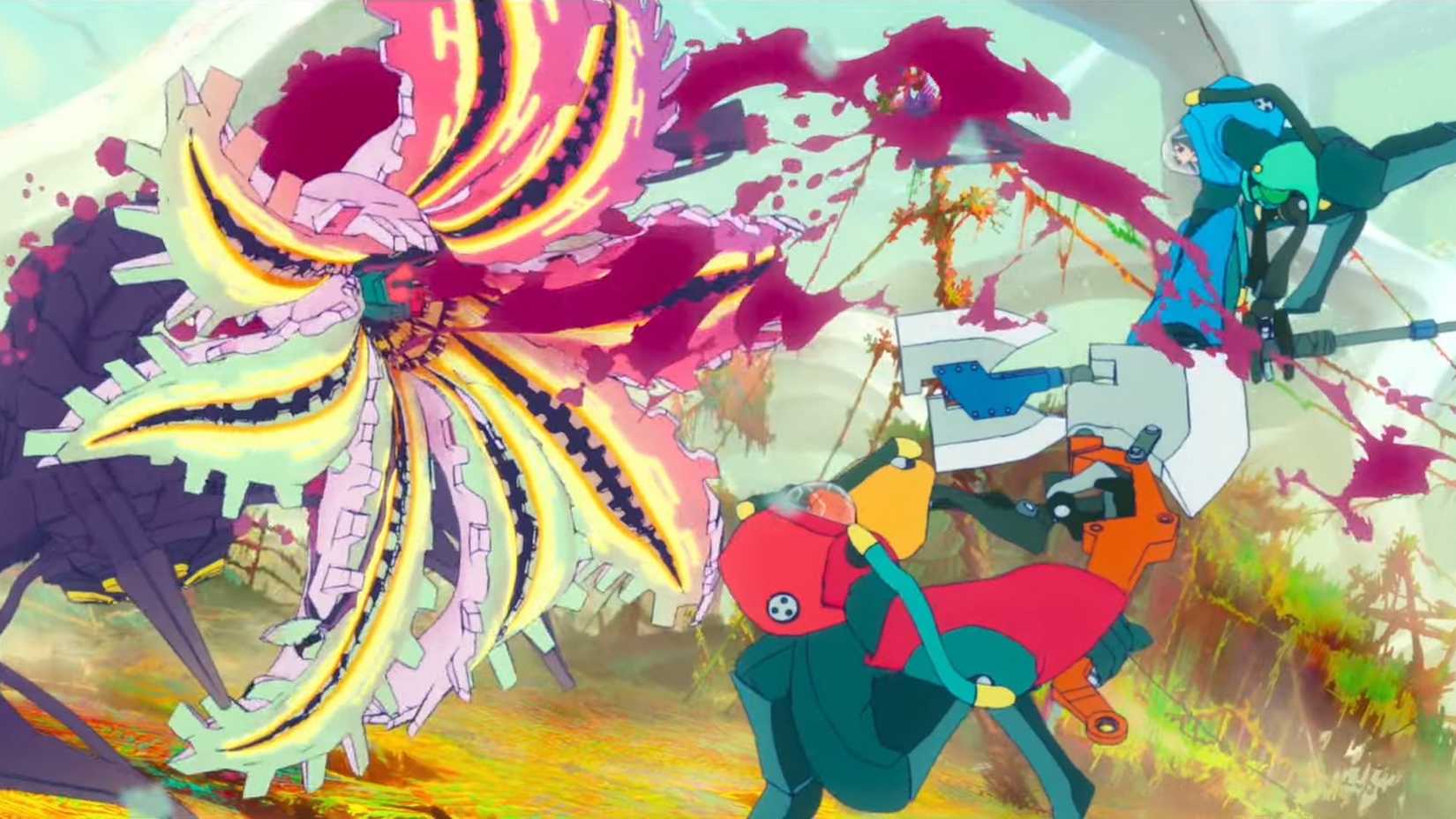
In this version, Rita is depicted as a biracial young woman from a marginalized, abusive background—a history that adds layers to her stoicism.
“She is of mixed heritage, with an African American mother and a white father who passed down her red hair,” Akimoto shared. “Though her father is absent, his legacy persists in her appearance, which her mother resented and targeted with abuse. For Rita, her hair was a symbol of shame and trauma. It is only through Keiji, who sees her hair as something beautiful, that she begins to reclaim her identity and allow herself to be vulnerable.”
All You Need Is Kill has evolved into a versatile anthology of survival stories, but this latest adaptation proves that the premise is most effective when used as a deep-dive into the human spirit. Despite the kinetic energy of the Hollywood version, the story’s true power lies in its quietest moments of connection.
All You Need Is Kill is currently playing in theaters.
Source: Polygon
Related articles
 Boxed Games Become a Problem for Collectors as Issues Reach PS5
 Gears of War: E-Day Reportedly Planned as Start of a New Trilogy, Rumors Say
 Shenmue III Enhanced Edition Delayed to Improve Graphics and Add New Features
 Ridley Scott Finds Screenwriter for New Film That May Continue the Prometheus and Alien: Covenant Story
 Zendaya to Be Promoted for Best Lead Actress Oscar for Third Dune Film
 Crimson Desert Charting the Unknown Expansion Will Add Sea Monsters and Ship Boarding, Details Revealed
 Ticket Presales Suggest Dune: Part Three Will Lose Heavily to Avengers: Doomsday at the Box Office
 DC Horror Film Clayface Earns Unusually High CinemaScore