
Marvel Zombies’ Ending Undermines the Show’s Smartest Twist
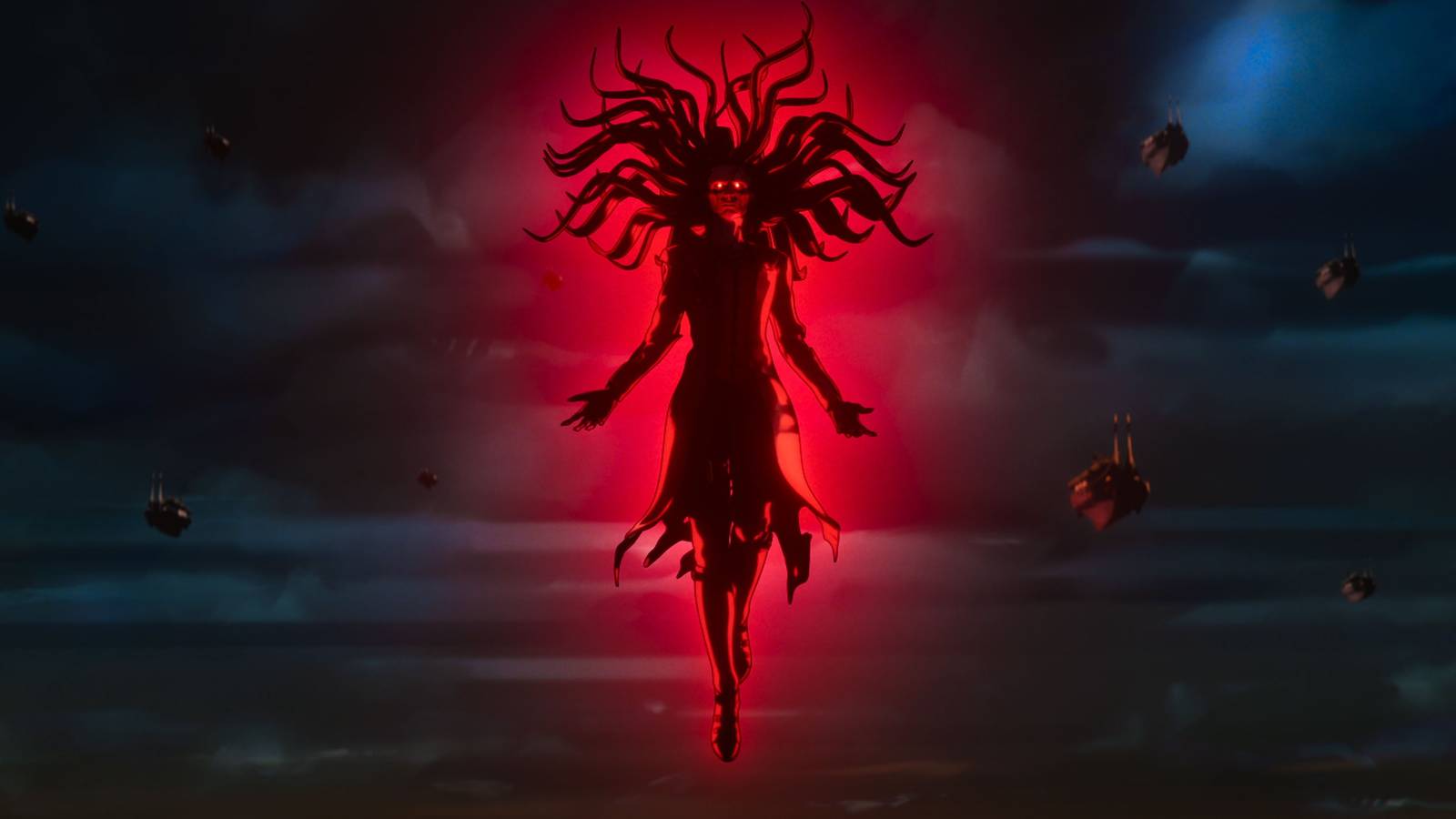
Marvel Zombies unfolds as a grim, road‑trip–style zombie saga: a band of heroes on the run, fighting to keep humanity from being consumed. The miniseries is more compelling in its unfolding than in its conclusion — the final beat leans on a predictable twist, while its most shocking revelation arrives in the penultimate episode.
[Ed. note: This article contains major spoilers for Marvel Zombies, including the ending]Marvel Zombies functions as a dark continuation of both the What If… ? episode “What If… Zombies?!” and elements of WandaVision. At its center is Wanda Maximoff — the Scarlet Witch, portrayed by Elizabeth Olsen — who has become the Queen of the Dead. In that role she marshals both ordinary undead and zombified heroes, using her sorcery and guile to erase the remaining enclaves of the living.
Wanda’s objective is to seize the boundless power of the Infinity Stones, which the Hulk absorbed after they were shattered in a confrontation with a zombified Thanos. She cannot accomplish this alone, however, and spends the four-episode arc psychically pursuing Kamala Khan (as credited in the series), whose own abilities tap into cosmic forces. After Wanda’s army slaughters or infects many of Kamala’s companions during a climactic battle meant to defend the Hulk, she tempts Kamala with a promise: join me, and you won’t be betraying your friends — you’ll be restoring them.
 Image: Marvel Television
Kamala eventually capitulates. Linking hands with Wanda, she hears Wanda intone, “And so the world begins again,” as a wash of energy — visually akin to Kamala’s own constructs — sweeps the globe and appears to mend the ruined planet. For a fleeting, joyful instant Kamala is reunited with ordinary pleasures, like sharing boba with friends. That idyll collapses when her vision snaps back to desolation: shambling corpses populate a blasted landscape, and Ironheart (Dominique Thorne) is seen fighting, pleading with Kamala not to trust the illusion. The series’ final image is a close, anguished scream from undead Wanda.
It’s unclear whether showrunner Bryan Andrews and writer Zeb Wells intended this coda as a tease for another installment or merely as a final, unsettling note. With the Infinity Stones’ raw potency combined with Hulk’s prior absorption of them — and Kamala’s ability to channel cosmic energy — the story’s mechanics could plausibly support a genuine restoration. In the comics, Wanda’s reality‑altering scope has produced entire alternate worlds and catastrophic consequences for mutantkind; the series draws on that same theme of reality being malleable yet treacherous.
Yet Wanda’s signature trick is manipulating perception, a tactic she deploys ruthlessly in Marvel Zombies — even using cannibalism as a vector to spread the infection among Asgardians. The finale intimates that Wanda may simply be clouding Kamala’s senses to keep her from seeing an ongoing fight. Because Ironheart was killed in episode one of the miniseries, this reading suggests much of Kamala’s quest might have been an elaborate hallucination.
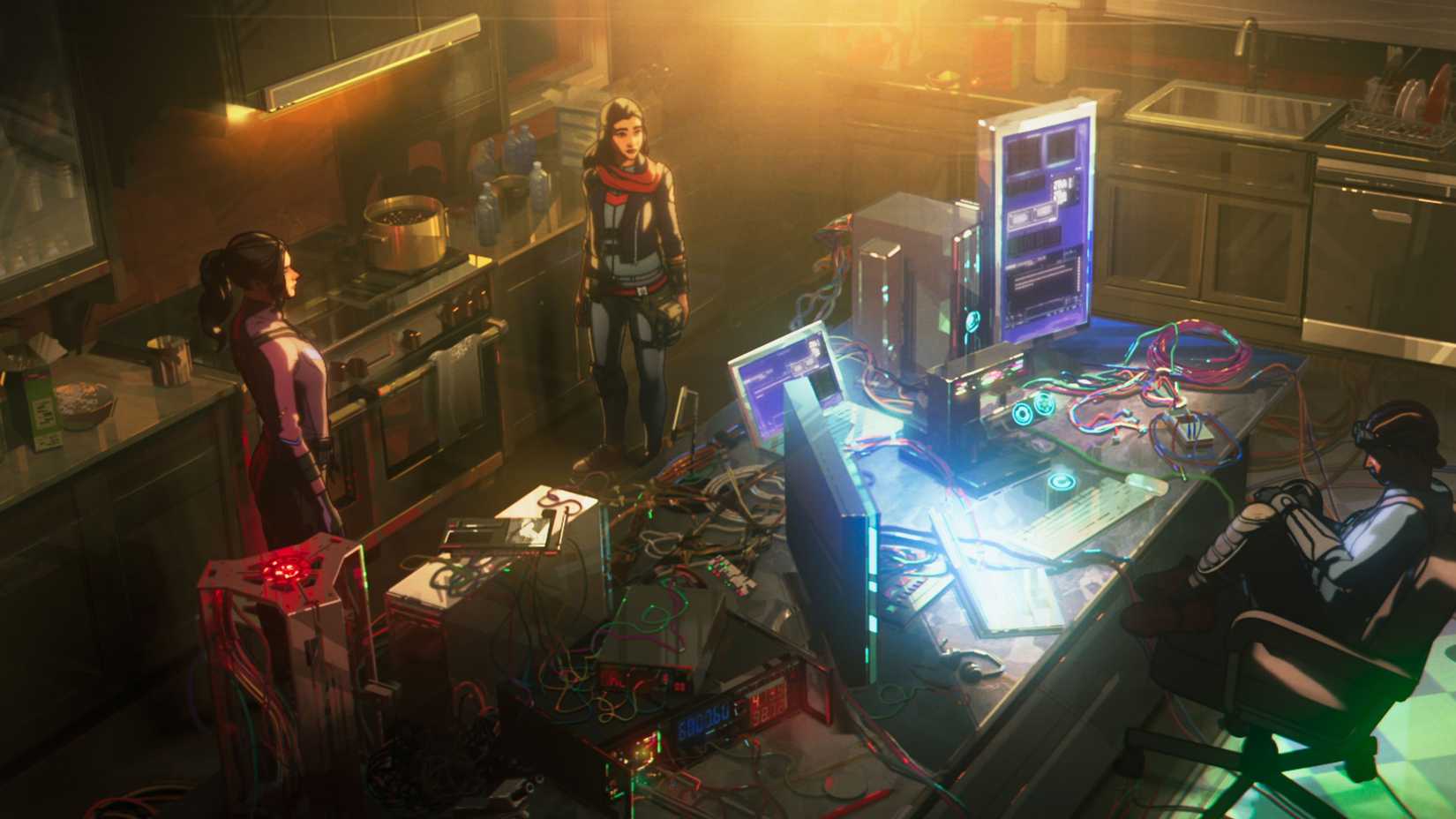 Image: Marvel Animation
That resolution reads like a narrative cop‑out: it fuses the “it was all a dream” device with the villainous fantasy trap — familiar from works such as Alan Moore’s For the Man Who Has Everything — and while the visual jolts work, the twist itself lands as somewhat empty.
The series’ more potent and surprising reversal occurs at the end of episode three. Kamala’s perilous road trip centers on a shrunken S.H.I.E.L.D. transmitter that might allow them to broadcast a distress signal into space. When she finally reaches orbit and attempts to summon the Nova Corps, she discovers the interstellar peacekeepers already know about the outbreak — and rather than intervene, they opt to quarantine Earth. The Nova Corps’ decision is brutal: they nearly annihilate Kamala and her companions to eliminate any chance of contagion.
That development is devastating. It reframes the series’ moral question about heroism when salvation seems impossible: if no outside help is coming, what choices remain for those trying to do right? Stripped of external rescue, Kamala becomes liable to accept Wanda’s gamble — remaking the world — because the alternative is to witness the slow, horrific extinction of everyone she loves.
Ending on the planetary surge of light rather than on Wanda’s final, screaming mask of undead menace would have been a bolder close. The energy wave offers the same ambiguity — did Kamala help heal the world, or did she doom it? — while leaving the story’s possibilities open, fitting for a tale spun out of What If… ? and for an MCU that thrives on branching realities.
Source: Polygon
Related articles
 Danny Boyle used artificial intelligence in his new film “Inks”
 Gary Oldman Reveals the Name of the New Bond
 Summer 2026 Becomes the Highest-Grossing Season in U.S. Box Office History
 Shadow Movie Screenings in Russia Face Shutdown
 Dance drama “The Art of Falling” to premiere on Okko in September
 Lilly Wachowski disavows involvement in the new “Matrix” film
 Kane Parsons to Return to The Backrooms
 First Emmy Award Winners Announced