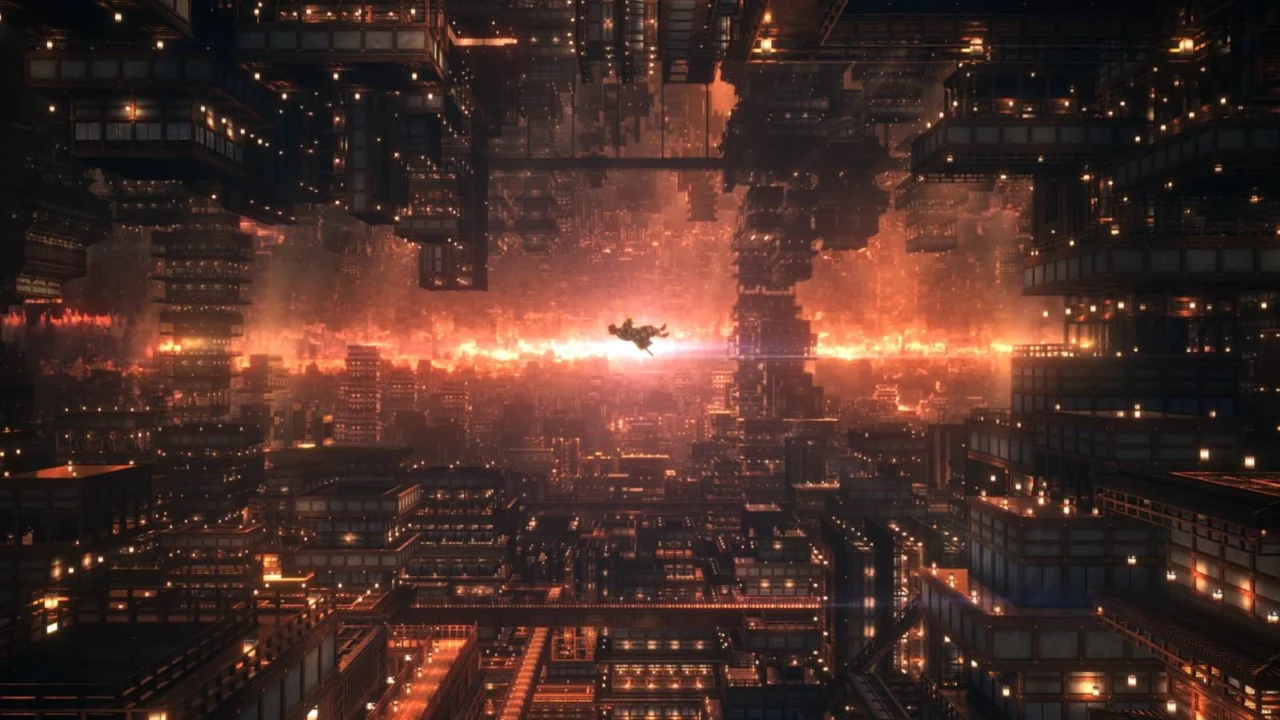
2025’s Biggest Anime Movie Was 25 Years in the Making: Why Teamwork is Its Greatest Asset

Demon Slayer: Infinity Castle has proven to be more than just a commercial phenomenon; it serves as a definitive validation that Ufotable’s 2020 record-breaker, Mugen Train, wasn’t merely a byproduct of a sparse pandemic release calendar. In a year crowded with heavy-hitting animation like Zootopia 2, Ne Zha 2, and KPop Demon Hunter, Infinity Castle didn’t just compete—it flourished, even securing a place in the North American awards circuit. While the industry often reserves critical accolades for the prestigious, universal storytelling of Studio Ghibli (seen with The Boy and the Heron), Infinity Castle has shattered that glass ceiling, bringing a lore-heavy, canonical chapter of an ongoing series into the mainstream awards conversation.
Ufotable has long been established as a vanguard of modern animation, celebrated for the Fate/stay night: Heaven’s Feel trilogy and Fate/Zero. The Tokyo-based outfit is particularly lauded for its sophisticated integration of 2D artistry and 3D digital environments, redefining how CG is perceived in a traditionally hand-drawn medium. During their visit to the Golden Globes—where the film was a finalist for Best Animated Feature—Ufotable co-founder and director Hikaru Kondo, alongside producer Yuma Takahashi, sat down to discuss the film’s global trajectory and the intricate process of adapting the manga’s final arcs into a cinematic trilogy.

Polygon: Do you believe anime has finally moved past its “niche” status at the North American box office?
Yuma Takahashi: To be perfectly honest, we aren’t fully immersed in the daily market shifts in America. I’d actually love to hear your perspective—how has the general public’s view of anime evolved there? Do you feel it has truly shed that underdog label?
I’d argue that 2025 will be seen as the definitive turning point—the year anime outpaced Superman. It feels like the foundation for where the medium is headed over the next decade.
Takahashi: I’ll offer my thoughts as best as I can. Our international fanbase has shown incredible passion since the very first arc, intensifying through Mugen Train. As a studio, we don’t differentiate between television and film in terms of craftsmanship; we always strive to deliver the highest possible visual fidelity to honor the narrative. Bringing Mugen Train to a global audience was an eye-opening experience. The energy we encountered during our world tours in 2023 and 2024, which was Kondo-san’s initiative, was incredibly motivating. It allowed us to witness the sheer scale of the U.S. fandom firsthand.
When I began adapting the source material into a screenplay, it became immediately apparent that it simply wouldn’t fit into a standard format.

As the chief director, what was your primary visual ambition for this film?
Hikaru Kondo: It began with the screenplay and the strategic planning of the narrative structure. That was the most significant hurdle—translating the manga’s pacing into a cinematic format was incredibly complex. I personally handled a portion of the storyboarding, focusing on how our specific artists would interpret those frames. For instance, when I look at a sequence involving Giyu, I consider what someone like Kunihiro can bring to the action. If I assign a scene to Kimura or Abe, I’m looking for that unique spark they provide. Our studio is fueled by these individual key animators who push the entire team forward.
Our workflow is remarkably fluid; it’s difficult to define it as a rigid pipeline.
Ultimately, I oversee the storyboards, but the process is highly collaborative. We decide which animator is best suited for a specific shot, then we debate the methodology: do we lead with 3D or 2D? Sometimes we require multiple rounds of pre-visualization before we’re ready to put pencil to paper. It’s a shot-by-shot evolution rather than a standard assembly line.

What is your take on the trend of adapting “canon” arcs into feature films? Do you think this will become the standard for the industry?
Takahashi: It’s a fascinating question, but one we can’t fully address until the entire trilogy is complete. Once all three films are out, the artistic intent behind that decision will be much more apparent.
Reflecting on your career and the many landmarks you’ve achieved, do you still find yourself holding a special place for your earlier projects?
Kondo: Every production brings its own set of triumphs and setbacks. That’s the nature of the industry. You take those lessons—the wins and the losses—and carry them into the next challenge. The success of Demon Slayer is the culmination of everything we’ve done previously. My past is exactly what brought us to this moment.
The true value of this studio lies in the years we’ve spent building this team together.
When you look at the staff behind Infinity Castle—people like Sotozaki, Matsushima, Kimura, and Terao—we’ve been working together since the Tales series and the Fate projects. This shared history is the core of our identity. You see the polished final product, but the foundation is a decade of collaboration. That longevity and trust are our most significant assets.
Can we expect a television re-edit of the Infinity Castle films, similar to what was done with Mugen Train?
Kondo: I’m afraid I can’t comment on that at this time.
Source: Polygon
Related articles
 Futurama Creator Discusses Show’s Future Beyond Season 14 Finale
 First viewers praise Dune: Part Three as potential Oscar competitor to The Odyssey
 Clayface Box Office May Trail Supergirl, But DC Studios Sees Upside
 Pre-orders Open for Mobapad M12 Pro Controller for Switch 2
 Creators of Tokyo Revengers Release Creditless Season 4 Opening
 Paradox Interactive Announces Europa Universalis V DLC Across the Pillars
 10 Near-Perfect Nintendo Switch Games Nobody Played
 Bloodborne Ported to PC and Runs Without Emulator