
Kojima Productions applies its game design philosophy to laptop hardware
For the past several weeks, I have been immersed in gaming on a machine that feels like an artifact plucked directly from a virtual world. The recently debuted ROG Flow Z13-KJP is a strictly limited edition Asus hardware collaboration with Kojima Productions. Internally, it shares the DNA of the standard Flow Z13—a versatile tablet-laptop hybrid featuring a detachable keyboard—but its exterior tells a much more ambitious story. This device is the unmistakable signature of Kojima Productions, a studio famously dedicated to blurring the line between high-concept science fiction and tangible reality.
Does a $3,700 price tag justify a “statement” gaming PC? For the average user, likely not; but for the Kojima loyalist, the Flow Z13-KJP is a masterclass in its niche. It is a highly adaptable piece of hardware that translates the design language of Death Stranding into a flashy, high-performance reality.

The ROG Flow Z13 is a compelling, if eccentric, evolution of the gaming laptop, prioritizing extreme portability. The Kojima makeover preserves this core identity: a 13.4-inch tablet with a fluid 180Hz touchscreen and a robust integrated kickstand. The kickstand is essential, as the detachable keyboard is designed for slimness rather than structural support. While this makes it less “lap-friendly” than a traditional clamshell, the result is a remarkably sleek, transportable powerhouse.
Despite its tablet form factor, the internals are surprisingly potent. Equipped with an AMD Ryzen AI MAX+ 395 processor and a Radeon 8060S GPU, it handles demanding titles with unexpected grace. I managed to push Nioh 3 to a stable 60 frames per second on lower settings; while asset pop-in and minor stutters occurred, the sheer scale of the game running on such a compact device was impressive. It also outperformed my Steam Deck OLED when running the Monster Hunter Stories 3: Twisted Reflection trial, maintaining a consistent 60fps on high settings with only occasional hitches.

Naturally, there are thermal and power thresholds that a full-sized gaming rig doesn’t face. Titles like Romeo is a Dead Man saw more frequent frame drops, though poor optimization likely played a role. Yet, even with these compromises, the Z13-KJP has become my primary gaming companion due to how effortlessly it transitions between different environments.
The true value of this partnership, however, lies in its aesthetic soul. When Asus approached Kojima Productions, the studio was granted significant creative agency. A representative from the studio noted that the Z13 was the perfect canvas because of its modular nature.
“We saw the detachable keyboard, the kickstand, and the thermal vents as opportunities for play—elements we could reinvent with designs rarely seen in computing,” the studio explained. “The goal was to craft something unprecedented, a machine that challenges the very visual definition of a PC.”
“Compared to designing a real-life computer, game designing could be considered somewhat freer.”
The visual result is striking. The chassis is a futuristic mosaic of accents and industrial lines that wouldn’t look out of place in Sam Porter Bridges’ inventory. The keyboard’s irregular, jutting silhouette is eye-catching, even if it sacrifices a bit of traditional ergonomics. It even includes a custom carrying case styled like Death Stranding’s cargo containers—though, in a minor oversight, there is no dedicated pocket for the bulky charger. It’s a product born of creative liberty, though tempered by the physics of hardware manufacturing.
“Our design process mirrored game development,” the studio shared. “When we propose a mechanic, our engineers often tell us it’s impossible. We then iterate until we find a middle ground. With this PC, we had countless discussions regarding vent density, laser etching precision, and logo placement. In many ways, the digital world offers far more freedom than the physical one.”

There is a profound sense of “play” embedded in the machine’s DNA. A gold plate on the chassis bears the motto “For Ludens who dare,” a hybrid of Asus and Kojima branding. “Ludens,” the studio’s astronaut mascot, is inspired by Johan Huizinga’s Homo Ludens, a 1938 text arguing that play is the fundamental source of human culture. Ludens isn’t just a logo; he represents the studio’s philosophical core.
“To explore uncharted territories, whether in space or digital realms, one must prioritize ‘play’,” Kojima Productions wrote. “Play fuels the creative brain. Ludens represents the delivery of play into the unknown through cutting-edge tech. His equipment is designed to survive the harshest environments, and we applied that same logic here.”
The Z13-KJP is framed as a tool belonging to Ludens himself—a piece of “Extra-Vehicular Creative Activity” gear. This immersion begins the moment you power it on, as the standard ROG splash screen is replaced by the Kojima Productions logo.
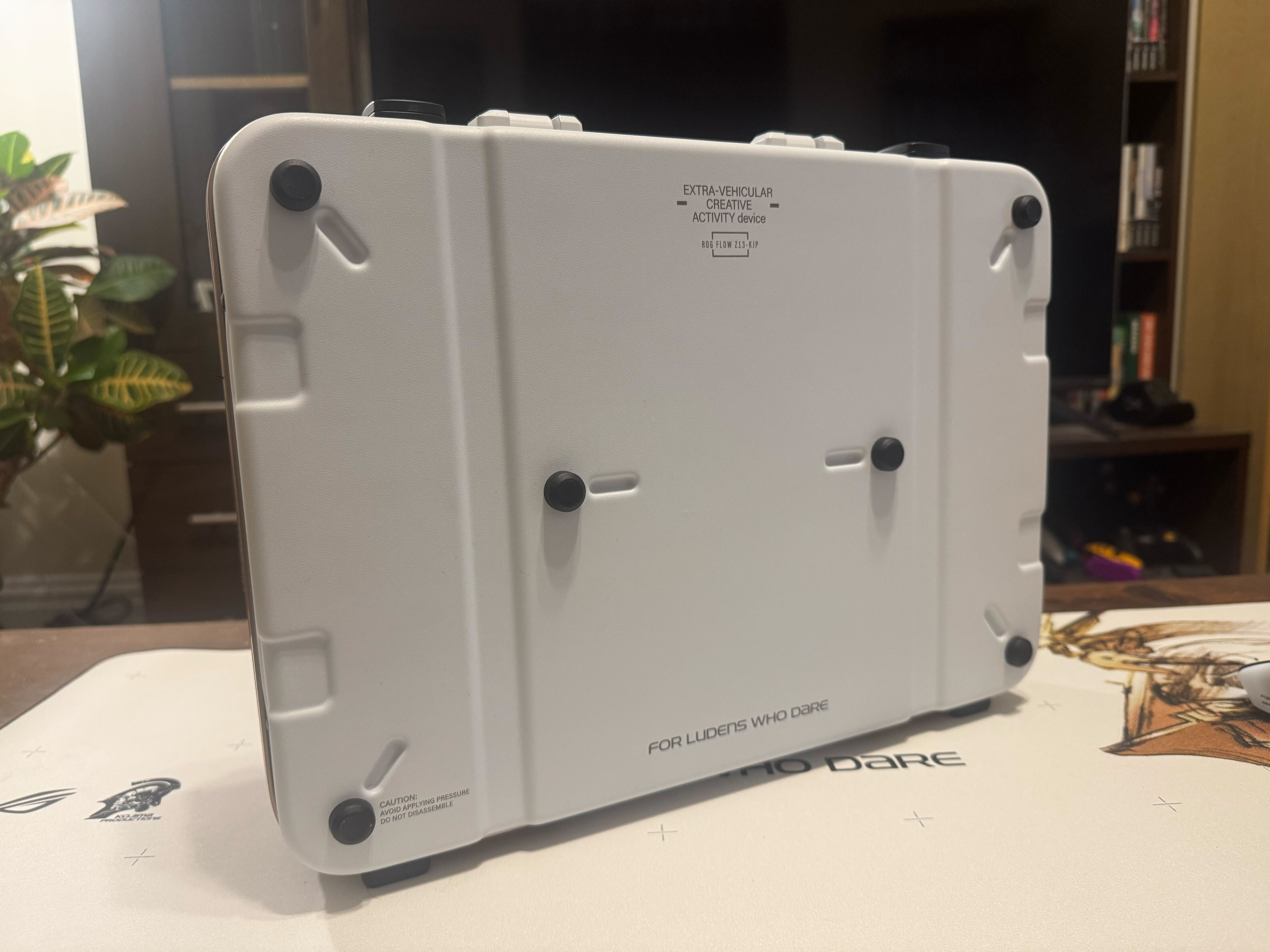
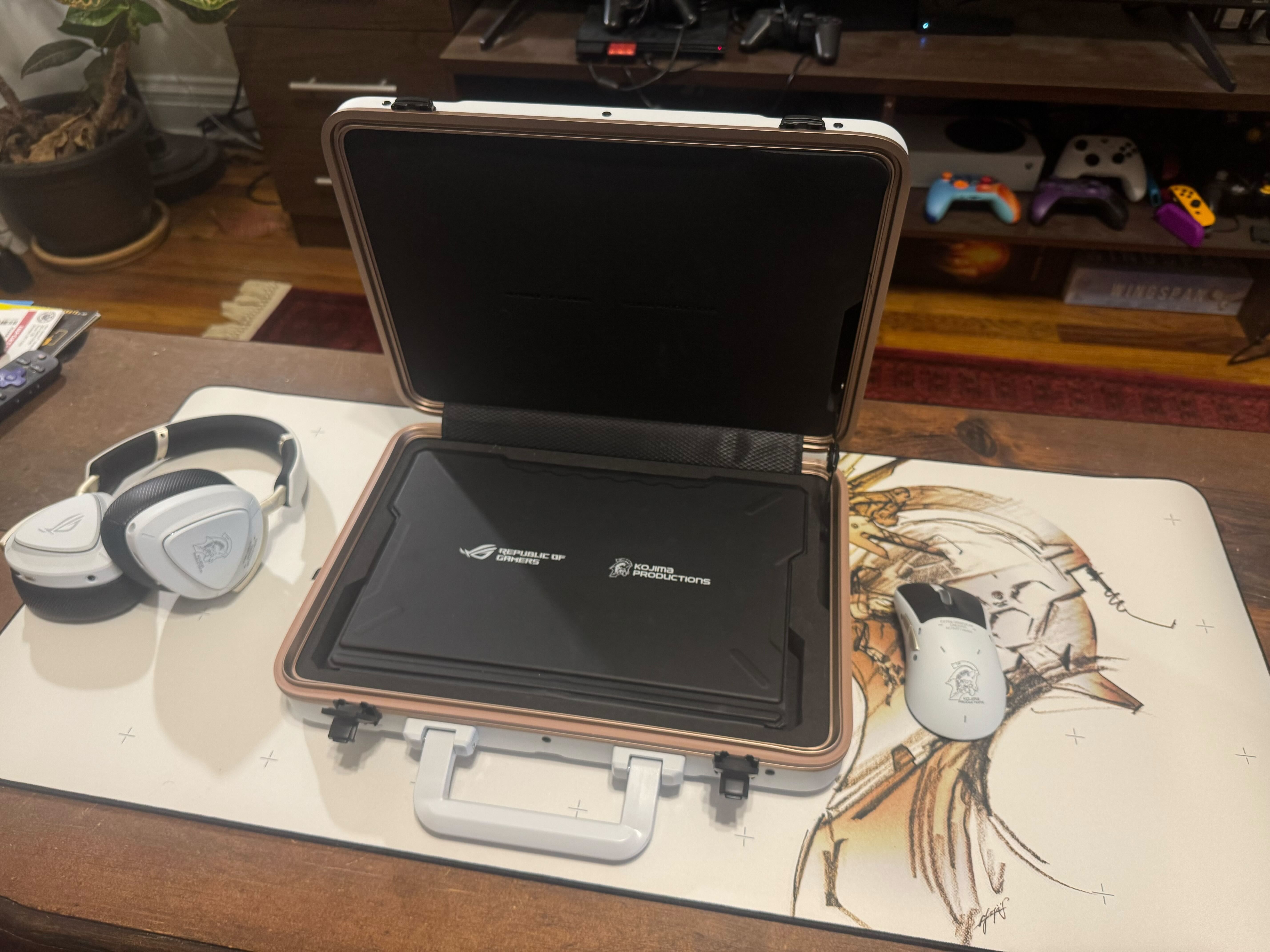


This level of detail goes far beyond simple branding; it taps into the tech-optimism inherent in the studio’s work. While Death Stranding depicts a fractured world, it focuses on technology as a bridge to reconnect humanity. The Z13-KJP aims to evoke that same spirit of utility and connection.
“Ludens symbolizes the technology that carries us into the future,” the studio noted. “We want users to carry this device into their own adventures, using it as a catalyst for their own creative boundaries. We hope the Flow Z13-KJP inspires that same sense of exploration.”
Can a laptop truly offer a new perspective on life? Perhaps that’s a stretch. It doesn’t change the reality that premium hardware has become increasingly expensive, nor does it escape the looming shadow of an AI-driven dystopia. It remains a luxury item—a very capable computer, but a computer nonetheless. It won’t save the world; it will just make your backpack look significantly cooler at airport security.
Still, seeing the ethos of Kojima Productions distilled into a physical object is fascinating. If the future must involve high-performance computing, let it be inspired by designs that push us toward the limits of our imagination. As long as these “cool computers” don’t require a small fortune or an ecological collapse to exist, I’m on board for the adventure.
Source: Polygon
Related articles
 Assassin’s Creed Black Flag Resynced Developers Confirm New Mode
 Best Visions to Use in Final Fantasy Resonance
 Activision’s Polish Studio Reportedly Developing Open-World RPG to Rival GTA VI and Cyberpunk 2077
 Amazon’s Mass Effect TV Series Reportedly Still in Production Despite BioWare Closure
 Shadow of the Tomb Raider Unexpectedly Launches on Switch 2, Making Full Trilogy Available
 Nintendo’s Shigeru Miyamoto Selected as First Game Developer to Receive Japan’s Order of Culture
 Best DMZ Traits in Modern Warfare 4
 BioWare Veteran Explains Who Was Actually Responsible for Controversial Dragon Age Decisions