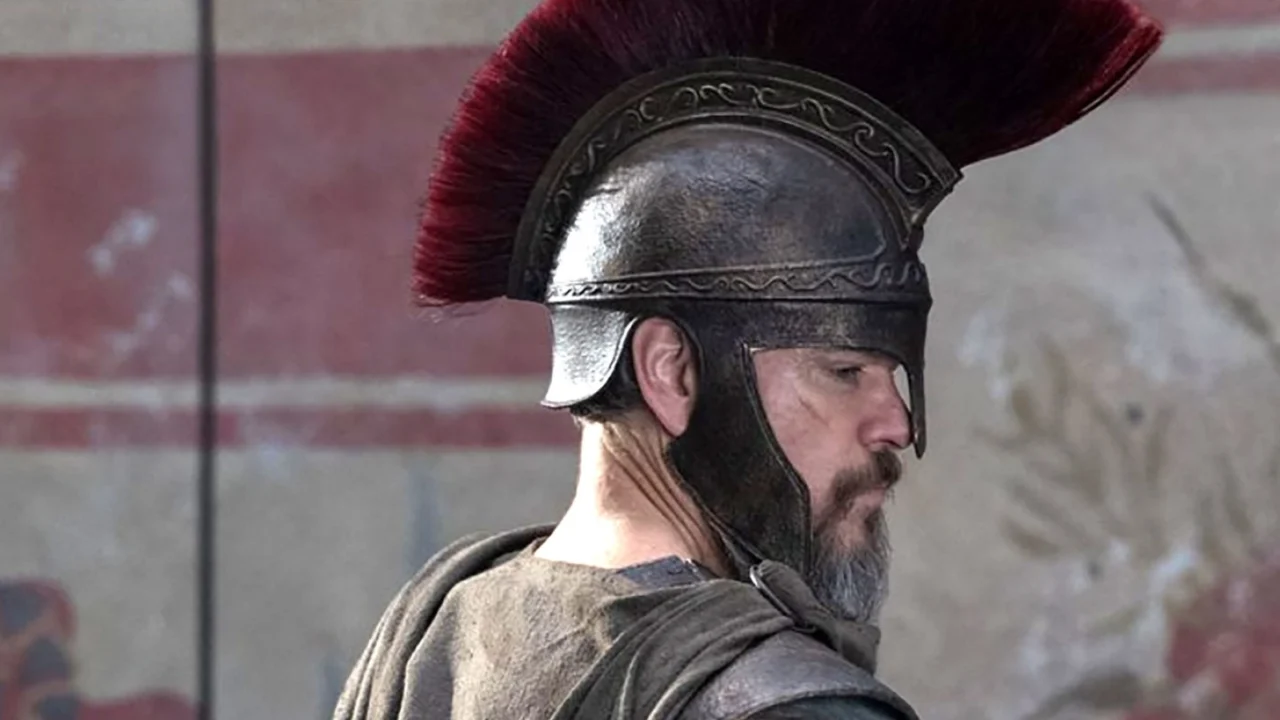
The Post-Odyssey Fate of Odysseus

In many respects, the conclusion of Christopher Nolan’s The Odyssey feels fated and deeply familiar. Over the 2,700 years since Homer’s epic was first transcribed, the title has become shorthand for any arduous, circuitous trek toward home. The King of Ithaca endures a decade of struggle, battling mythical entities to return to his palace. But the lingering question remains: what truly awaits him once he finally steps back onto Ithacan soil?
[Ed. note: The following contains light spoilers for Christopher Nolan’s The Odyssey.]Staying faithful to the legendary source material, Matt Damon’s Odysseus eventually finds his way home in Nolan’s feature film. As in the classic poem, he returns as a stranger, forced to reveal his true identity to his wife, Penelope (Anne Hathaway), and his son, Telemachus (Tom Holland). He must also reclaim his throne by dispatching the suitors vying for his wife’s hand. While the historicity of Odysseus is debated, literature throughout the centuries has frequently explored the hero’s life beyond his homecoming.
Deconstructing the finale of Nolan’s The Odyssey
While Nolan doesn’t shy away from the divine or the monstrous, his version of The Odyssey leans into a grounded, visceral realism. Homer’s original text culminates in a chaotic civil war on Ithaca, averted only by the direct intervention of the goddess Athena. Nolan bypasses the divine intervention trope and, notably, omits the ensuing civil conflict entirely.
Instead, the director’s visual language mirrors the bittersweet resolution found in The Lord of the Rings: The Return of the King. The weary hero, his journey finally complete, sails toward the western horizon alongside his wife, entrusting the kingdom of Ithaca to Telemachus. It serves as a poignant transition: an era of gods and magic fading into memory. This sentiment aligns with prophetic warnings within the epic that Odysseus’ wanderlust would never truly be quenched. Many artists have since built upon this restless spirit.
Alfred, Lord Tennyson’s 1842 poem “Ulysses” captures this perfectly. In it, a bored Odysseus finds domestic stability stifling, leaving the governance of Ithaca to his son so he might “sail beyond the sunset” and seek out uncharted realms—a vision that clearly informs Nolan’s cinematic approach.
Image: Universal PicturesNikos Kazantzakis’ 20th-century epic, The Odyssey: A Modern Sequel, takes this wanderlust even further. His iteration of the hero abandons his home to roam a world filled with archetypal figures reflecting Buddha, Don Quixote, and Christ, ultimately meeting his end in the icy waters of Antarctica. However, the most “canonical” post-script to the story takes an altogether stranger path.
The Telegony: Closing the loop of the Epic Cycle
Another significant departure in Nolan’s film involves the relationship between Odysseus and the enchantress Circe. While their dalliance is a brief chapter in the original text, a later lost epic known as The Telegony expands on this connection. Though the full text has vanished, summaries confirm that their union resulted in a son, Telegonus.
Before Telegonus enters the narrative, Odysseus is tasked by the prophet Tiresias to journey far inland, away from the influence of the sea, to make amends with Poseidon. The Telegony follows this path: Odysseus travels to Thesprotia, marries the queen, wages war, and eventually returns to Ithaca.
In a twist of tragic irony, Telegonus eventually seeks out his father, arrives at Ithaca during a storm, and mistakenly engages the aging king in battle. He kills Odysseus with a spear tipped with a stingray’s venomous spine—an accidental fulfillment of the prophecy that the hero’s death would come “from the sea.” Following the tragedy, the survivors return to Circe’s island, leading to a complex web of marriages where sons wed their fathers’ former lovers, creating a cycle of mythic entanglement that only the ancient Greeks could conceive.
The Dantesque Descent
In the 14th century, Dante Alighieri offered a far darker perspective. In the eighth circle of Hell, his Inferno depicts Ulysses (the Roman name for the hero) trapped in a column of fire. Dante frames the hero’s legendary intelligence not as a virtue, but as a manipulative, dangerous form of fraud—specifically regarding the deceit of the Trojan Horse.
Dante’s Ulysses abandons his family entirely, driving his crew toward death out of mere intellectual vanity and a reckless, selfish curiosity. While Nolan’s Odysseus shares this final, outward-bound trajectory, the director avoids Dante’s condemnation. For Nolan, this departure isn’t an act of pride, but a graceful exit—a final, romantic migration from the world of men into the realm of enduring legend.
The Odyssey is currently in theaters.
Source: Polygon
Related articles
 Level-5 President Apologizes for AI Use in Game Presentation
 Blizzard Shifts Diablo 5 Formula to Mirror Dragon Age and Baldur’s Gate
 Could Marvel’s Wolverine Cost Sony a Top Nomination at The Game Awards Due to Low Scores
 Roblox Discloses Creator Earnings
 $400 Death Stranding 2 Sam Figure Features Typo
 Kojima Discusses Budget and Team Size Limitations for Death Stranding
 Blizzard Details Diablo IV Season 15 Battle Pass Rewards and Deluxe Edition Bonuses
 Clair Obscur: Expedition 33 Director Comments on Sandfall’s Next Game