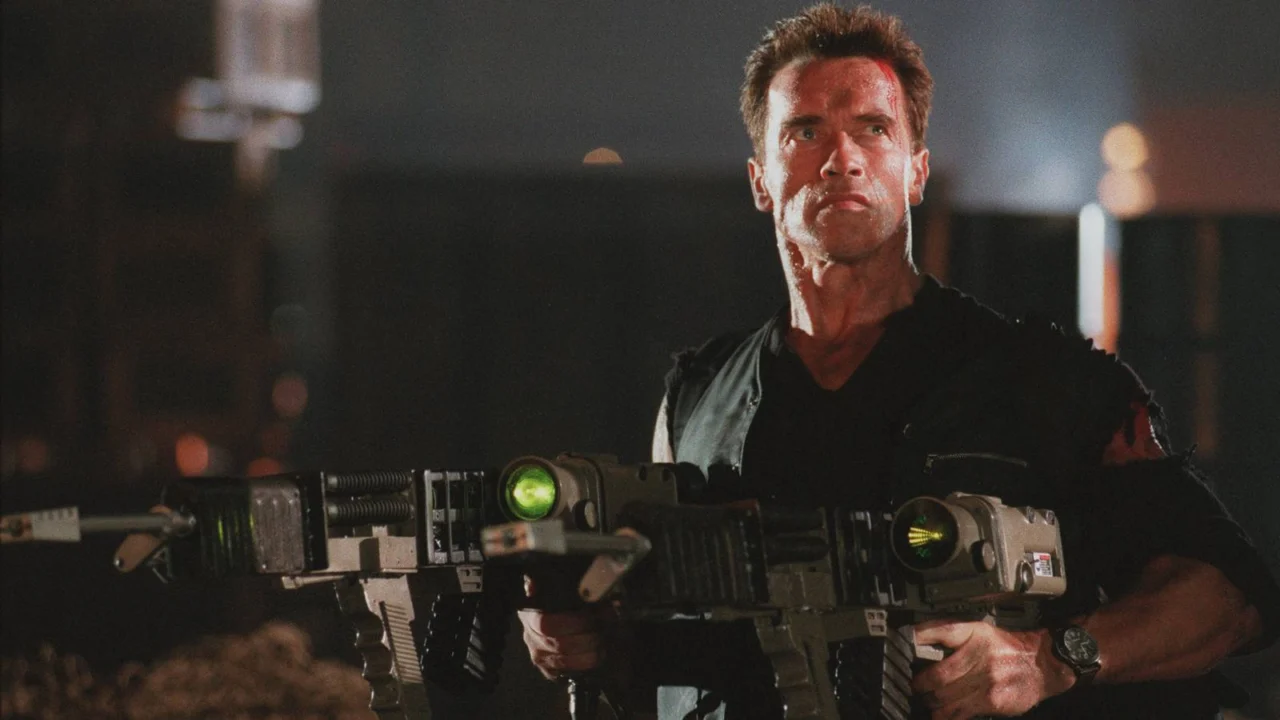
3 Wild Scenes That Made Arnold Schwarzenegger the King of ’90s Action (Excluding True Lies)

By 1996, Arnold Schwarzenegger had already solidified his status as the king of the blockbuster, having survived alien encounters, dismantled liquid-metal threats, and unraveled the mysteries of a simulated Martian existence. When director Chuck Russell took the reins for the thriller Eraser—arriving hot on the heels of the massive success of True Lies—he recognized that simply delivering a standard action beat would not suffice for an icon of Arnold’s caliber.
Russell initially spent time collaborating with Schwarzenegger on a swashbuckling adaptation of Captain Blood. However, when that project stalled, Schwarzenegger presented the script for Eraser—a Warner Bros. production ready for immediate green-lighting. Russell saw the potential instantly. “It was a fantastic script,” Russell remarked during the film’s 30th-anniversary 4K remaster rollout. “My goal was simply to inject it with spectacle that had never been seen in an Arnold film before.”
Schwarzenegger had been drawn to Russell’s directorial sensibilities after working with him on The Mask, sensing the director could apply a more dynamic visual flair to his next project. Russell embraced this, aiming to highlight a more protective, heroic side of the star rather than just a destructive force. He proposed three distinct, high-concept action sequences that would eventually redefine the film. Looking back, he was spot on.
A railgun worthy of futuristic warfare
Photo: Warner Bros. PicturesLong before railguns became a staple of modern military discourse and gaming, Russell was obsessed with the emerging technology. During his research for Eraser, he discovered that railguns were real, but restricted to massive, ship-mounted naval hardware. He had a daring vision: “What if we miniaturized them so that a single operative could wield that kind of devastation?” he asked. “And to cap it off, why not have Arnold dual-wielding them in the final act?”
While the film wasn’t a military documentary, Russell leaned into “hyper-reality” to give the weapons visual punch, adding glowing trajectories that sliced through the atmosphere with sci-fi intensity. Remarkably, he later received subtle praise from insiders in Naval Intelligence, who noted that his creative interpretation was closer to reality than he had realized.
The alligator clash: Pure action cinema
Image: Warner Bros. PicturesOnce you’ve established a tone of high-octane hyper-reality, it provides permission for truly wild set pieces. Inspired by the off-the-wall humor of True Lies, Russell sought a sequence that would catch the audience off guard. His solution: a shootout in a zoo.
The resulting alligator encounter remains one of the film’s most memorable moments. “It’s absurd, sure,” Russell admits with a smile. “But I have no regrets. It was pure fun.” The sequence captures the perfect balance of grit and camp—culminating in an iconic one-liner after dispatching the predator. The director behind A Nightmare on Elm Street 3 definitely understood how to land a punchy, memorable moment.
Why the skydiving sequence still holds up
The third pillar of Russell’s vision arguably aged the best. The film’s climactic freefall remains breathtaking because it emphasizes practical ingenuity over digital artifice. Russell relied on elite skydiving experts and cinematographers who jumped alongside the stunt performers, capturing the danger on 35mm film in real-time.
“People forget that there was a cameraman alongside them for every second of that fall,” says Russell. “There is some CGI, sure, but 90% of what you are seeing is real stunt work.”
Schwarzenegger himself dove head-first into the process, performing intense work on a wire-rig to simulate the leap from a 747. Even with the necessary green-screen work, his commitment to the spectacle shines through. “There is so much craft in those scenes,” Schwarzenegger noted. “You can genuinely sense the gravity of the fall.”
The remastered 4K Blu-ray of Eraser is available now.
Source: Polygon
Related articles
 Report: GTA VI Will Not Allow Free Character Switching Between Jason and Lucia
 LEGO Harry Potter Collection Coming to Nintendo Switch 2
 Second Season of ‘Ao Ashi’ Set for Release Four Years After Season One
 First Details Revealed for New Star Trek Film
 Star Wars Zero Company Handles Difficulty Like No Other Game Ever Has
 HBO Max to Launch Podcast Accompanying Harry Potter Series Reboot
 Sony Defends Disc-Free Consoles as Take-Two Nears GTA VI Leaker ID
 Ten Best Far Side Comics About Dinosaurs