
Volume 84 – Ready or Not Development Update
Welcome to the 84th edition of our Ready or Not Development briefing as of March 28th, 2025!
In today’s briefing, we will delve into the strides we’ve made in optimization, provide insights into the development of our AI difficulty system, discuss narrative content pieces, and update you on convention merchandise.
Note: These development briefings aim to keep you informed about various components of our ongoing support for Ready or Not, but they do not cover every aspect we are working on at any given time. Please remember that the content within our development briefings might still be under development and is subject to change.
An impressive 1,200+ assets are undergoing updates as part of our sustained optimization efforts. Internally, we have already observed significant improvements in preventing CPU bottlenecks, which should allow for better GPU utilization and consequently enhanced overall performance.
The occurrence of stuttering across levels has been minimized by ‘instancing’ assets, enabling multiple previously duplicated assets to be grouped and handled as one (e.g., walls). Additionally, many exceedingly performance-demanding materials have now been optimized, thereby reducing unnecessary shader complexity in scenes.
Over one hundred assets have had their collision settings updated for better performance, including the simplification of intricate collisions in the game.
We have begun integrating Simplygon into our development pipeline, which impacts our character models and other assets. This process helps reduce the occurrence of ‘quad overdraw’ in the game, a situation where multiple pixels are rendered even when some of them are obscured by others, thus adversely affecting performance.
We’ve also resolved an issue with the in-game long hair physics that previously could lead to significant frame drops.
Our SWAT AI received a comprehensive performance review to ensure its systems operate more efficiently, and we’ve conducted a shadow pass across base-game levels to mitigate any shadow-related performance issues.
Further, our animation team tackled some major bottlenecks in character movement systems and is working on integrating additional animation quality improvements, which are being carefully refined behind the scenes.
Our game design, engineering, and QA teams have been industriously developing the new difficulty system for all missions in the game. We are now commencing an intensive difficulty playtesting phase focusing on three missions: Ides of March, Elephant, and Dorms.
These three levels have been specifically chosen for intensive playtesting since they each embody key suspect AI archetypes and scenario types present throughout Ready or Not. Dedicating thorough playtesting to these missions provides us with a representative understanding of how the global difficulty mode modifiers affect the game overall.
Ides of March was selected due to its barricaded suspects scenario, with a high proportion of skilled professional suspects employing traps. Conversely, Elephant features a highly dynamic active shooter scenario with amateur suspects, inclusive of bomb defusal. Lastly, Dorms presents inexperienced suspects using melee, alongside numerous civilians, yet it offers a more manageable level size in comparison to a mission like Twisted Nerve.
By gaining a comprehensive insight into how these global difficulty modifiers impact gameplay within these controlled environments, we can effectively evaluate their impact on other levels and finely tune the mission-specific difficulty modifiers for each mission.
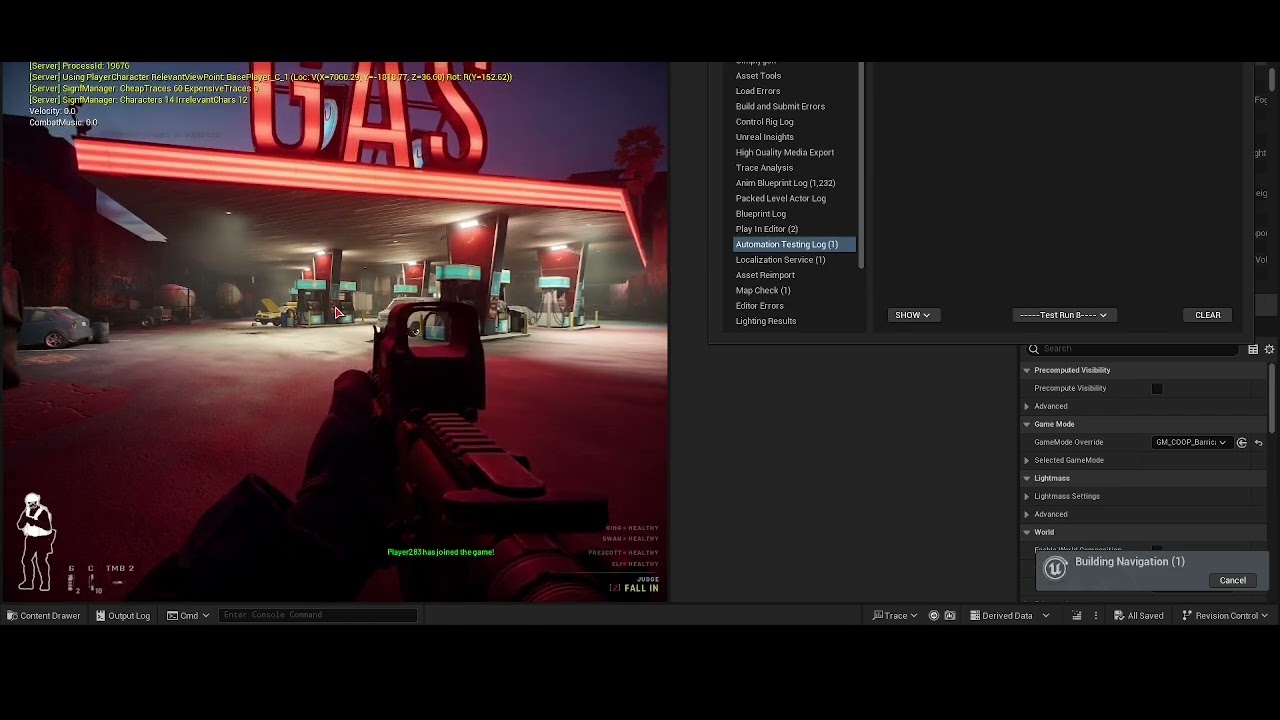
A cutting-edge automated testing program developed by one of our programming team members is speeding up the testing process for AI difficulty system behaviors across all levels. This automated procedure artificially accelerates in-game scenarios, allowing us to test over 50 different AI value modifiers (e.g., hearing range, accuracy, vision) in just a second, with each level in the game being loaded and tested within a mere 15 minutes.
Our QA team would typically have to manually navigate these levels, locate suspects, and test each stimulus value manually, such as by shooting at suspects or throwing grenades. This automated approach allows us to quickly iterate and address AI behavior issues without requiring additional QA testing time for these tedious aspects of stimulus value testing.
(Video Below: Catch a glimpse of the automated testing program in action – blink and you’ll miss it. To the right of the viewport, a set of checked stimulus values is showcased once the test ends.)
Our marketing and narrative teams are crafting several promotional content pieces scheduled to roll out soon, which will further elaborate on the lore and world-building of Ready or Not. These pieces may also incorporate details from behind-the-scenes narrative construction that are not explicitly visible in-game.
If you haven’t yet subscribed to the VOID Interactive YouTube channel, now is a great time to do so!
If you plan on attending gaming conventions within the next six months or so, you might have the chance to grab some exclusive Ready or Not convention merchandise!
While we may not have a booth or merchandise at every occasion, consider yourself fortunate if you encounter some of us and receive a bag of goodies while supplies last!
Additionally, we are in the process of designing a host of new items and merchandise offerings for the future.
As you can see, we are placing significant emphasis on quality of life enhancements, particularly concerning optimization, in preparation for our next content update. Our revised AI behavior testing process is now addressing various peculiarities that have persisted among suspects and civilians while aiding us in shaping the difficulty system. Moreover, with creative content and conventions on the horizon, there is plenty more to look forward to!
This concludes our 84th development briefing; thank you for joining us. Be sure to tune in next time for more development updates!

Follow Ready or Not on Steam here.
Explore our other links: Discord, X, YouTube, Instagram, Facebook, Spotify.
VOID Interactive
Related articles
 New Elden Ring Mini Replicas Arrive: Malenia, Messmer & Wylder
 Elden Ring – Community Quests
 ELDEN RING: Tarnished Pack DLC Now Available
 Version 1.17 Patch Notes
 ELDEN RING – RAGING WOLF 1/6 SCALE STATUE
 ELDEN RING: SHADOW OF THE ERDTREE – Official Vinyl Soundtrack
 Explore the Elden Ring Blaidd the Half-Wolf Lamp
 Release Notes – December 16, 2025