
Guillermo del Toro’s New Film Makes Frankenstein’s Monster Hotter and More Sympathetic Than Ever

Guillermo del Toro is not the first director to promise fidelity to Mary Shelley’s 1818 novel when adapting Frankenstein. After Francis Ford Coppola’s lush revival of classic Gothic fiction with Bram Stoker’s Dracula came back into vogue, Kenneth Branagh attempted his own restoration in 1994 with Mary Shelley’s Frankenstein. Like Shelley’s book, Branagh’s film presents the Creature (played by Robert De Niro) as literate and contemplative—still terrifying, but also pitiable and horribly scarred.
Del Toro’s new, sumptuous take on Frankenstein, which opened in limited release before its streaming run, pursues a very different path. The director startled some observers by casting 28‑year‑old Australian Jacob Elordi as the Creature, but when paired with bold production and makeup design the choice proves unexpectedly effective. Elordi emerges as the film’s most compelling presence.
Rather than mask Elordi’s attractiveness, del Toro and his teams emphasize it. Their Creature reads as sculptural—athletic, with clean, marble‑like skin and elegant seamwork—initially hairless and almost statuelike when Victor Frankenstein (played by Oscar Isaac) first tends to him. In the context of the film’s period setting, that aesthetic reinforces the Creature as a product of Enlightenment hubris: an experiment in engineered perfection rather than a mere grotesque aberration.
 Photo: Ken Woroner/Netflix
Elordi’s physical presence is a large part of the effect. At about 6’5″, he towers over most of the cast—he’s nearly as imposing in bare feet as Boris Karloff was in platform shoes in James Whale’s seminal 1931 film—while Shelley’s original text even envisions the Creature as roughly eight feet tall. Elordi uses his stature with emotional intelligence, projecting both menace and a searching vulnerability familiar from his work in Euphoria and Sofia Coppola’s Priscilla.
In del Toro’s film the Creature can be both overwhelming in moments of violence—sequences that borrow the cadence of superhero spectacle—and achingly tender in quieter scenes, reaching toward Isaac’s Victor, Mia Goth’s Elizabeth, and David Bradley’s blind elderly figure who offers the Creature refuge. Over time the character adopts a more Gothic silhouette—growing hair and wearing ragged furs—and transitions from a mute, newly born being into a painfully aware and emotionally volatile soul. Del Toro, who gravitates toward tragic romances, frames much of the story as an almost operatic love tale between the Creature and Elizabeth: occasionally overblown, but carried with remarkable subtlety by Elordi. By contrast, Isaac sometimes struggles to match the grand scale of del Toro’s visuals and ends up leaning toward melodrama.
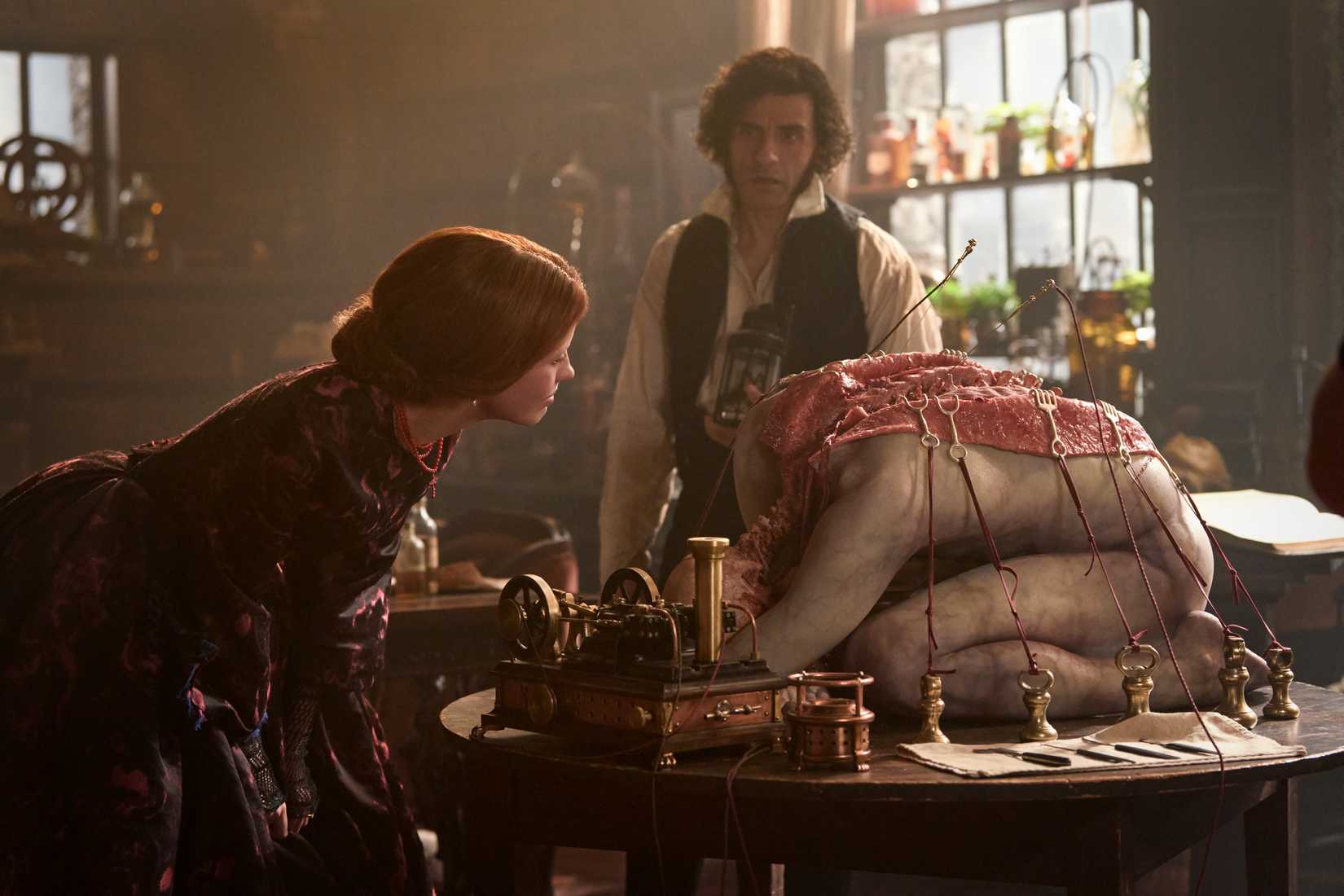 Photo: Ken Woroner/Netflix
Although the film contains visceral, sometimes grisly imagery and leans heavily into Gothic ornamentation, it isn’t presented primarily as a conventional horror picture. Shelley’s novel has always straddled genres—rooted as much in speculative inquiry as in terror—and del Toro’s screenplay foregrounds the moral and philosophical questions at the story’s core (there’s even an explicit accusation directed at Victor: “You are the monster.”). Still, del Toro’s sentimental streak is unmistakable: he reshapes Shelley’s plot to heighten the romantic and tragic entanglements, crafting a fraught quadrangle among the Creature, Elizabeth, Victor, and Victor’s younger brother William (Felix Kammerer), who is betrothed to Elizabeth in this adaptation.
The result is expansive and occasionally florid. If the picture falls short of the emotional loft it aims for, that’s in part because Elordi’s magnetism often outshines his human co-stars—David Bradley being a notable exception—suggesting an unnerving modern coda to Shelley’s warning: what if the life we create surpasses its creators?
Frankenstein is currently playing a limited theatrical run and will stream on Netflix on November 7, 2025.
Source: Polygon
Related articles
 Nolan’s “Oppenheimer” Surpasses “Spider-Man” at the Box Office
 Natalie Portman Becomes a Mother for the Third Time
 Zach Cregger Will Not Direct Franchises After “Resident Evil”
 The Rolling Stones to Receive a Biopic
 “Spider-Man: Brand New Day” breaks all-time US record
 “Prime Time” starring Robert Pattinson receives critical reviews
 Robert Pattinson Responds to Chris Hansen’s Complaints About the Movie “Primetime”
 Ryan Reynolds’ “Mayday” receives positive reviews from critics