What Do They Even Teach at Nevermore Academy?
Netflix’s Wednesday leans on the familiar supernatural-school template — a gifted teen enrolled at a boarding academy who uncovers mysteries while suspecting faculty of secret agendas. But the show’s overloaded second season largely sidelines a core element of that subgenre: the nuts-and-bolts of schooling itself.
Ed. note: This article contains major spoilers for Wednesday seasons 1 and 2.
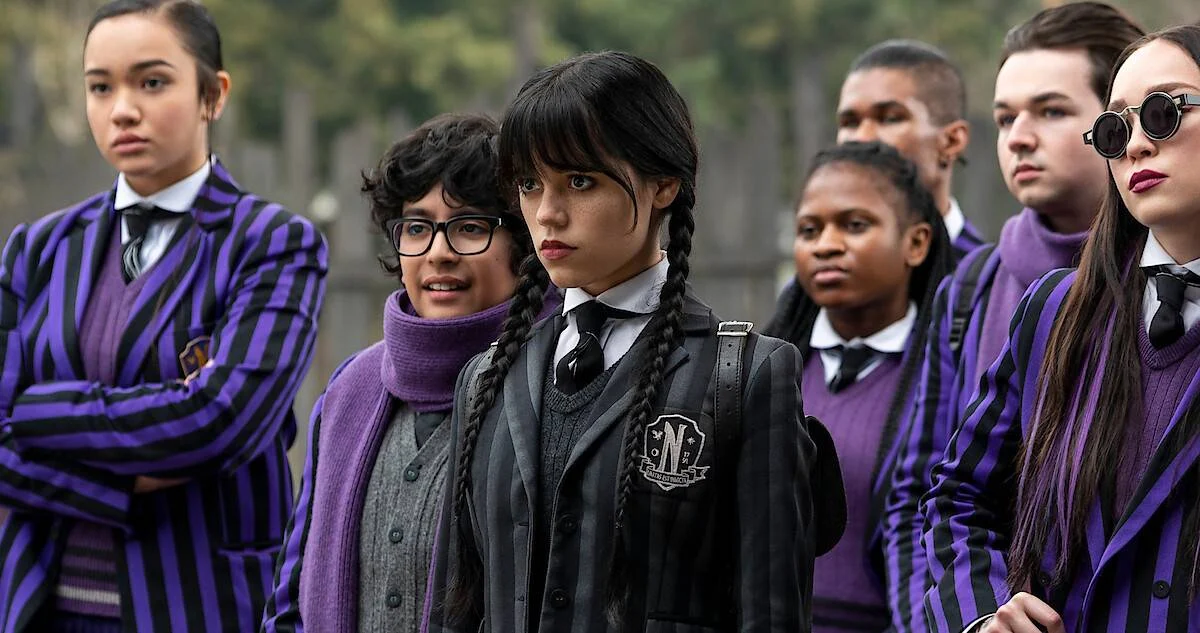
The production values climb noticeably in season two, and Nevermore’s revamped campus gives off unmistakable Hot Topic–meets–Gothic-architecture energy: stylized uniforms, Instagram-ready set dressing, and an on-campus beverage cart dispensing outrageously decorated drinks. Students spend a lot of screen time loitering, flirting, and trying to rope Wednesday Addams (Jenna Ortega) into their schemes — but we rarely see what they’re academically engaged in. What, exactly, do they study?
 Photo: Helen Sloan/Netflix
Season one established that Nevermore at least once offered formal courses — Christina Ricci’s character taught botany, and we glimpsed both her classroom and the school library. But after her departure there’s no clear continuity: a library appears only as a plot device in a riddle, and we never see students using it for study. If those facilities still exist, they’re largely ornamental on screen.
Season two introduces Billie Piper as a music instructor who tries to recruit Wednesday into a band, while Christopher Lloyd appears in the macabre role of a jarred head who doubles as the biology teacher and detention supervisor. Those are recognizable school roles, plus a musical extracurricular, but beyond that the curriculum is murky. Wednesday is an aspiring writer who refuses editorial changes to her manuscript — a conflict that would fuel a tense English or creative-writing class, if we were ever shown taking one.
New principal Barry Dort (Steve Buscemi) is obsessed with fundraising, staging expensive spectacles like welcome bonfires and weekend camps rather than demonstrating academic stewardship. He pressures a scholarship student to prioritize fundraising over coursework — even leveraging her siren ability. Is that vocational training or just moral compromise disguised as practical education?
 Photo: Netflix
Beyond a handful of staffed classes, Nevermore’s internal logic is hazy. Season one sorted students into groups defined by their species — sirens, werewolves, gorgons and vampires — but the vampires fade from view in season two, supplanted by a quirky new cohort called the DaVincis, who can fabricate elaborate props on demand. The reshuffling raises questions about the school’s cohesion and priorities.
Do students at Nevermore receive a conventional education while practicing their abilities, or does the academy mostly function as a social club for supernatural teens? Eugene Ottinger (Moosa Mostafa) can control bees in season one and later commands a wider array of arthropods, maintaining his collection in a shed — which reads like an independent study that goes unchecked. That lax oversight even allows Pugsley Addams (Isaac Ordonez) to hide a zombie on campus without meaningful consequences.
Hogwarts, for all its peril, always made it clear students were learning. Nevermore, by contrast, treats academics and campus safety as afterthoughts. The school year is cut short in season two’s finale after the second principal in as many years dies, and given how little the series interrogates the institution itself, one might wonder whether Nevermore should remain open for a third season.
Source: Polygon
Related articles
 “The Bunker” starring Bardem and Cruz screened at Venice
 The Librarians: The Next Chapter Season 2 Has Concluded
 “The Mummy 4” filming has begun
 Urfin Jus Movie Announced
 Ellen Burstyn Receives Honorary Golden Lion
 Danny Boyle used artificial intelligence in his new film “Inks”
 Gary Oldman Reveals the Name of the New Bond
 Summer 2026 Becomes the Highest-Grossing Season in U.S. Box Office History