Ranked Worst to Best: Magic’s 10 Best Alchemy Cards
The most divisive experiment in the history of Magic: The Gathering is finally reaching its terminus. When Wizards of the Coast first introduced Alchemy to MTG Arena back in 2021, it heralded a digital-first frontier—an environment where cards could receive overnight patches and mechanics like Conjure, Seek, and Perpetual could function unrestricted by physical cardboard limits. Now, with Wizards officially scheduling the format’s retirement for early 2027, Arena‘s most audacious creative sandbox is entering its final curtain call.
Whether embraced or reviled, Alchemy profoundly broadened Magic’s mechanical vocabulary. It demonstrated that a digital platform could test concepts utterly impossible in paper play just as seamlessly as it emulated traditional matches. Generating the Power Nine out of thin air, permanently shifting card statistics across zones, and directly mitigating first-turn win-rate imbalances horrified hardcore purists, yet it simultaneously provided digital duelists with a lightning-fast, perpetually evolving metagame.
Though the dedicated matchmaking queue is sunsetting, Alchemy’s digital footprint will persist across formats like Historic, Timeless, and Brawl. To truly comprehend this erratic, fascinating era of digital card engineering, let us examine the ten cards that best encapsulate the Alchemy project—ranging from format-defining value engines to clever structural adjustments.
10
Forsaken Crossroads — Alchemy: Innistrad
Forsaken Crossroads may appear visually uninspired, but it brilliantly exemplifies why Alchemy was willing to challenge foundational Magic design tenets. Entering the battlefield tapped, this land prompts you to choose a color and scry, but if you aren’t the starting player, it untaps immediately. In short, it was meticulously engineered to offset the inherent disadvantage of drawing second. Acknowledging the play/draw disparity so overtly is rare for Magic; instead of ignoring the imbalance, Alchemy designed a functional counterweight to address it.
Forsaken Crossroads eventually found a home far beyond standard Alchemy, seeing widespread play in Historic, Brawl, and other digital environments. While it rarely wins games single-handedly, that exact subtlety makes it a quintessential inclusion on this list. Alchemy wasn’t solely focused on overpowered effects; some of its most compelling contributions were refreshingly pragmatic.
9
Symmetry Sage — Adventures in the Forgotten Realms
As the first non-exclusive card on this roster, Symmetry Sage showcases the format’s iterative rebalancing philosophy. Developers adjusted the digital iteration from a 0/2 to a 0/3, amplifying the power boost granted to another creature via its Magecraft ability—which elevates a target creature’s base power to 3 whenever you cast or copy an instant or sorcery. This subtle tweak transformed an already intriguing one-drop into an intimidating threat for blue aggressive lists.
Symmetry Sage embodies the ingenuity of Alchemy: the ability to spawn an alternate digital variant of a card without disrupting the physical counterpart resting in a player’s binder. It gained substantial traction in Historic alongside low-cost wizards designed to exploit its stat-shifting capabilities. Consequently, it represents another facet of Alchemy’s heritage—proving how digital patches could reshape the competitive identity of pre-existing cards.
8
Fragment Reality — Alchemy: Kamigawa
What occurs when you pair one of Magic‘s premier removal effects with a uniquely eccentric Alchemy penalty? Enter Fragment Reality. For a single white mana, this instant exiles any non-token artifact, creature, or enchantment. Much like Generous Gift, Path to Exile, and Chaos Warp, however, the opponent receives a random creature card with a strictly lower mana value from their library. That calculated exchange is the entire premise: you aren’t simply blanking a threat; you are gambling that its replacement will prove less hazardous than the permanent you removed.
Despite this downside, the sheer mana efficiency made Fragment Reality a staple far outside standard Alchemy matchmaking. Following problematic interactions involving specific Leyline packages that dominated Historic and Timeless, Wizards tweaked the card so it could exclusively target opposing permanents. Few selections better illustrate how Alchemy was balanced around post-release digital adjustments.
7
Fearsome Whelp — Alchemy: Innistrad
Fearsome Whelp initially appears unassuming until you map out its compounding value over multiple turns. At the onset of your end step, this dragon permanently discounts dragon spells residing in your hand. It’s a classic, time-honored effect reminiscent of cards like Dragonspeaker Shaman or The Ur-Dragon. However, if opponents leave the Whelp unchecked for even a couple of rotations, those hoarded draconian threats rapidly plummet in cost through exponential scaling.
This design captures the exact type of mechanical exploration Alchemy was built for: taking a familiar tribal cost-reduction trope and rendering its impact permanent via digital tracking. Wizards even targeted Fearsome Whelp for early nerfs, highlighting how quickly cumulative cost-reduction could spiral out of hand. While visually understated, it perfectly encapsulates the format’s penchant for snowballing threats.
6
Inquisitor Captain — Alchemy: Innistrad
Inquisitor Captain appears harmless on paper, but tailored archetypes turn it into a four-mana value explosion. Its ability scans your graveyard, hand, and library for an array of low-cost creatures, deploying Seek to isolate two eligible candidates—placing one directly onto the battlefield while returning the other to your library. It rewards hyper-focused swarm strategies, transforming a crowded roster into an immediate surge of board presence.
The Captain highlighted how Alchemy’s digital-only mechanics could forge interactions far more volatile than conventional Magic design permits. Alongside contemporaries like Town-Razer Tyrant, Goldspan Dragon, and Fearsome Whelp, the Captain faced swift rebalancing. Even post-nerf, constructing a deck packed with cheap threats and leveraging a single four-drop to unleash instant battlefield dominance remains a uniquely distinct playstyle rarely mirrored in paper formats.
5
Oracle of the Alpha — Alchemy: Dominaria
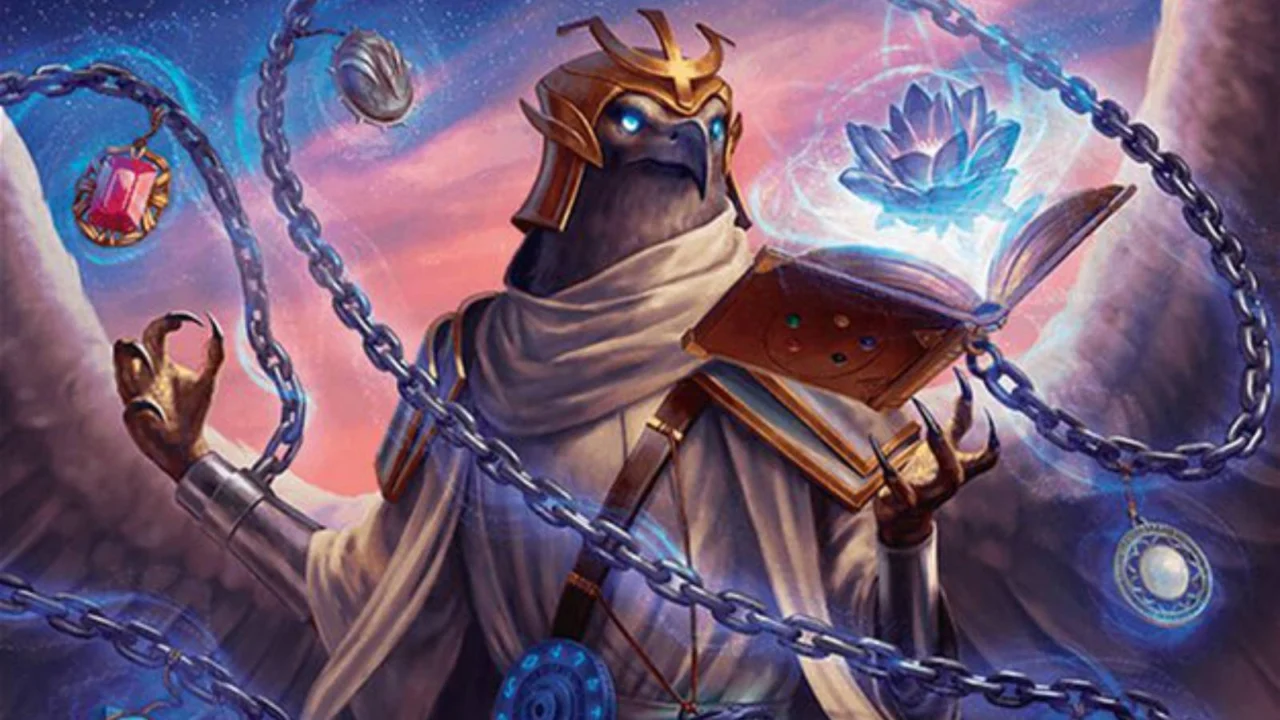
While powerful Alchemy designs abound, few boast the audacity to shuffle the legendary Power Nine directly into your deck like Oracle of the Alpha. Upon entering the battlefield, this three-mana blue bird wizard conjures Ancestral Recall, Black Lotus, the five Moxen, Timetwister, and Time Walk straight into your library. It is wonderfully, intentionally absurd. The Power Nine remain some of the most iconic yet inaccessible relics in Magic history, and Alchemy simply decided that digital environments warranted a sandbox where players could wield them.
While not necessarily the most competitively optimized creature on this list, efficiency misses the point. Its mere existence embodies the unbound freedom of Arena‘s digital card pool. Unfettered by the physical constraints of sanctioned tabletop play, Oracle of the Alpha stands out as one of the format’s most unforgettable creations.
4
Key to the Archive — Alchemy: Innistrad
Key to the Archive serves as arguably the finest showcase for Alchemy’s spellbook mechanic. At four mana, this artifact already functions as a reliable mana-fixing tool, but its true allure lies in the curated selection of spells it offers upon arrival. Its spellbook features legendary, high-impact options such as Demonic Tutor, Time Warp, Counterspell, Day of Judgment, and Lightning Bolt.
Because you cannot guarantee which specific option will appear, it bypasses the deterministic certainty of a traditional tutor, yet every activation grants access to game-altering plays. Key to the Archive feels less like a standard artifact and more like a portal granting Alchemy players temporary access to Magic‘s massive, historic archives.
3
Town-Razer Tyrant — Alchemy: Innistrad
Town-Razer Tyrant was among the earliest indicator cards demonstrating how far Alchemy could stretch traditional design boundaries. This four-mana dragon targets an opponent’s nonbasic land upon entering, turning it into a ticking time bomb: either sacrifice the land or suffer damage. It offered a potent form of land punishment, growing notoriously effective at checking greedy, multi-colored mana bases.
Wizards ultimately rebalanced the aptly named Tyrant multiple times, eventually restricting its targeting to nonbasic lands and shifting its damage trigger from the upkeep step to the end step. Those iterative adjustments underscore why Town-Razer remains a quintessential snapshot of early Alchemy—proving how digital patches enabled developers to experiment with disruptive effects that would otherwise prove too volatile to alter in paper format.
Get Polygon’s Wishlister newsletter
A weekly cheat sheet to what you’ll eventually love to play. No buying, no commitment — just saving for later.
Free. Unsubscribe anytime.
2
Rusko, Clockmaker — Alchemy: The Brothers’ War
Rusko, Clockmaker distills the essence of Alchemy into a uniquely eccentric and deeply frustrating package. This four-mana 3/3 creature doesn’t merely generate value on entry; it conjures a Midnight Clock and persistently transforms noncreature spells into additional resources. Every noncreature cast triggers Rusko’s engine, draining opponents while bolstering your life total. Such a relentless combination made it exceptionally resilient against aggressive rush-downs or grindy attrition wars.
More significantly, Rusko exemplifies why digital-only Magic feels fundamentally distinct from its tabletop counterpart. The card relies heavily on conjuring and repeatable digital triggers that would be cumbersome—if not entirely impossible—to execute physically. The Clockmaker ultimately became notorious across Historic and Brawl, perfectly showcasing the format’s willingness to compress an entire self-sustaining engine into a single legendary creature.
1
Crucias, Titan of the Waves — Alchemy: The Brothers’ War
Crucias is arguably the prime exhibit when explaining how Alchemy could occasionally spiral out of control. This four-mana Grixis (black-red) threat required minimal support to commandeer a match, pairing a resilient 3/3 stat line with a triggered ability that generated Treasures while offering exceptionally potent card selection.
The defining factor wasn’t simply that Crucias generated staggering value; it allowed players to dictate precisely what resource they needed on demand, converting surplus cards into whatever missing puzzle piece the deck required. This flexibility made it a nightmare for opponents attempting to play standard midrange strategy. Wizards eventually intervened, scaling Crucias down from a 3/3 to a 3/1 after black-red midrange shells pushed it to dominance as one of Alchemy’s premier archetypes.
Rat decks are an absolute nightmare, but they’re pretty straightforward to get right
Source: Polygon
Related articles
 Escape from Tarkov Developers Preview Leagues and Distribute In-Game Items to Survey Participants
 HoYoverse Teases Honkai Star Rail Version 4.6 Presentation for Unusual Time
 Memory Market Crisis Has Not Affected Valve’s Steam Deck 2 Plans
 Bungie Delays Marathon Season 3 and Drops Strict Update Schedule
 Modder Ports Parasite Eve II to PC After 27 Years With Enhanced Graphics and High-Resolution Support
 Total War: Warhammer 40,000 Creator Discusses Tabletop Game’s Impact on Strategy
 How to Get Valve’s VR Headset, Steam Frame, and Price Details
 Jason Statham Action Thriller Becomes Streaming Hit