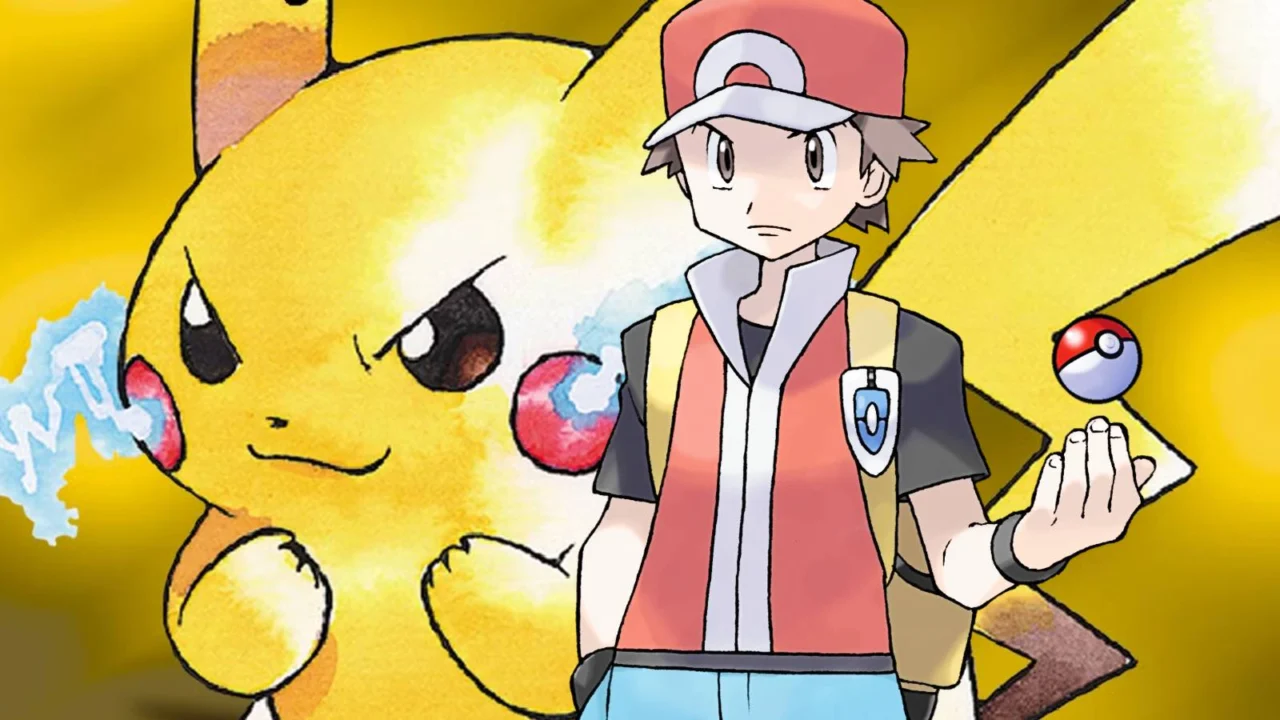
Pokémon’s Greatest Battle Remains Unsurpassed
While “aura farming” has recently emerged as a ubiquitous piece of internet slang to describe calculated displays of charisma, the true sovereign of “aura” in the Pokémon universe was established at the franchise’s very inception. Decades later, his presence remains an untouchable standard for the series.
This character occupies a rare space in gaming history, serving as both a cherished protagonist and the most formidable adversary players ever encounter. I am referring to Red, the silent hero of the Kanto region. While he led the charge in Generations 1 and 3, it was his role as the final, hidden challenge in the Johto sequels—and their subsequent remakes—that cemented his legendary status.
Pokémon Gold, Silver, and Crystal represented a monumental paradigm shift for the series. Despite utilizing the same handheld hardware as their predecessors, these titles felt light-years ahead. They introduced a more vibrant visual palette, fluid animations, and a suite of mechanical innovations that redefined the franchise: the Special stat split, held items, breeding, and a real-time day/night cycle. Yet, the most profound evolution was the endgame. Defeating the Elite Four wasn’t the conclusion; it was an invitation to revisit Kanto. But claiming dominance over two regions eventually requires a confrontation with the true master of the world.

Experiencing Pokémon Gold on a Game Boy Color was a revelation in scope. These sequels didn’t just iterate; they acknowledged the history of the world players had already explored. Stepping back into Kanto remains one of the most cherished memories for lifelong fans—a journey that inevitably leads to the frost-bitten peak of Mt. Silver.
After conquering the Kanto Gym Leaders, Professor Oak grants you access to the mountain’s summit. In the year 2000, before the era of ubiquitous high-speed internet and comprehensive walkthroughs, the summit was shrouded in mystery. I recall wondering if a new Legendary bird or a mythical beast awaited me at the top. Instead, the game delivered a twist that no one saw coming, creating a sense of genuine shock that modern leaks have largely made impossible.
There he stood, isolated at the edge of the world. True to his origins, Red remains entirely mute. Without a word of dialogue or a moment to prepare, the battle commences. He leads with Pikachu—a charming nod to Pokémon Yellow and the animated series—until you realize the creature is level 81. The initial “cute” factor vanishes instantly beneath a wave of sheer power.
Until the fourth generation, Red was indisputably the strongest trainer in the franchise. His roster was so overleveled that casual players, unfamiliar with the nuances of EVs or optimal typing, were routinely decimated. His mystique stems from more than just statistics, though. This is a champion who ascended to the throne and then walked away, vanishing into the wilderness to pursue absolute mastery. His mother in Pallet Town hasn’t heard from him in years; he has severed all worldly ties. He is the Pokémon equivalent of a kensei—a sword saint who has transcended human limitations through solitary discipline.

I’m not ashamed to admit it took me a decade to settle the score. I never managed to defeat him on my original copy of Gold. It wasn’t until HeartGold and SoulSilver revitalized my passion for the series that I returned to the mountain. This time, I was prepared with a balanced team and a deeper understanding of competitive mechanics.
Yet, even with a decade of growth, Red still humbled me several times. His updated team in the Gen 4 remakes was even more vicious. When I finally took down his level 88 Pikachu—the highest-level NPC Pokémon for several generations—the sense of gravitas remained. Seeing his sprite waiting in the snow still evokes a unique kind of tension that no other boss battle in the series has quite replicated.
The brilliance of this encounter lies in its execution: the subversion of fighting your own previous identity as the final boss, the jarring level gap, and the somber, heavy silence of the location. Red doesn’t need a monologue; his position at the highest point of the world says everything. It remains the most powerful moment in the history of the Pokémon games.

Red’s appearance was the perfect thematic conclusion to the Johto era. These games succeeded in making the world feel boundless by constantly providing “one more thing” to discover. This final duel wasn’t just a challenge; it was a passing of the torch and a masterclass in blending nostalgia with innovation. To put it simply: Red’s aura isn’t just a trend—it’s permanent.
…
…
Source: Polygon
Related articles
 The Rings of Power Season 3 Gets a New Trailer
 Hacker Claims Jailbreak of New PS5 Firmware 14.20 Eight Hours After Release
 EA Shuts Down BioWare, Cancels Next Mass Effect Game
 Left 4 Dead RTX Announced as NVIDIA Shows Enhanced Version of Left 4 Dead 2
 Diablo: Unbound, a Tabletop Dungeon Adventure With Random Loot, Announced
 Reddit user voices38 deletes account after court ruling allowing identity disclosure, and v0ices38 appears
 Borderlands and BioShock Are Being Removed From Steam Libraries After 13 Years, and Players Lose Licenses to Purchased Games
 Cyberpunk 2077 Co-op Mod Gets New Trailer as Modders Announce Open Beta